 Pocket Botanist

Check these first
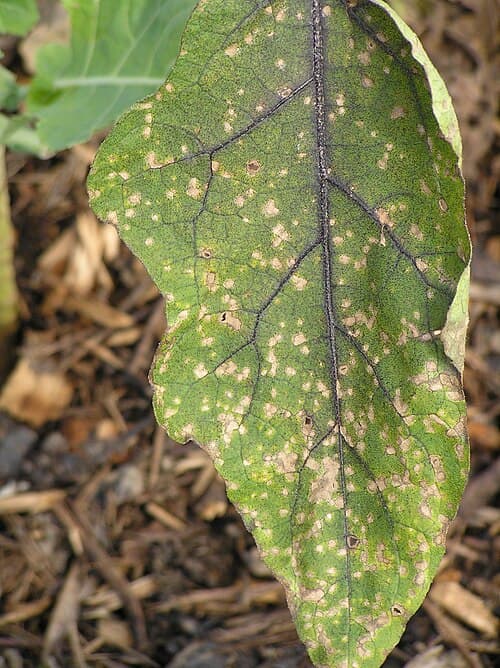
- Look closely at a single spot. A brown or black spot with a yellow ring around it is often fungal or bacterial leaf spot; a white, powdery coating is powdery mildew; orange or rusty bumps on the underside of the leaf are rust.
- Notice where the spots are. Pale, bleached patches only on the side facing the sun, especially after a move, are usually sunburn.
- Turn the leaf over and check for tiny insects, fine webbing or sticky residue.
- Think about how you water. Wet leaves, watering late in the day and plants crowded close together all help leaf spot fungi spread.
Most common causes
The causes our guides to 1,398 plants name most often.
Fungal leaf spot
Named for 892 plantsHow to tell: Small, circular brown or black spots appear on the leaves, often with a yellow halo.
What to do: Remove the affected leaves immediately to stop the spread. Improve air circulation around the plant and avoid getting water on the leaves.
Powdery mildew
Named for 354 plantsHow to tell: You see a white, powdery coating on the surface of the leaves.
What to do: Improve air circulation around the plant by thinning out crowded stems. You can spray the leaves with a mixture of one tablespoon of baking soda in a gallon of water.
Rust fungus
Named for 151 plantsHow to tell: You will see small orange or reddish pustules on the undersides of the leaves. These spots may eventually turn brown or black.
What to do: Remove and destroy the infected leaves immediately to stop the spread. Improve air circulation around the plant and avoid overhead watering.
Sunburn
Named for 117 plantsHow to tell: Bleached or scorched patches appear on the leaves that receive direct afternoon sun.
What to do: Move the plant to a location with bright, indirect light. Use a sheer curtain to filter the light if it is too intense.
Poor air circulation
Named for 98 plantsHow to tell: The leaves stay wet for a long time after watering or rain.
What to do: Move the plant to a spot with better airflow. Avoid overhead watering to keep the leaves dry.
Aphid damage
Named for 79 plantsHow to tell: Tiny insects cluster on the stems and undersides of leaves, leaving behind sticky honeydew that can attract mold and cause yellow or brown spots.
What to do: Spray the plant with a gentle stream of water to knock the aphids off. If they persist, apply insecticidal soap once a week until they are gone.
Fungal infection
Named for 78 plantsHow to tell: Dark, water soaked spots appear on the leaves, sometimes with a yellow halo.
What to do: Remove the affected leaves immediately to stop the spread. Improve air circulation around the plant and avoid misting the leaves.
Overwatering
Named for 69 plantsHow to tell: The soil stays soggy for long periods and the spots appear soft or mushy.
What to do: Let the top inch of soil dry out completely before watering again. Ensure your pot has drainage holes so excess water can escape.
Not sure what you're seeing? Try the free photo health check.
Plants most prone to this
Our guides rate it likely for 827 plants. Here are 48 of them, A to Z.
- Abelia
- American persimmon
- Basil
- Bilberry
- Black willow
- Bottle Gourd
- Buttonbush
- Carrot
- Chinese holly
- Clematis
- Common dog violet
- Common ragweed
- Corn Salad
- Crimson Clover
- Eastern baccharis
- European crabapple
- Field pansy
- Four o'clock flower
- Geiger tree
- Golden oat grass
- Grey sallow
- Heath speedwell
- Hyacinth
- Japanese dandelion
- Judas tree
- Large flowered tickseed
- Lily of the Valley
- Many-flowered wood-rush
- Meadow foxtail
- Morning Glory
- Northern starflower
- Paper birch
- Periwinkle
- Potato
- Ragged Robin
- Redshank
- Rue anemone
- Scentless Mayweed
- Siberian tea
- Snake Gourd
- Spineless Yucca
- Sulphur cinquefoil
- Tarragon
- Travellers palm
- Virginia strawberry
- Western columbine
- Wild Jack
- Winter Wheat
Find your plant
Every plant guide links to its own pages on that plant's problems. Find yours in the A to Z:
Other symptoms
Pest, disease and disorder guides
How often do the guides name each cause, across every symptom? See what goes wrong with plants, counted.
The causes on this page are drawn from our plant guides, which are generated with AI from each plant's care profile. They are general information, not horticultural advice. Read about how we build these guides.