 Pocket Botanist
Plant guide
Wild Strawberry.
Fragaria vesca
Pronounced fra-GA-ree-uh VESS-kuh
Also known as Alpine Strawberry, European Strawberry, Hillside Strawberry



The wild strawberry is a charming, low growing perennial that produces small, intensely flavorful berries. It spreads through runners, making it a lovely ground cover for woodland gardens. You will find it thrives in dappled shade and moist, well draining soil.
At a glance
- Care level
- Easy
- Plant type
- Herbaceous perennial
- Light
- Partial shade to full sun
- Indoor light
- Bright indirect
- Water
- Every 2 to 5 days
- Mature size
- 15 to 20 cm tall
- Growth rate
- Fast
- Hardiness
- USDA 3 to 10
- Bloom time
- Mid to late spring
Care
Keep the soil consistently moist but never waterlogged to encourage healthy fruit production. Watch for signs of powdery mildew on the leaves if the air circulation is poor. Mulching around the base helps keep the berries clean and off the damp soil.
- Watering
- Keep the soil evenly moist throughout the growing season.
- Feeding
- Apply a balanced organic fertilizer once in early spring.
- Pruning
- Trim back old foliage in late winter to make room for new growth.
- Repotting
- Repot when the plant becomes root bound or the runners have filled the container.
- Soil
- Rich, loamy, well draining soil
- Soil pH
- Slightly acidic to neutral
- Temperature
- -25 to 30°C
- Humidity
- 40 to 70%
- Drought tolerance
- Moderate
- Lifespan
- Perennial, typically 3 to 5 years.
- Fragrance
- Strong
- Deer and rabbits
- Low
Signs it needs repotting
- Roots growing out of drainage holes
- Water running straight through the soil
- Plant growth slowing significantly
Safety
- People
- The plant is not toxic to humans.
- Children
- The small berries are safe for children, but always supervise young ones to prevent choking.
- Contact allergens
- Some individuals may experience mild skin irritation from the fine hairs on the leaves.
- Airborne allergens
- The pollen is generally not considered a significant allergen.
- Edibility
- Always ensure you have correctly identified the plant before consuming any part of it.
How to identify it
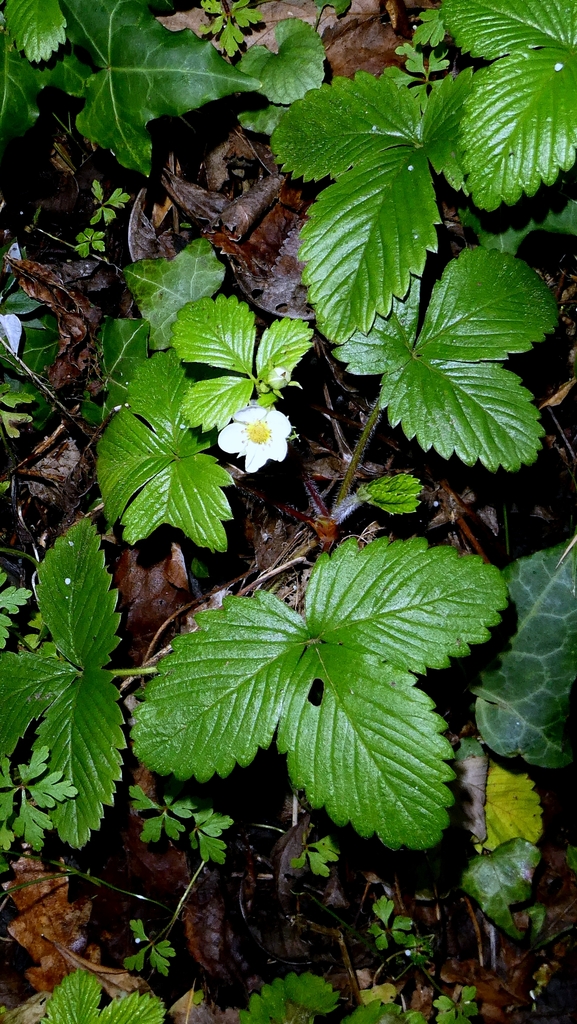
- Three leaflets with serrated edges
- White flowers with five petals
- Small red conical fruits
- Reddish stems and runners
- Height
- 0.1 to 0.2m
- Spread
- 0.2 to 0.4m
- Leaves
- bright green, evergreen
- Flowers
- white, 1 to 2cm
- Fruit
- red, Summer
Problems to watch for
- AphidsCommon
- Powdery MildewCommon
- Slugs and SnailsCommon
- Gray MoldUncommon
- Leaf SpotUncommon
- Root RotUncommon
- Spider MitesUncommon
- Verticillium WiltRare
By symptom
Check your wild strawberry from a photo
Pocket Botanist looks at a photo of your plant and tells you what's wrong and what to try first.
Growing it
- Propagation
- division, seed, runners
- When to plant
- spring, early autumn
- Overwintering
- Mulch around the base to protect roots from extreme temperature fluctuations. In very cold climates, you can cover the plants with straw.
- In containers
- It grows very well in pots, provided you use a container at least 20 centimeters deep with good drainage.
Runner Division
- 1. Identify a healthy runner with a small plantlet.
- 2. Pin the plantlet into the soil until roots form.
- 3. Sever the runner from the parent plant.
Planting aromatic herbs nearby can help mask the scent of the berries from hungry garden visitors.
Grows well with
Keep away from
- Cabbage — They compete for similar soil nutrients and space.
Similar species
- Wild Strawberry — It is a closely related North American native species.
Science
- Family
- Rosaceae
- Genus
- Fragaria
- Order
- Rosales
- Class
- Magnoliopsida
- Native range
- Temperate regions of the Northern Hemisphere.
- Conservation
- It is a common and widespread species not currently of conservation concern.
It colonizes forest edges and clearings by spreading via runners to form dense mats.
- Value to wildlife
- nectar source, wildlife food source
- Pollinators
- bees, butterflies
- Uses
- ground cover, edible garden, container plant
Through the year
Ecological indicators
- Moisture
- 5/9
- Nutrients
- 5/9
- Salinity
- 2/9
- Soil reaction
- 5/9
- Light
- 5/9
- Temperature
- 5/9
Taxonomy resolved against GBIF.
Questions people ask
- Does it need full sun?
- It prefers partial shade but will tolerate full sun if kept moist.
- Can I grow it in a pot?
- Yes, it thrives in containers and hanging baskets.
Where the name comes from
Fragaria comes from the Latin word for fragrant, referring to the scent of the fruit, while vesca means edible.
Good to know
- The seeds are located on the outside of the fruit.
- It spreads naturally through runners.
- It has been cultivated since ancient times.
Keep your wild strawberry growing
This page is a general guide. Save your plant in Pocket Botanist and you get care reminders timed for this plant, plus a care history that shows what worked.
This guide was generated with AI and checked against GBIF taxonomy. It is general information, not horticultural or veterinary advice. Read about how we build these guides.