 Pocket Botanist
Pflanzenratgeber
Sea almond.
Terminalia catappa
Aussprache ter-mi-NAY-lee-uh kuh-TAP-puh
Auch bekannt als Alman Tree, Almond, Almond Tree, Beach Almond, Country Almond, India Almond, Indian Almond, Indian-almond


The sea almond is a large tropical tree known for its wide, horizontal branches and impressive, leathery leaves. It produces edible nuts that taste a bit like almonds and is a common sight along sandy coastlines. You'll love how its foliage turns vibrant shades of red and yellow before dropping.

Auf einen Blick
- Pflegestufe
- Einfach
- Pflanzenart
- Tropical tree
- Licht
- Full sun
- Licht im Innenraum
- Direkte Sonne
- Gießen
- Alle 3 bis 7 Tage
- Endgröße
- 30 to 40 meters
- Wachstum
- Schnell
- Winterhärte
- USDA 10 bis 12
- Blütezeit
- Spring to early summer
Pflege
This tree thrives in warm, humid environments with plenty of sun. Watch for yellowing leaves, which can indicate the soil is staying too wet or the tree is entering a natural dormancy phase. Ensure the soil drains well to keep the roots happy.
- Gießen
- Keep the soil consistently moist but never waterlogged.
- Düngen
- Use a balanced fertilizer during the active growing season.
- Schneiden
- Trim back dead or crossing branches once a year to maintain shape.
- Umtopfen
- Repot young trees annually until they reach a size that requires a permanent container or ground planting.
- Boden
- Sandy, well draining soil
- Boden-pH
- 6.0 to 7.5
- Temperatur
- 15 bis 35°C
- Luftfeuchtigkeit
- 60 bis 90%
- Trockenheitstoleranz
- Mittel
- Lebensdauer
- Long lived, often over 50 years.
- Duft
- Leicht
- Wildverbiss-Resistenz
- Mittel
Anzeichen fürs Umtopfen
- Roots growing out of the drainage holes
- Stunted growth despite regular feeding
Sicherheit
- Menschen
- The plant is not considered toxic, but the hard shells of the fruit can be a choking hazard.
- Kinder
- The large, woody fruit shells are hard and can pose a choking risk if left on the ground.
- Kontaktallergene
- The sap can cause mild skin irritation in sensitive individuals.
- Allergene in der Luft
- Pollen may trigger mild allergic reactions in some people.
- Essbarkeit
- The kernel inside the fruit is edible, but the fibrous husk is not meant for consumption.
So erkennst du die Pflanze
- Large, glossy, leathery obovate leaves
- Horizontal, tiered branching pattern
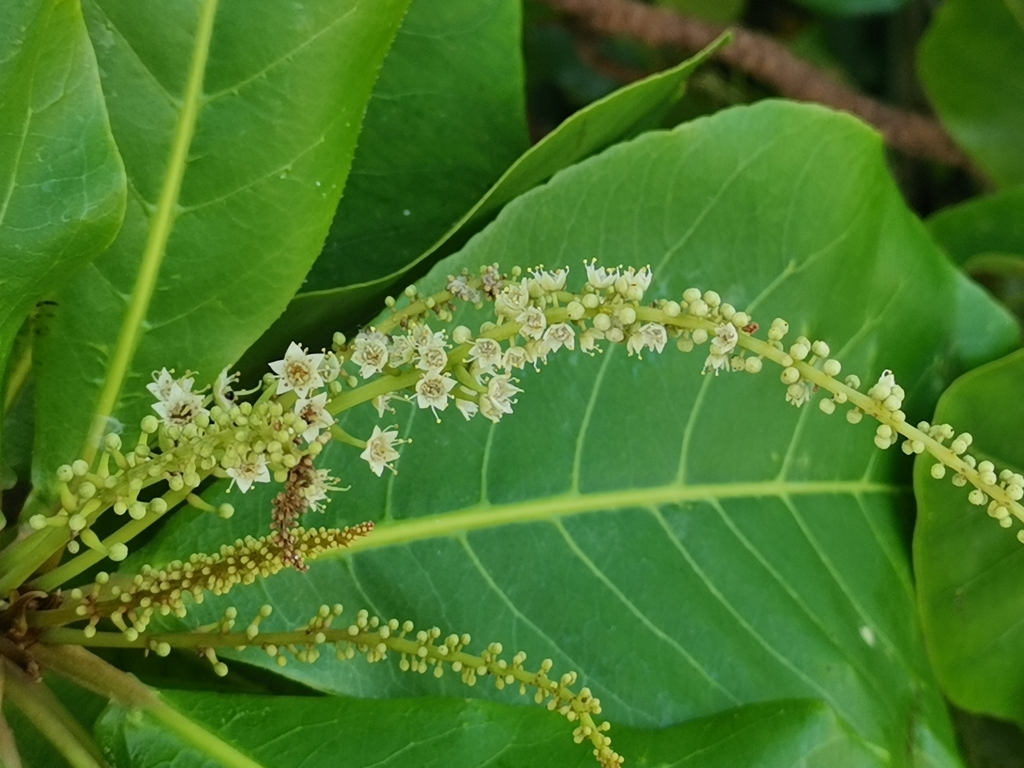
- Small, greenish white flower spikes
- Fibrous, almond shaped drupe fruits
- Höhe
- 15 bis 25m
- Breite
- 10 bis 20m
- Blätter
- green, red, yellow, deciduous
- Blüten
- white, greenish-white, 0,5 bis 1cm
- Früchte
- green, red, brown, Year round in tropics
Häufige Probleme
- Leaf spot — Fungal infections can cause dark spots on foliage during wet seasons.
- Aphids — Small insects that feed on sap and may cause leaf curling.
Standort und Pflege
- Vermehrung
- seed, cuttings
- Pflanzzeit
- Spring, Summer
- Überwinterung
- Keep the tree in a warm, frost-free environment during winter. Reduce watering if the tree enters a semi-dormant phase.
- Im Kübel
- It is suitable for containers only while in its juvenile stage, requiring a very large pot.
Seed propagation
- Clean the fruit to remove the fleshy outer layer.
- Soak the seed in water for 24 hours.
- Plant in well-draining soil at a shallow depth.
- Keep warm and moist until germination.
Plant this tree as a canopy layer to provide dappled shade for smaller tropical shrubs.
Gute Pflanzpartner
- Kokospalme — They share similar coastal environmental requirements.
- Chinese hibiscus — They thrive in the same warm, tropical conditions.
Ähnliche Arten
- Terminalia muelleri — It is a smaller relative with similar leaf structure.
Botanisches
- Familie
- Combretaceae
- Gattung
- Terminalia
- Ordnung
- Myrtales
- Klasse
- Magnoliopsida
- Ursprüngliche Heimat
- Tropical Asia, Australia, and the Pacific Islands.
- Artenschutz
- This tree is widely naturalized and not of conservation concern.
It is a pioneer species that thrives in sandy, coastal soils and disperses its seeds via ocean currents.
- Nutzen für Wildtiere
- nectar source, provides nesting sites
- Bestäuber
- Bienen, Schmetterlinge, Nachtfalter
- Verwendung
- ornamental shade tree, edible nuts, timber, medicinal bark
Im Jahresverlauf
Ökologische Zeigerwerte
- Salzgehalt
- 6/9
- Bodenreaktion
- 7/9
- Licht
- 8/9
- Temperatur
- 9/9
- Feuchtigkeit
- 6/9
- Nährstoffe
- 5/9
Taxonomie abgeglichen mit GBIF.
Häufige Fragen
- Does it need full sun?
- Yes, it grows best in full, bright sunlight.
- Can I grow it in a pot?
- Only when young, as it eventually becomes a very large tree.
Woher der Name kommt
The genus name Terminalia refers to the leaves appearing at the very ends of the shoots. The species name catappa is derived from its Malay name.
Gut zu wissen
- It is often called the Indian almond tree.
- The seeds are rich in oil and taste similar to almonds.
- It is highly salt tolerant and thrives near beaches.
- The leaves are used in aquariums to lower water pH.
Probleme mit Sea almond?
Diese Seite bietet allgemeine Infos. Pocket Botanist erkennt Probleme anhand eines Fotos deiner echten Pflanze, passt das Gießen an dein Licht und deinen Standort an und erinnert dich an die Pflege.
Dieser Ratgeber wurde mit KI erstellt und mit der GBIF-Taxonomie abgeglichen. Er dient zur allgemeinen Information und ersetzt keine gärtnerische oder tierärztliche Beratung. Hier erfährst du, wie wir diese Ratgeber erstellen.