 Pocket Botanist
Plant guide
Okra.
Abelmoschus esculentus
Pronounced ah-bel-MOS-kus es-kyoo-LEN-tus
Also known as Lady's-Finger, Okra, gumbo



Scan with your phone's camera to get the app
Or go to pocketbotanist.app/get on your phone

Okra is a warm season vegetable that thrives in sunny garden spots. It produces beautiful hibiscus like flowers followed by edible green pods. You will love how quickly it grows during the heat of summer.
At a glance
- Care level
- Easy
- Plant type
- Annual vegetable
- Light
- Full sun
- Indoor light
- Direct sun
- Water
- Every 2 to 4 days
- Mature size
- 4 to 6 feet
- Growth rate
- Fast
- Hardiness
- USDA 9 to 11
- Bloom time
- Mid summer to early autumn
Care
Plant in well draining soil once the weather is consistently warm. Watch for aphids on the undersides of leaves and harvest pods while they are still young and tender. Keep the soil moist but not waterlogged to ensure the best production.
- Watering
- Keep the soil consistently moist for the best pod development.
- Feeding
- Apply a balanced fertilizer once a month to support heavy fruit production.
- Pruning
- Remove lower leaves as the plant grows to improve airflow and focus energy on fruit.
- Repotting
- Okra is an annual plant and does not require repotting.
- Soil
- Rich, well draining loam
- Soil pH
- 6.0 to 7.0
- Temperature
- 15 to 35°C
- Humidity
- 40 to 70%
Safety
- People
- The plant is non-toxic to humans.
- Children
- The stiff, prickly hairs on the stems and leaves can be irritating to a child's skin if handled without gloves.
- Contact allergens
- The fine, stiff hairs on the leaves and stems can cause skin irritation or dermatitis in sensitive individuals.
- Airborne allergens
- There is no significant evidence of respiratory allergies associated with this plant.
- Edibility
- The pods must be harvested while young and tender, as they become woody and fibrous very quickly.
How to identify it
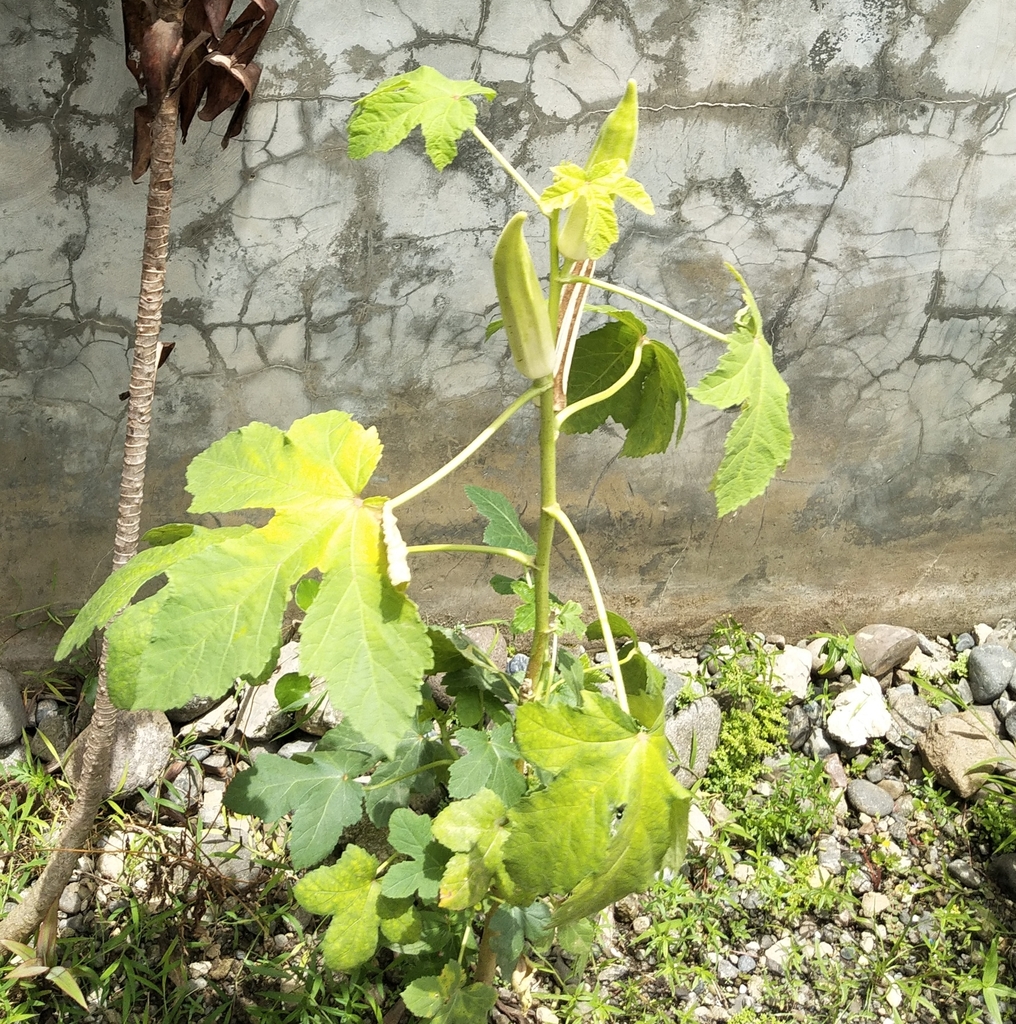
- Large palmately lobed leaves
- Showy yellow flowers with red centers
- Long ribbed green seed pods
- Sturdy upright central stem
- Height
- 0.6 to 2m
- Spread
- 0.3 to 0.9m
- Leaves
- green, deciduous
- Flowers
- yellow, red, 5 to 8cm
- Fruit
- green, red, Summer to autumn
Problems to watch for
- AphidsCommon
- Powdery MildewCommon
- CaterpillarsUncommon
- Root RotUncommon
- Spider MitesUncommon
- Verticillium WiltUncommon
- WhiteflyUncommon
- ChlorosisRare
Check your okra from a photo
Pocket Botanist looks at a photo of your plant and tells you what's wrong and what to try first.
Scan with your phone's camera to get the app
Or go to pocketbotanist.app/get on your phone
Growing it
- Propagation
- seed
- When to plant
- Spring
Planting okra with low-growing herbs like basil helps shade the soil and retain moisture.
Grows well with
Similar species
- Hibiscus · They belong to the same family and share similar flower structures.
Science
- Family
- Malvaceae
- Genus
- Abelmoschus
- Order
- Malvales
- Class
- Magnoliopsida
- Native range
- Tropical Africa
- Conservation
- Not of conservation concern.
It is a heat-loving plant that naturally inhabits warm, tropical regions with consistent moisture.
- Value to wildlife
- nectar source
- Pollinators
- bees, butterflies
- Uses
- culinary vegetable, thickening agent for soups, ornamental garden plant
Through the year
Ecological indicators
- Salinity
- 2/9
- Soil reaction
- 6/9
- Light
- 8/9
- Temperature
- 8/9
- Moisture
- 6/9
- Nutrients
- 7/9
Taxonomy resolved against GBIF.
Questions people ask
- How do I know when to harvest?
- Harvest the pods when they are 5 to 8 centimeters long, usually 3 to 5 days after flowering.
- Does it need full sun?
- Yes, it requires at least 6 to 8 hours of direct sunlight daily to produce well.
Where the name comes from
The genus name Abelmoschus comes from the Arabic for musk mallow, referring to the scent of the seeds, while esculentus means edible in Latin.
Good to know
- Okra is a staple ingredient in gumbo.
- The seeds can be roasted and used as a caffeine-free coffee substitute.
- Okra mucilage is sometimes used as a natural thickener in food processing.
- It thrives in the heat of the deep south.
Keep your okra growing
This page is a general guide. Save your plant in Pocket Botanist and you get care reminders timed for this plant, plus a care history that shows what worked.
Scan with your phone's camera to get the app
Or go to pocketbotanist.app/get on your phone
This guide was generated with AI on and checked against GBIF taxonomy. It is general information, not horticultural or veterinary advice. Read about how we build these guides.