 Pocket Botanist
Pflanzenratgeber
Great Mullein.
Verbascum thapsus
Aussprache ver-BASS-kum THAP-sus
Auch bekannt als Aaron's rod, Aaron's-rod, Big Taper, Blanketweed, Charmin of the woods, Common Mullein, Flannel Mullein, Flannel Plant


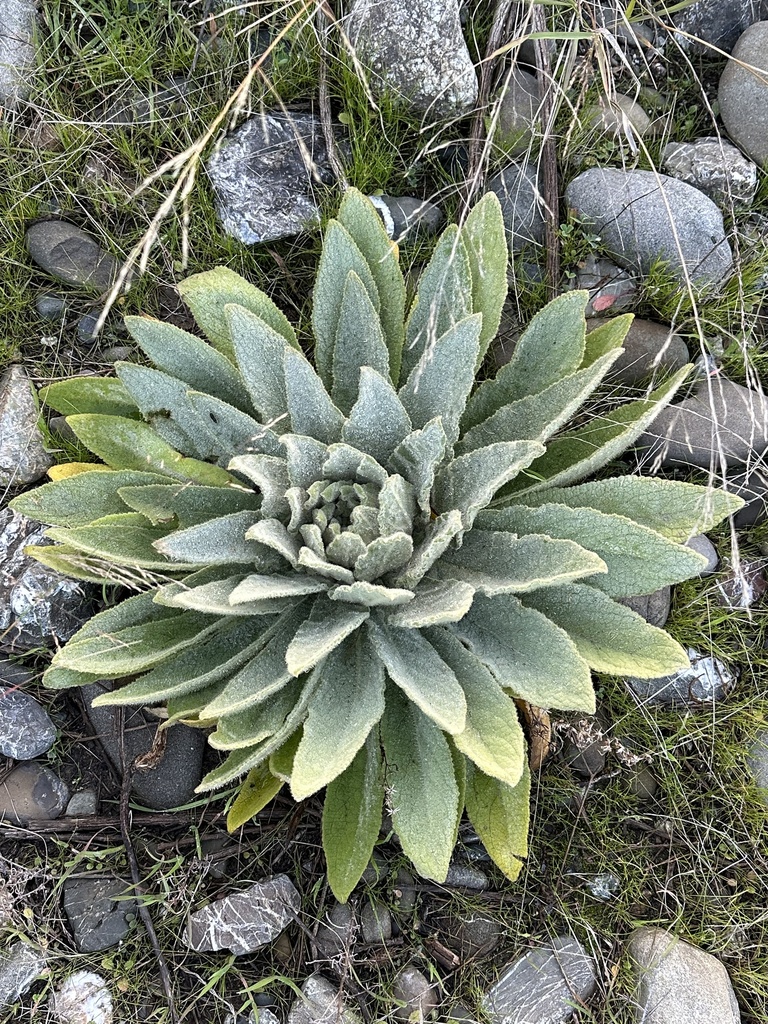
Mullein is a striking biennial plant that produces a tall, impressive spike of yellow flowers. It's often found growing in fields and along roadsides where it enjoys plenty of sun. You'll love how its fuzzy, silver-green leaves add a unique texture to your garden.

Auf einen Blick
- Pflegestufe
- Einfach
- Pflanzenart
- Biennial herb
- Licht
- Full sun
- Licht im Innenraum
- Direkte Sonne
- Gießen
- Alle 7 bis 14 Tage
- Endgröße
- 6 to 8 feet
- Wachstum
- Schnell
- Winterhärte
- USDA 3 bis 9
- Blütezeit
- Mid to late summer
Pflege
Plant this in a spot that gets plenty of sunshine to keep it happy. Watch for wilting leaves during dry spells, which is your sign that it needs a good drink. It's a very low-maintenance plant that mostly takes care of itself once it's settled in.
- Gießen
- Water deeply when the top inch of soil feels dry to the touch.
- Düngen
- It rarely needs fertilizer if planted in decent garden soil.
- Schneiden
- Cut back the flower stalk after it finishes blooming to keep the area tidy.
- Umtopfen
- Since it's a biennial, you likely won't need to repot it before it completes its life cycle.
- Boden
- Well-draining, sandy or rocky soil
- Boden-pH
- 6.0 to 7.5
- Temperatur
- -30 bis 35°C
- Luftfeuchtigkeit
- 30 bis 70%
- Trockenheitstoleranz
- Hoch
- Lebensdauer
- Biennial, typically 2 years.
- Duft
- Leicht
- Wildverbiss-Resistenz
- Hoch
Anzeichen fürs Umtopfen
- Roots growing out of the drainage holes.
- Stunted growth despite adequate light and water.
Sicherheit
- Menschen
- The plant is generally considered non-toxic, though the fine hairs on the leaves can cause mechanical irritation.
- Kinder
- The fine, fuzzy hairs on the leaves may cause irritation if handled by children, and the seeds should not be eaten.
- Kontaktallergene
- The dense, stellate hairs on the leaves can cause contact dermatitis or skin irritation in sensitive individuals.
- Allergene in der Luft
- The pollen can be a minor respiratory irritant for those with severe hay fever.
- Essbarkeit
- While often used in herbal teas, the seeds contain rotenone and should not be ingested.
So erkennst du die Pflanze
- Tall central flowering spike
- Soft, woolly, silver-green leaves
- Large basal rosette of leaves
- Small yellow five-petaled flowers
- Höhe
- 0,6 bis 2m
- Breite
- 0,3 bis 0,6m
- Blätter
- gray-green, deciduous
- Blüten
- yellow, 1 bis 3cm
Häufige Probleme
- Powdery mildew — A fungal infection that appears as white dusty patches on the foliage.
Standort und Pflege
- Vermehrung
- seed
- Pflanzzeit
- spring, autumn
- Überwinterung
- The first-year rosette stays low to the ground and remains evergreen in mild climates. No special protection is needed as it is very cold hardy.
- Im Kübel
- It is not ideal for containers due to its long taproot, but it can grow in a very deep pot of at least 40 centimeters.
Direct Sowing
- 1. Collect seeds in late summer or autumn.
- 2. Scatter seeds onto bare, disturbed soil in a sunny location.
- 3. Press them lightly into the surface without burying them, as they need light to germinate.
Pair this plant with other sun-loving, drought-tolerant wildflowers to create a low-maintenance meadow aesthetic.
Gute Pflanzpartner
- Purple coneflower — They share similar requirements for full sun and well drained soil.
- Leuchtendes Mädchenauge — Both plants thrive in open, sunny meadows and disturbed ground.
Ähnliche Arten
- Verbascum blattaria — A related species with similar growth habits and flower structure.
Botanisches
- Familie
- Scrophulariaceae
- Gattung
- Verbascum
- Ordnung
- Lamiales
- Klasse
- Magnoliopsida
- Ursprüngliche Heimat
- Europe, Northern Africa, and Asia.
- Artenschutz
- It is considered an invasive weed in many parts of North America and is not of conservation concern.
It is a pioneer species that thrives in disturbed, sunny, and dry soils where competition from other plants is low.
- Nutzen für Wildtiere
- nectar source
- Bestäuber
- Bienen, Schmetterlinge
- Verwendung
- ornamental, medicinal, erosion control
Im Jahresverlauf
Ökologische Zeigerwerte
- Salzgehalt
- 2/9
- Bodenreaktion
- 6/9
- Licht
- 8/9
- Temperatur
- 5/9
- Feuchtigkeit
- 3/9
- Nährstoffe
- 3/9
Taxonomie abgeglichen mit GBIF.
Häufige Fragen
- Is it a perennial?
- It is a biennial, meaning it lives for two years.
- Does it spread easily?
- Yes, it produces thousands of seeds that germinate readily in disturbed soil.
Woher der Name kommt
The genus name Verbascum is a Latin corruption of barbascum, meaning bearded, while the species name thapsus refers to the ancient city of Thapsus in Tunisia.
Gut zu wissen
- It is often called cowboy toilet paper due to the soft, fuzzy texture of its leaves.
- The plant is a biennial, forming a rosette in its first year and a tall flower spike in its second.
- It was historically used as a torch by dipping the dried stalk in tallow.
Auch in
Probleme mit Great Mullein?
Diese Seite bietet allgemeine Infos. Pocket Botanist erkennt Probleme anhand eines Fotos deiner echten Pflanze, passt das Gießen an dein Licht und deinen Standort an und erinnert dich an die Pflege.
Dieser Ratgeber wurde mit KI erstellt und mit der GBIF-Taxonomie abgeglichen. Er dient zur allgemeinen Information und ersetzt keine gärtnerische oder tierärztliche Beratung. Hier erfährst du, wie wir diese Ratgeber erstellen.