 Pocket Botanist
Plant guide
Black-eyed Susan.
Rudbeckia hirta
Pronounced rud-BEK-ee-uh HER-tuh
Also known as Black-Eyed-Susan, Black-eyed Susan, Blackeyed Susan


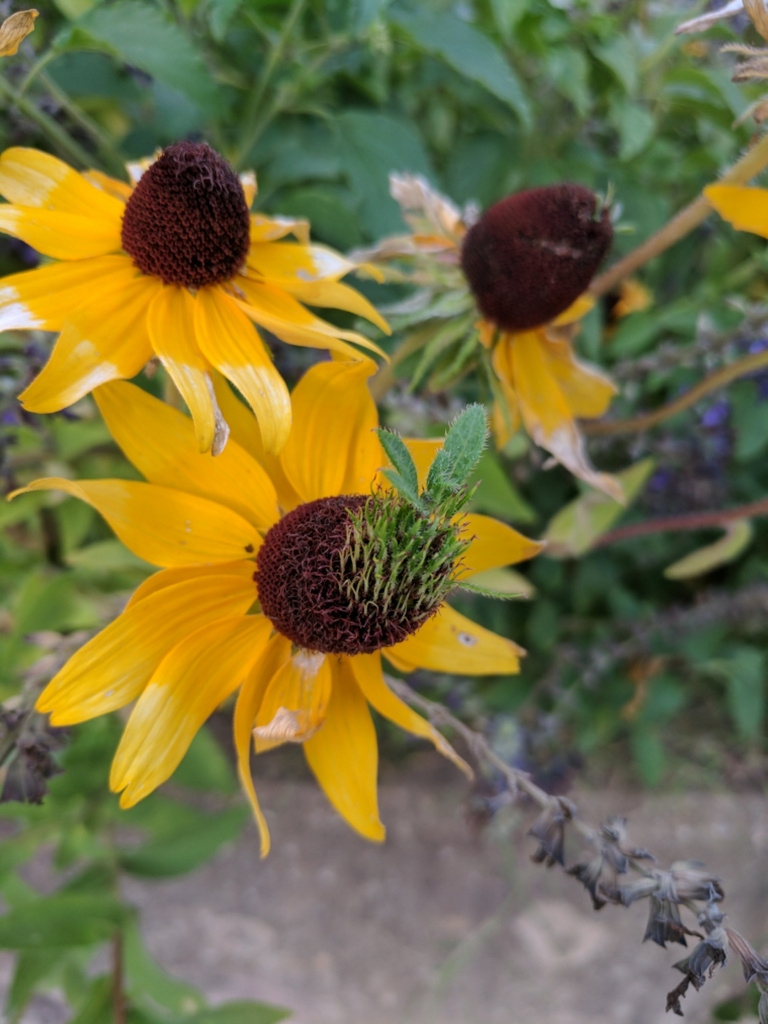
Black-eyed Susans are cheerful, sun-loving perennials that bring a classic meadow look to any garden. They produce daisy-like flowers with dark centers that attract pollinators throughout the summer. These plants are quite adaptable and thrive in various soil conditions.

At a glance
- Care level
- Easy
- Plant type
- Herbaceous perennial
- Light
- Full sun
- Indoor light
- Direct sun
- Water
- Every 5 to 10 days
- Mature size
- 60 to 90 cm
- Growth rate
- Fast
- Hardiness
- USDA 3 to 9
- Bloom time
- Early summer to mid autumn
Care
Plant in a spot with plenty of sun and ensure the soil drains well. Deadhead spent blooms to encourage more flowers, and watch for powdery mildew if the air circulation is poor. They are quite hardy but appreciate a good drink during dry spells.
- Watering
- Keep the soil consistently moist but not waterlogged, especially during the first growing season.
- Feeding
- Apply a balanced, slow-release fertilizer once in early spring to support healthy growth.
- Pruning
- Cut back the dead foliage to the ground in late winter or early spring before new growth appears.
- Repotting
- If growing in containers, refresh the potting mix and move to a slightly larger pot every two years.
- Soil
- Well-draining, loamy soil
- Soil pH
- 6.0 to 7.5
- Temperature
- -20 to 35°C
- Humidity
- 40 to 70%
- Drought tolerance
- Moderate
- Lifespan
- Short lived perennial, typically 2 to 3 years.
- Deer and rabbits
- Moderate
Signs it needs repotting
- Roots growing out of the drainage holes.
- Water running straight through the pot without soaking in.
- Stunted growth during the active season.
Safety
- People
- The plant is generally considered to have low toxicity but may cause skin irritation in sensitive individuals.
- Pets
- This plant is generally considered non-toxic to cats and dogs.
- Children
- The plant is not inherently dangerous to children, but the hairy foliage can be scratchy if handled.
- Contact allergens
- The coarse hairs on the stems and leaves can cause mechanical skin irritation.
- Airborne allergens
- The pollen can trigger allergic reactions in sensitive individuals during the late summer bloom.
- Edibility
- This plant is not considered edible and may cause mild gastric distress if ingested.
How to identify it
- Daisy-like yellow petals
- Dark brown central cone
- Rough hairy stems
- Lance-shaped green leaves
- Height
- 0.3 to 0.9m
- Spread
- 0.3 to 0.6m
- Leaves
- green, deciduous
- Flowers
- yellow, brown, 5 to 10cm
Problems to watch for
- Leaf SpotCommon
- Powdery MildewCommon
- AphidsUncommon
- Aster YellowsUncommon
- Root RotUncommon
By symptom
Check your black-eyed susan from a photo
Pocket Botanist looks at a photo of your plant and tells you what's wrong and what to try first.
Growing it
- Propagation
- seed
- When to plant
- spring, autumn
- Overwintering
- Leave the dried flower heads standing through winter to provide food for birds and interest in the garden. Cut back to the ground in early spring.
- In containers
- It grows well in containers if provided with a pot at least 30 cm deep and good drainage.
Seed
- Collect dry seed heads in late autumn.
- Sow seeds directly into prepared soil in fall or early spring.
- Cover lightly with soil as they need some light to germinate.
Plant in groups to create a strong visual impact and provide a better target for visiting pollinators.
Grows well with
- Purple Coneflower — They share similar light and moisture needs while providing a lovely color contrast.
- Blazing Star — The vertical spikes of Liatris complement the rounded form of the Black eyed Susan.
Similar species
- Brown eyed Susan — It has smaller flowers and a more branching habit than R. hirta.
Science
- Family
- Asteraceae
- Genus
- Rudbeckia
- Order
- Asterales
- Class
- Magnoliopsida
- Native range
- North America
- Conservation
- This species is widespread and secure across its native range.
It is a pioneer species that quickly colonizes disturbed ground and open meadows.
- Value to wildlife
- nectar source, seed source for birds
- Pollinators
- bees, butterflies, moths
- Uses
- pollinator gardens, meadow plantings, cut flowers
Through the year
Ecological indicators
- Salinity
- 2/9
- Soil reaction
- 5/9
- Light
- 7/9
- Temperature
- 5/9
- Nutrients
- 4/9
- Moisture
- 5/9
Taxonomy resolved against GBIF.
Questions people ask
- Is it a perennial?
- It is technically a short lived perennial that often behaves like an annual or biennial.
- Does it need deadheading?
- Deadheading encourages more blooms, but leaving them allows birds to eat the seeds.
Where the name comes from
The genus honors Olof Rudbeck, a Swedish botanist, while hirta refers to the hairy texture of the leaves.
Good to know
- It is the state flower of Maryland.
- The dark center is actually a cluster of tiny disk florets.
- It thrives in disturbed soils and open fields.
Keep your black-eyed susan growing
This page is a general guide. Save your plant in Pocket Botanist and you get care reminders timed for this plant, plus a care history that shows what worked.
This guide was generated with AI and checked against GBIF taxonomy. It is general information, not horticultural or veterinary advice. Read about how we build these guides.