 Pocket Botanist
Plant guide
Donkey's Tail.
Sedum morganianum
Pronounced SEE-dum mor-gan-ee-AH-num
Also known as Donkeytail, burro's-tail, donkey's-tail


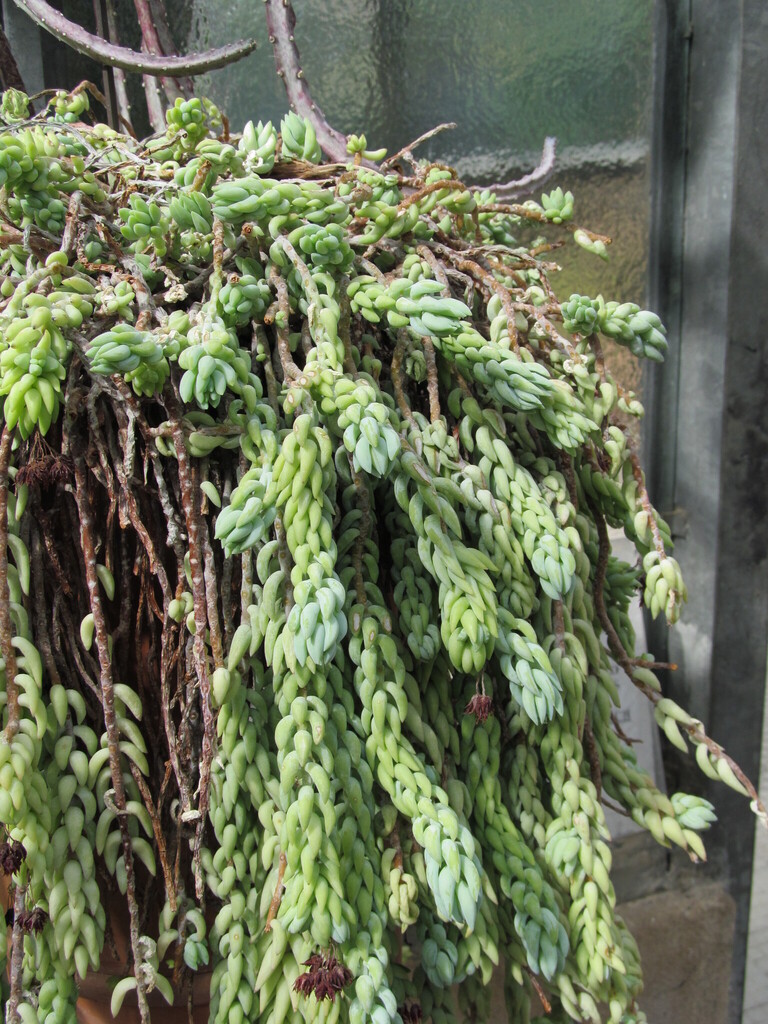
Donkey's tail is a beautiful trailing succulent known for its long, fleshy stems covered in plump, blue green leaves. It makes a stunning addition to hanging baskets where its weight can be fully appreciated. This plant is quite fragile, so it is best kept in a spot where it won't be bumped or brushed against.
At a glance
- Care level
- Moderate
- Plant type
- Succulent
- Light
- Bright, indirect light with some direct morning sun.
- Indoor light
- Bright indirect
- Water
- Every 14 to 21 days
- Mature size
- 60 cm length
- Growth rate
- Slow
- Hardiness
- USDA 10 to 11
- Bloom time
- Late spring to summer
Care
Provide plenty of bright light to keep the stems from stretching out. Allow the soil to dry out completely between waterings to prevent root rot. If the leaves start to shrivel, it is likely thirsty, but be careful not to overwater.
- Watering
- Water thoroughly only when the soil has dried out completely.
- Feeding
- Use a balanced liquid fertilizer diluted to half strength during the growing season.
- Pruning
- Prune only to remove dead stems or to shape the plant after it has finished blooming.
- Repotting
- Repot only when the plant has clearly outgrown its container, being very careful with the fragile stems.
- Soil
- Well draining cactus or succulent mix.
- Soil pH
- 6.0 to 7.0
- Temperature
- 4 to 30°C
- Humidity
- 20 to 50%
- Drought tolerance
- High
- Lifespan
- Perennial, typically 5 to 10 years.
- Deer and rabbits
- Moderate
Signs it needs repotting
- Roots growing out of the drainage holes.
- The plant has stopped growing despite proper care.
- The soil dries out much faster than it used to.
Safety
- People
- The plant is mildly toxic if ingested and the sap can cause skin irritation in sensitive individuals.
- Pets
- This plant is generally considered non toxic to cats and dogs.
- Children
- Keep this plant out of reach of small children because the leaves are easily detached and could pose a choking hazard.
- Contact allergens
- The sap can cause mild contact dermatitis in sensitive people.
- Airborne allergens
- There are no known significant respiratory allergens associated with this plant.
- Edibility
- This plant is not considered edible and may cause stomach upset if ingested.
How to identify it
- Trailing stems up to 60 cm long
- Plump, overlapping, tear drop shaped leaves
- Glaucous, blue green leaf color
- Fragile leaves that detach easily
- Height
- 0.15 to 0.6m
- Spread
- 0.3 to 0.9m
- Leaves
- blue-green, grey-green, evergreen
- Flowers
- pink, red, 1 to 2cm
Problems to watch for
- MealybugsCommon
- Root RotCommon
- Fungus GnatsUncommon
- Leaf DropUncommon
Check your donkey's tail from a photo
Pocket Botanist looks at a photo of your plant and tells you what's wrong and what to try first.
Growing it
- Propagation
- cuttings, leaf cuttings
- When to plant
- spring, summer
- Overwintering
- Bring the plant indoors before the first frost, as it cannot tolerate freezing temperatures. Keep it in a bright, cool location and reduce watering significantly during the winter months.
- In containers
- It is an excellent container plant, especially in hanging baskets that allow the stems to trail freely, and requires a pot with drainage holes.
Leaf Cuttings
- 1. Gently twist a healthy leaf from the stem.
- 2. Let the leaf callous over in a dry spot for 2 to 3 days.
- 3. Place the leaf on top of well draining succulent soil.
- 4. Mist lightly only when the soil is completely dry.
- 5. Wait for small roots and a new plantlet to emerge.
Group succulents with similar water needs to prevent overwatering the more sensitive species.
Grows well with
- Echeveria — They share similar light and water requirements.
- Jade Plant — Both are drought tolerant succulents that thrive in similar conditions.
Similar species
- Baby Burro's Tail — It has smaller, more rounded leaves and is often confused with the standard species.
Science
- Family
- Crassulaceae
- Genus
- Sedum
- Order
- Saxifragales
- Class
- Magnoliopsida
- Native range
- Southern Mexico and Honduras.
- Conservation
- This species is not currently listed as endangered or threatened.
It grows on rocky cliffs where it can trail downwards, allowing its leaves to shed excess water quickly.
- Value to wildlife
- nectar source
- Pollinators
- bees, butterflies
- Uses
- hanging baskets, indoor container plant, rock garden specimen
Through the year
Ecological indicators
- Soil reaction
- 6/9
- Light
- 7/9
- Temperature
- 7/9
- Moisture
- 2/9
- Nutrients
- 3/9
- Salinity
- 2/9
Taxonomy resolved against GBIF.
Questions people ask
- Why are the leaves falling off?
- The leaves are very delicate and drop easily when bumped or moved.
- How often should I water it?
- Water only when the soil has completely dried out, usually every 2 to 3 weeks.
Where the name comes from
The genus name Sedum comes from the Latin word sedere, meaning to sit, referring to how these plants sit on rocks. The species name morganianum honors Dr. W.D. Morgan, a Mexican plant enthusiast.
Good to know
- It is commonly known as Burro's Tail or Donkey's Tail.
- The leaves are covered in a waxy coating called epicuticular wax that helps prevent water loss.
- It is a succulent that stores water in its plump, fleshy leaves.
- The trailing stems can grow up to 2 feet long in ideal conditions.
Also in
Keep your donkey's tail growing
This page is a general guide. Save your plant in Pocket Botanist and you get care reminders timed for this plant, plus a care history that shows what worked.
This guide was generated with AI and checked against GBIF taxonomy. It is general information, not horticultural or veterinary advice. Read about how we build these guides.