 Pocket Botanist
Guide botanique
Rajah pitcher plant.
Nepenthes rajah
Prononciation neh-PEN-theez RAH-jah


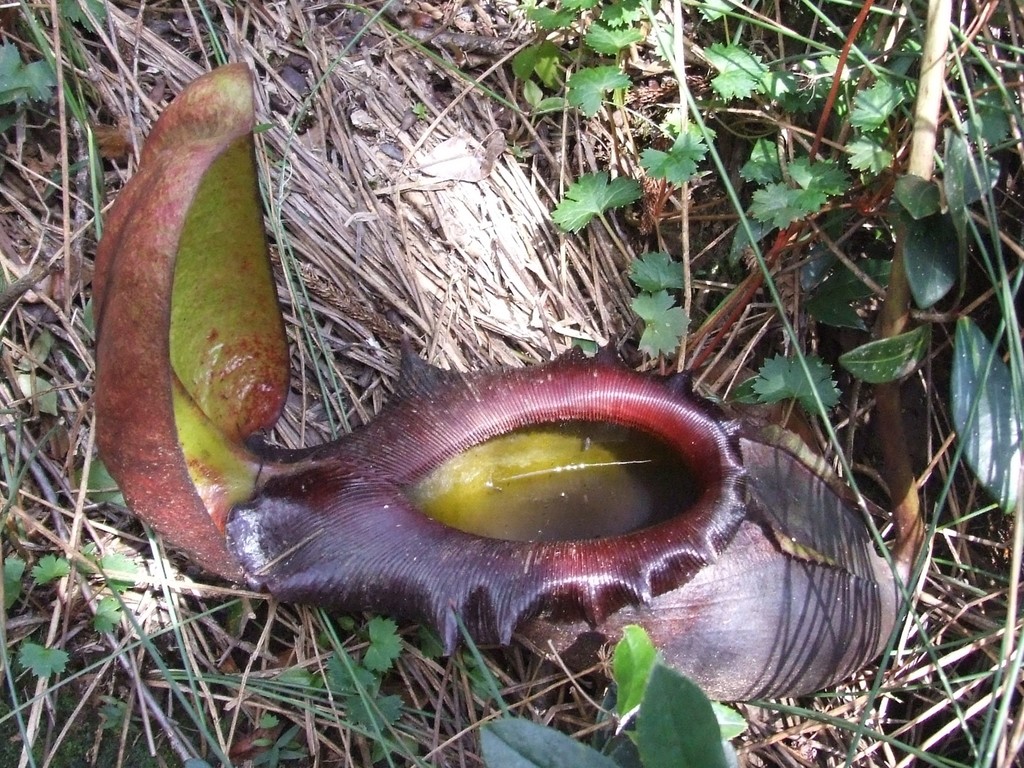
La plante lanceole de Rajah est une spectaculaire espèce carnivore originaire des montagnes de Bornéo. Elle est célèbre pour produire d'énormes lanceoles terrestres qui peuvent même piéger de petits vertébrés. Cette plante est un véritable objet de collection qui nécessite des conditions très spécifiques pour prospérer.
En un coup d'œil
- Niveau d'entretien
- Difficile
- Type de plante
- Vivace carnivore
- Lumière
- Lumière vive et filtrée
- Lumière en intérieur
- Lumière vive indirecte
- Arrosage
- Tous les 1 à 3 jours
- Taille adulte
- 1,5 mètre
- Croissance
- Lente
- Rusticité
- USDA 11 à 12
- Floraison
- Irregular throughout the year
Entretien
Maintenez une humidité élevée et des températures nocturnes fraîches pour imiter son habitat de haute altitude. Utilisez uniquement de l'eau distillée ou de l'eau de pluie, car les minéraux de l'eau du robinet endommageront rapidement les racines. Surveillez le brunissement des feuilles, qui signale souvent que l'humidité est trop faible.
- Arrosage
- Gardez le substrat constamment humide, mais jamais détrempé.
- Engrais
- Utilisez un engrais orchidée très dilué uniquement sur les feuilles, ou laissez la plante attraper ses propres insectes.
- Taille
- Taillez les lanceoles mortes ou noircies pour garder la plante nette.
- Rempotage
- Rempotez doucement lorsque la plante dépasse son conteneur, en veillant à ne pas déranger le système racinaire sensible.
- Sol
- Mélange de mousse de sphaigne et de perlite
- pH du sol
- 4,0 à 5,5
- Température
- 10 à 28°C
- Humidité
- 70 à 95%
- Résistance à la sécheresse
- Faible
- Durée de vie
- Perennial, can live for many decades in the wild.
- Parfum
- Léger
- Résistance aux chevreuils et lapins
- Élevée
Signes qu'il faut rempoter
- Roots growing out of the drainage holes
- The medium has broken down and become compacted
- The plant has outgrown its current container
Sécurité
- Humains
- The plant is not considered toxic, but the digestive fluids inside the pitchers are acidic and can cause irritation.
- Enfants
- Keep pitchers out of reach of small children to prevent them from drinking the acidic fluid or tipping the plant over.
- Allergènes de contact
- The stiff hairs on the leaves and pitchers may cause mild mechanical skin irritation.
- Allergènes aéroportés
- There are no known significant respiratory allergens associated with this species.
- Comestibilité
- This plant is not edible and should not be consumed by humans or pets.
Comment l'identifier
- D'énormes lanceoles digestives en forme d'urne
- De grandes feuilles coriaces vert foncé
- Attachement foliaire pelté
- Coloration des lanceoles rouge à violet
- Péristome épais et côtelé
- Hauteur
- 0,3 à 0,5m
- Envergure
- 0,4 à 1,5m
- Feuilles
- green, evergreen
- Fleurs
- brown, red, 1 à 2cm
- Fruits
- brown, Late summer
Problèmes courants
- Root rot — Occurs when the growing medium stays too soggy and lacks proper aeration.
- Aphids — Small insects that suck sap from new growth and flower stalks.
La cultiver
- Multiplication
- seed, cuttings
- Quand planter
- spring, summer, autumn, winter
- Hivernage
- Keep the plant in a stable, warm environment with high humidity throughout the year, as it does not have a dormant season.
- En pot
- It is best grown in large hanging baskets or specialized terrariums that can accommodate its massive size.
Seed
- Sow seeds on live sphagnum moss.
- Maintain high humidity and bright, indirect light.
- Keep temperatures consistent until germination occurs.
Cuttings
- Take a stem cutting with at least two nodes.
- Place in a moist, airy medium.
- Cover to maintain high humidity until roots develop.
Always use a nutrient poor, well draining medium like live sphagnum moss to mimic its natural boggy habitat.
Bonnes associations
- Sphagnum — It provides the perfect acidic and moisture retentive substrate for the roots.
Espèces similaires
- Nepenthes attenboroughii — It is another giant pitcher plant that shares a similar high altitude habitat.
Science
- Famille
- Nepenthaceae
- Genre
- Nepenthes
- Ordre
- Caryophyllales
- Classe
- Magnoliopsida
- Région d'origine
- High altitude slopes of Mount Kinabalu and Mount Tambuyukon in Borneo.
- Préservation
- It is listed as Endangered by the IUCN and is protected under CITES Appendix I, meaning trade is strictly regulated.
It grows in ultramafic soils on cool, misty mountain slopes where it relies on specialized nutrients from its prey.
- Intérêt pour la faune
- nectar source
- Pollinisateurs
- abeilles, coléoptères
- Utilisations
- botanical collection, scientific study
Au fil des saisons
Repères écologiques
- Salinité
- 1/9
- Réaction du sol
- 4/9
- Lumière
- 6/9
- Température
- 3/9
- Humidité
- 8/9
- Nutriments
- 1/9
Taxonomie vérifiée avec le GBIF.
Ce qu'on demande souvent
- Can I grow this on my windowsill?
- It is very difficult to grow in a typical home because it requires extremely high humidity and specific temperature drops at night.
- What should I feed it?
- It does not need to be fed, as it will capture its own insects if kept in an appropriate environment.
D'où vient le nom
It is named after Sir James Brooke, the first White Rajah of Sarawak, who was a British adventurer.
Bon à savoir
- It is native only to Mount Kinabalu and Mount Tambuyukon in Sabah, Malaysia.
- The pitchers can hold up to 3.5 liters of fluid.
- It has a unique symbiotic relationship with tree shrews that feed on nectar from the pitcher lid and defecate into the pitcher.
- The pitchers are some of the largest in the entire genus Nepenthes.
Aussi dans
Ta plante a mauvaise mine ?
Cette page est un guide général. Pocket Botanist diagnostique les problèmes directement à partir d'une photo de ta plante, adapte l'arrosage à sa luminosité et te prévient quand il faut t'en occuper.
Ce guide a été généré par IA et vérifié avec la taxonomie du GBIF. Il s'agit d'informations générales, et non de conseils horticoles ou vétérinaires. Découvre comment nous concevons ces guides.