 Pocket Botanist
Plant guide
Dragon blood tree.
Dracaena cinnabari Balf.f.
Pronounced druh-SEE-nuh sin-nuh-BAR-ee
Also known as Dragon's Blood Tree, Socotra dragontree, dragon blood tree, “Dragon’s Blood” Tree


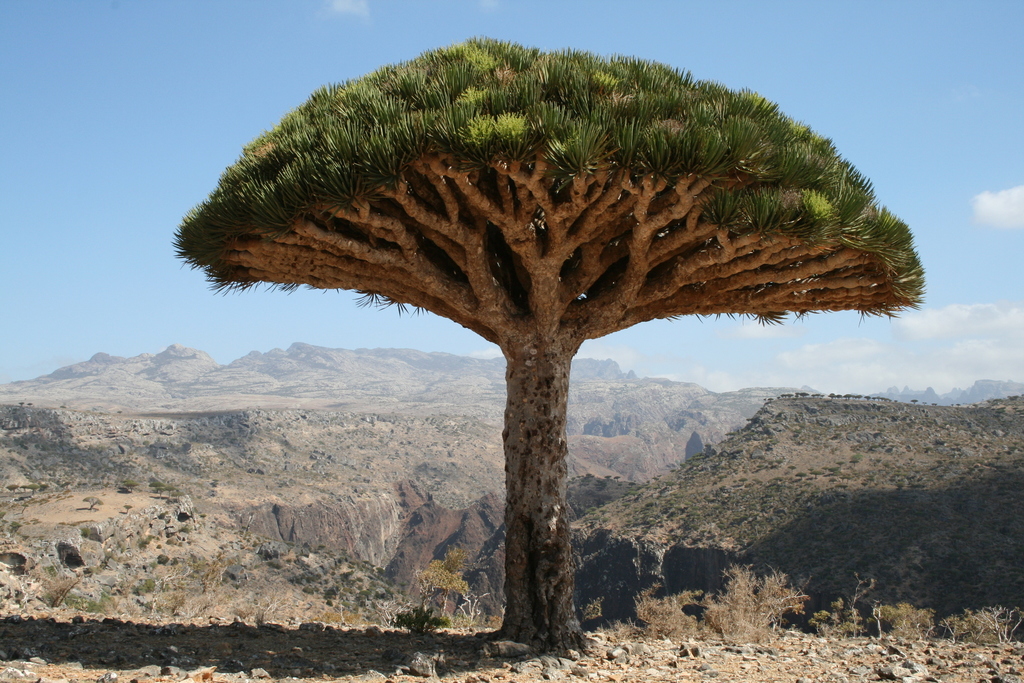
The dragon blood tree is a striking succulent native to the Socotra archipelago. It is famous for its unique umbrella shape and the red resin it produces. This tree is a slow grower that thrives in harsh, arid conditions.

At a glance
- Care level
- Difficult
- Plant type
- Succulent tree
- Light
- Full sun
- Indoor light
- Direct sun
- Water
- Every 14 to 30 days
- Mature size
- 30 feet
- Growth rate
- Slow
- Hardiness
- USDA 10 to 12
- Bloom time
- Early to mid spring
Care
Provide plenty of direct sunlight and ensure the soil drains very quickly to prevent rot. Watch for yellowing leaves which often indicate too much moisture in the root zone. Keep the environment warm and dry to mimic its natural habitat.
- Watering
- Allow the soil to dry out completely between waterings to avoid root rot.
- Feeding
- Use a balanced liquid fertilizer diluted to half strength during the growing season.
- Pruning
- Only prune to remove dead or damaged branches to maintain its natural shape.
- Repotting
- Repot only when the plant becomes severely root bound as it prefers tight spaces.
- Soil
- Well draining sandy or rocky soil
- Soil pH
- Neutral to slightly alkaline
- Temperature
- 10 to 35°C
- Humidity
- 20 to 50%
- Drought tolerance
- High
- Lifespan
- Perennial, can live for hundreds of years.
- Deer and rabbits
- High
Signs it needs repotting
- Roots circling the bottom of the pot
- Growth has completely stalled
- Soil no longer absorbs water
Safety
- People
- The plant contains saponins which can cause digestive upset if ingested.
- Pets
- This plant is considered toxic to cats and dogs if ingested.
- Children
- Keep away from small children as the stiff, pointed leaves can cause scratches.
- Contact allergens
- The resin may cause mild skin irritation in sensitive individuals.
- Airborne allergens
- There is no significant evidence of airborne allergens.
- Edibility
- The sap and plant parts are not intended for human consumption.
How to identify it
- Distinctive dense umbrella shaped canopy
- Thick succulent trunk and branches
- Stiff sword shaped evergreen leaves
- Produces dark red resinous sap
- Small fragrant white or green flowers
- Height
- 6 to 10m
- Spread
- 5 to 8m
- Leaves
- dark green, blue green, evergreen
- Flowers
- white, greenish, 0.5 to 1cm
- Fruit
- orange, red, Late summer to autumn
Problems to watch for
- Brown Leaf EdgesCommon
- MealybugsCommon
- Root RotCommon
- Leaf DropUncommon
- Scale InsectsUncommon
- Spider MitesUncommon
By symptom
Check your dragon blood tree from a photo
Pocket Botanist looks at a photo of your plant and tells you what's wrong and what to try first.
Growing it
- Propagation
- seed, cuttings
- When to plant
- spring, early summer
- Overwintering
- Protect from freezing temperatures and keep the plant in a dry, bright location during winter months.
- In containers
- It is not well suited for containers due to its massive size and slow growth rate.
Seed
- 1. Soak seeds in warm water for 24 hours.
- 2. Sow in a well draining sandy mix.
- 3. Keep warm and lightly moist until germination.
Group with other slow growing succulents that require minimal water and excellent drainage.
Grows well with
- Aloe — They share similar drought tolerant requirements and native habitats.
Similar species
- Dragon Tree — It shares a similar growth habit and resinous properties.
Science
- Family
- Asparagaceae
- Genus
- Dracaena
- Order
- Asparagales
- Class
- Liliopsida
- Native range
- Socotra archipelago, Yemen
- Conservation
- This species is listed as vulnerable due to habitat loss and climate change in its native range.
It survives in arid, rocky mountain environments by capturing moisture from clouds through its dense canopy.
- Value to wildlife
- provides habitat for endemic birds
- Pollinators
- bees, beetles
- Uses
- ornamental specimen, traditional resin source
Through the year
Ecological indicators
- Soil reaction
- 7/9
- Light
- 8/9
- Moisture
- 2/9
- Salinity
- 3/9
- Temperature
- 8/9
- Nutrients
- 2/9
Taxonomy resolved against GBIF.
Questions people ask
- Can I grow this indoors?
- It is extremely difficult to maintain indoors due to its need for intense light and specific airflow.
- How often should I water it?
- Water sparingly, allowing the soil to dry out completely between sessions.
Where the name comes from
The name Dracaena comes from the Greek word for female dragon, referring to the red resin, while cinnabari refers to the color of that resin.
Good to know
- The red resin is historically known as dragon's blood.
- It is endemic to the Socotra archipelago in Yemen.
- The tree is adapted to survive on mountain mist.
Also in
Keep your dragon blood tree growing
This page is a general guide. Save your plant in Pocket Botanist and you get care reminders timed for this plant, plus a care history that shows what worked.
This guide was generated with AI and checked against GBIF taxonomy. It is general information, not horticultural or veterinary advice. Read about how we build these guides.