 Pocket Botanist
Guide botanique
Arbre du sang du dragon.
Dracaena cinnabari Balf.f.
Prononciation druh-SEE-nuh sin-nuh-BAR-ee
Aussi appelée Arbre du sang du dragon, Socotra dragontree, arbre du sang du dragon, Arbre "Sang du Dragon"


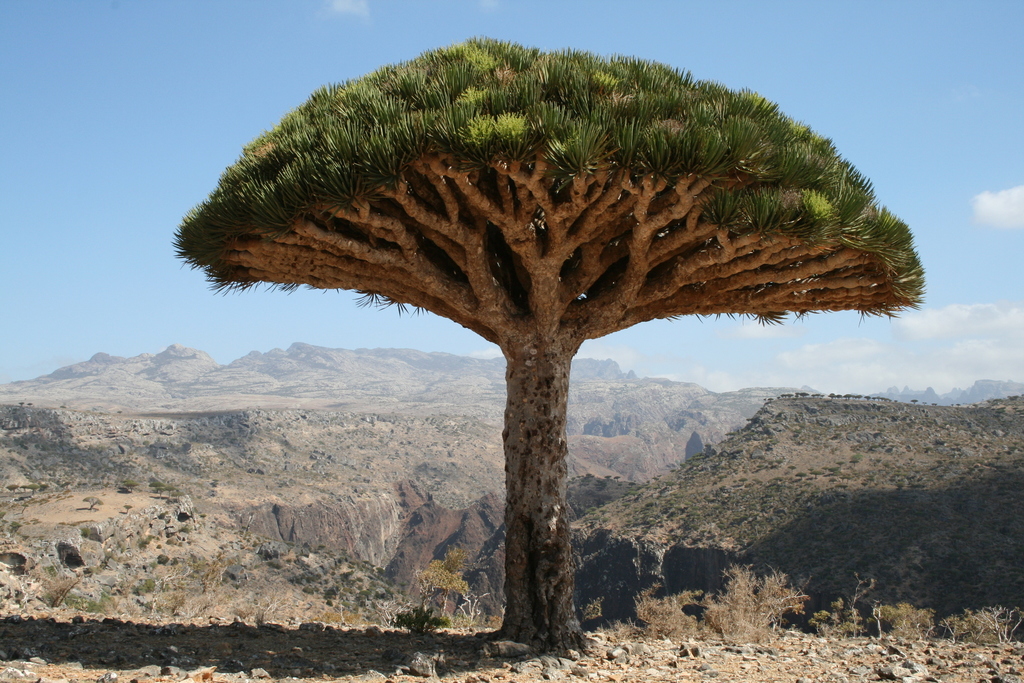
L'arbre du sang du dragon est une succulente remarquable originaire de l'archipel de Socotra. Il est célèbre pour sa forme unique en parapluie et la résine rouge qu'il produit. Cet arbre a une croissance lente et prospère dans des conditions dures et arides.

En un coup d'œil
- Niveau d'entretien
- Difficile
- Type de plante
- Arbre succulent
- Lumière
- Plein soleil
- Lumière en intérieur
- Soleil direct
- Arrosage
- Tous les 14 à 30 jours
- Taille adulte
- 30 pieds
- Croissance
- Lente
- Rusticité
- USDA 10 à 12
- Floraison
- Début à mi-printemps
Entretien
Fournissez beaucoup de soleil direct et assurez-vous que le sol se draine très rapidement pour éviter la pourriture. Surveillez le jaunissement des feuilles, qui indique souvent un excès d'humidité dans la zone racinaire. Maintenez un environnement chaud et sec pour imiter son habitat naturel.
- Arrosage
- Laissez le sol sécher complètement entre les arrosages pour éviter la pourriture des racines.
- Engrais
- Utilisez un engrais liquide équilibré dilué à moitié de sa force pendant la saison de croissance.
- Taille
- Taillez uniquement pour enlever les branches mortes ou endommagées afin de maintenir sa forme naturelle.
- Rempotage
- Rempotez uniquement lorsque la plante est sévèrement à l'étroit dans son pot, car elle préfère les espaces restreints.
- Sol
- Sol sableux ou rocheux bien drainant
- pH du sol
- Neutre à légèrement alcalin
- Température
- 10 à 35°C
- Humidité
- 20 à 50%
- Résistance à la sécheresse
- Élevée
- Durée de vie
- Vivace, peut vivre des centaines d'années.
- Résistance aux chevreuils et lapins
- Élevée
Signes qu'il faut rempoter
- Racines enroulées au fond du pot
- La croissance a complètement stagné
- Le sol n'absorbe plus l'eau
Sécurité
- Humains
- La plante contient des saponines qui peuvent provoquer des troubles digestifs en cas d'ingestion.
- Animaux
- Cette plante est considérée comme toxique pour les chats et les chiens en cas d'ingestion.
- Enfants
- Tenir à l'écart des jeunes enfants car les feuilles rigides et pointues peuvent causer des éraflures.
- Allergènes de contact
- La résine peut provoquer une légère irritation cutanée chez les personnes sensibles.
- Allergènes aéroportés
- Il n'y a pas de preuves significatives d'allergènes aéroportés.
- Comestibilité
- La sève et les parties de la plante ne sont pas destinées à la consommation humaine.
Comment l'identifier
- Canopée distinctive en forme de parapluie dense
- Tronc et branches succulentes épaisses
- Feuilles persistantes rigides en forme d'épée
- Produit une sève résineuse rouge foncé
- Petites fleurs blanches ou vertes parfumées
- Hauteur
- 6 à 10m
- Envergure
- 5 à 8m
- Feuilles
- vert foncé, vert bleuté, persistant
- Fleurs
- blanc, verdâtre, 0,5 à 1cm
- Fruits
- orange, rouge, Fin d'été à automne
Problèmes à surveiller
- Brunissement du bord des feuillesCourant
- Cochenilles farineusesCourant
- Pourriture des racinesCourant
- Chute des feuillesPeu courant
- CochenillesPeu courant
- TétranyquesPeu courant
Vérifie la santé de ta plante en photo
Pocket Botanist analyse une photo de ta plante et te dit ce qui ne va pas et quoi essayer en premier.
La cultiver
- Multiplication
- semis, bouturage
- Quand planter
- printemps, début d'été
- Hivernage
- Protéger des températures glaciales et conserver la plante dans un endroit sec et lumineux pendant les mois d'hiver.
- En pot
- Il n'est pas bien adapté aux conteneurs en raison de sa taille massive et de sa croissance lente.
Semis
- 1. Trempez les graines dans de l'eau tiède pendant 24 heures.
- 2. Semez dans un mélange sableux bien drainant.
- 3. Maintenez au chaud et légèrement humide jusqu'à la germination.
Groupez avec d'autres plantes succulentes à croissance lente qui nécessitent peu d'eau et un excellent drainage.
Bonnes associations
- Aloe perryi — Ils partagent des exigences similaires en matière de tolérance à la sécheresse et des habitats indigènes.
Espèces similaires
- Dracaena draco — Il partage un port de croissance et des propriétés résineuses similaires.
Science
- Famille
- Asparagaceae
- Genre
- Dracaena
- Ordre
- Asparagales
- Classe
- Liliopsida
- Région d'origine
- Archipel de Socotra, Yémen
- Préservation
- Cette espèce est classée comme vulnérable en raison de la perte d'habitat et du changement climatique dans son aire de répartition indigène.
Il survit dans les environnements montagneux arides et rocheux en capturant l'humidité des nuages grâce à sa canopée dense.
- Intérêt pour la faune
- fournit un habitat pour les oiseaux endémiques
- Pollinisateurs
- abeilles, coléoptères
- Utilisations
- spécimen ornemental, source traditionnelle de résine
Au fil des saisons
Repères écologiques
- Réaction du sol
- 7/9
- Lumière
- 8/9
- Humidité
- 2/9
- Salinité
- 3/9
- Température
- 8/9
- Nutriments
- 2/9
Taxonomie vérifiée avec le GBIF.
Ce qu'on demande souvent
- Puis-je le cultiver à l'intérieur ?
- Il est extrêmement difficile à maintenir à l'intérieur en raison de son besoin de lumière intense et d'une circulation d'air spécifique.
- Quelle est la fréquence d'arrosage ?
- Arrosez avec parcimonie, en laissant le sol sécher complètement entre les arrosages.
D'où vient le nom
Le nom Dracaena vient du mot grec pour dragon femelle, faisant référence à la résine rouge, tandis que cinnabari fait référence à la couleur de cette résine.
Bon à savoir
- La résine rouge est historiquement connue sous le nom de sang de dragon.
- Il est endémique de l'archipel de Socotra au Yémen.
- L'arbre est adapté pour survivre grâce à la brume de montagne.
Aussi dans
Garde ta plante en pleine forme
Cette page est un guide général. Enregistre ta plante dans Pocket Botanist et tu reçois des rappels d'entretien adaptés à cette plante, ainsi qu'un historique d'entretien qui montre ce qui a marché.
Ce guide a été généré par IA et vérifié avec la taxonomie du GBIF. Il s'agit d'informations générales, et non de conseils horticoles ou vétérinaires. Découvre comment nous concevons ces guides.