 Pocket Botanist
Plant guide
Greater celandine.
Chelidonium majus
Pronounced kel-ih-DOH-nee-um MAY-jus
Also known as Celandine, Great Celandine, Greater Celandine, Nipplewort



Scan with your phone's camera to get the app
Or go to pocketbotanist.app/get on your phone

Greater celandine is a charming, hardy perennial often found in woodland edges and hedgerows. It produces delicate yellow flowers and has a long history in traditional herbal practices. You'll find it's quite adaptable to various garden spots.
At a glance
- Care level
- Easy
- Plant type
- Herbaceous perennial
- Light
- Partial shade to full sun
- Indoor light
- Bright indirect
- Water
- Every 3 to 7 days
- Mature size
- 3 feet
- Growth rate
- Medium
- Hardiness
- USDA 4 to 8
- Bloom time
- Mid spring to late summer
Care
Keep the soil consistently moist but not waterlogged to mimic its natural woodland habitat. Watch for wilting leaves as a sign it needs more moisture. It can spread quickly, so keep an eye on its growth if you want to contain it.
- Watering
- Water whenever the top inch of soil feels dry to the touch.
- Feeding
- Apply a balanced liquid fertilizer during the active growing season.
- Pruning
- Trim back spent flower stalks to encourage a tidy appearance and prevent unwanted self seeding.
- Repotting
- Repot only if the plant becomes root bound or you need to refresh the soil.
- Soil
- Moist, well-draining soil
- Soil pH
- Neutral to slightly alkaline
- Temperature
- -25 to 30°C
- Humidity
- 40 to 70%
- Drought tolerance
- Moderate
- Lifespan
- Short lived perennial, typically 2 to 3 years.
- Deer and rabbits
- High
Signs it needs repotting
- Roots growing out of the drainage holes
- Water running straight through the pot
Safety
- People
- All parts of the plant are poisonous if eaten, and the sap can cause severe skin irritation or blistering.
- Pets
- This plant is considered toxic to cats and dogs if ingested, as it contains alkaloids that can cause irritation.
- Children
- Keep children away from this plant as the sap is caustic and the foliage is toxic if ingested.
- Contact allergens
- The yellow latex sap is a potent skin irritant that can cause contact dermatitis.
- Airborne allergens
- Pollen may cause mild respiratory irritation in sensitive individuals.
- Edibility
- This plant is toxic if ingested and should never be consumed.
How to identify it
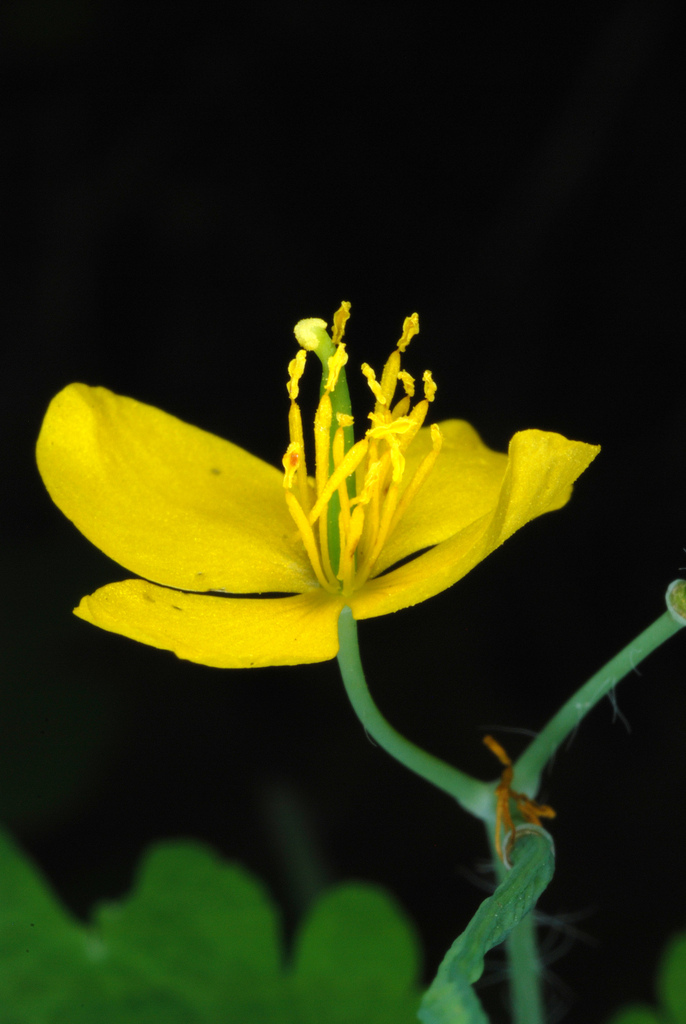
- Bright yellow four petaled flowers
- Deeply lobed, fern like foliage
- Orange sap inside stems
- Small, elongated seed pods
- Height
- 0.3 to 0.9m
- Spread
- 0.3 to 0.6m
- Leaves
- bright green, glaucous, deciduous
- Flowers
- yellow, 1 to 2cm
- Fruit
- brown, Late summer
Problems to watch for
- AphidsCommon
- Powdery MildewCommon
- Leaf SpotUncommon
- RustUncommon
- Slugs and SnailsUncommon
- Root RotRare
Check your greater celandine from a photo
Pocket Botanist looks at a photo of your plant and tells you what's wrong and what to try first.
Scan with your phone's camera to get the app
Or go to pocketbotanist.app/get on your phone
Growing it
- Propagation
- seed
- When to plant
- spring, autumn
- Overwintering
- The foliage will die back completely in winter. No special protection is needed as the roots are hardy.
- In containers
- It grows well in pots, but ensure the container is at least 20 centimeters deep to accommodate the root system.
Seed
- Collect seeds from the brown pods in late summer.
- Sow seeds directly into the soil in autumn.
- Thin seedlings in spring to allow for proper spacing.
Plant this in a contained area as it is an aggressive self seeder that can crowd out smaller perennials.
Grows well with
- Common Ivy · They share similar woodland shade requirements.
- Foxglove · Both plants enjoy the same dappled shade and soil conditions.
Similar species
- Greater Celandine Poppy · It has similar yellow flowers but is a better behaved native alternative.
Science
- Family
- Papaveraceae
- Genus
- Chelidonium
- Order
- Ranunculales
- Class
- Magnoliopsida
- Native range
- Europe and western Asia.
- Conservation
- This is a common, often invasive species that is not of conservation concern.
It thrives in disturbed soils, hedgerows, and shaded woodland edges where it can easily outcompete native ground cover.
- Value to wildlife
- pollen source
- Pollinators
- bees, butterflies
- Uses
- ornamental, traditional herbalism
Through the year
Ecological indicators
- Salinity
- 1/9
- Soil reaction
- 6/9
- Light
- 5/9
- Temperature
- 5/9
- Moisture
- 5/9
- Nutrients
- 6/9
Taxonomy resolved against GBIF.
Questions people ask
- Is it safe to use on my skin?
- No, the sap is caustic and can cause burns or severe irritation.
- How do I stop it from spreading?
- Remove the plants before they set seed to prevent them from taking over your garden.
Where the name comes from
The name Chelidonium is derived from the Greek word chelidon, meaning swallow, while majus means greater.
Good to know
- It is commonly known as swallowwort because it was once believed to bloom when swallows arrived.
- The name Chelidonium comes from the Greek word for swallow.
- It is a member of the poppy family, Papaveraceae.
- The plant readily self seeds in gardens.
Also in
Keep your greater celandine growing
This page is a general guide. Save your plant in Pocket Botanist and you get care reminders timed for this plant, plus a care history that shows what worked.
Scan with your phone's camera to get the app
Or go to pocketbotanist.app/get on your phone
This guide was generated with AI on and checked against GBIF taxonomy. It is general information, not horticultural or veterinary advice. Read about how we build these guides.