 Pocket Botanist
Plant guide
Saw Banksia.
Banksia serrata
Pronounced BANK-see-uh seh-RAY-tuh



Scan with your phone's camera to get the app
Or go to pocketbotanist.app/get on your phone

The Saw Banksia is a striking Australian native known for its unique, cone shaped flower spikes. It thrives in well drained, sandy soils and adds a rugged beauty to any garden. You will love how its architectural foliage stands out all year long.
At a glance
- Care level
- Moderate
- Plant type
- Evergreen tree
- Light
- Full sun
- Indoor light
- Direct sun
- Water
- Every 7 to 14 days
- Mature size
- 15 meters
- Growth rate
- Medium
- Hardiness
- USDA 9 to 11
- Bloom time
- Late summer to early winter
Care
Plant this beauty in a spot with excellent drainage to prevent root rot. Keep an eye out for yellowing leaves, which often signal that the soil is holding too much moisture. It is quite hardy once established and appreciates plenty of sunshine.
- Watering
- Water deeply when the top few inches of soil feel dry to the touch.
- Feeding
- Use a low phosphorus fertilizer specifically formulated for native plants.
- Pruning
- Lightly trim after flowering to maintain a tidy shape and encourage new growth.
- Repotting
- Only repot if the plant is clearly root bound, as they prefer to stay undisturbed.
- Soil
- Sandy, acidic, well drained
- Soil pH
- 5.5 to 6.5
- Temperature
- -5 to 35°C
- Humidity
- 40 to 70%
- Drought tolerance
- High
- Lifespan
- Perennial, typically 20 to 50 years.
- Fragrance
- Light
- Deer and rabbits
- High
Signs it needs repotting
- Roots growing out of the drainage holes.
- Water sitting on the surface for too long.
- Stunted growth despite healthy conditions.
Safety
- People
- There is no known toxicity to humans.
- Children
- The sharp, serrated leaf edges and woody seed cones pose a minor risk of scratches or injury to small children.
- Contact allergens
- The stiff, serrated leaves can cause minor skin scratches if handled without gloves.
- Airborne allergens
- The pollen may cause mild respiratory irritation in sensitive individuals during the flowering season.
- Edibility
- The plant is not considered edible for humans.
How to identify it
- Large, cylindrical flower spikes
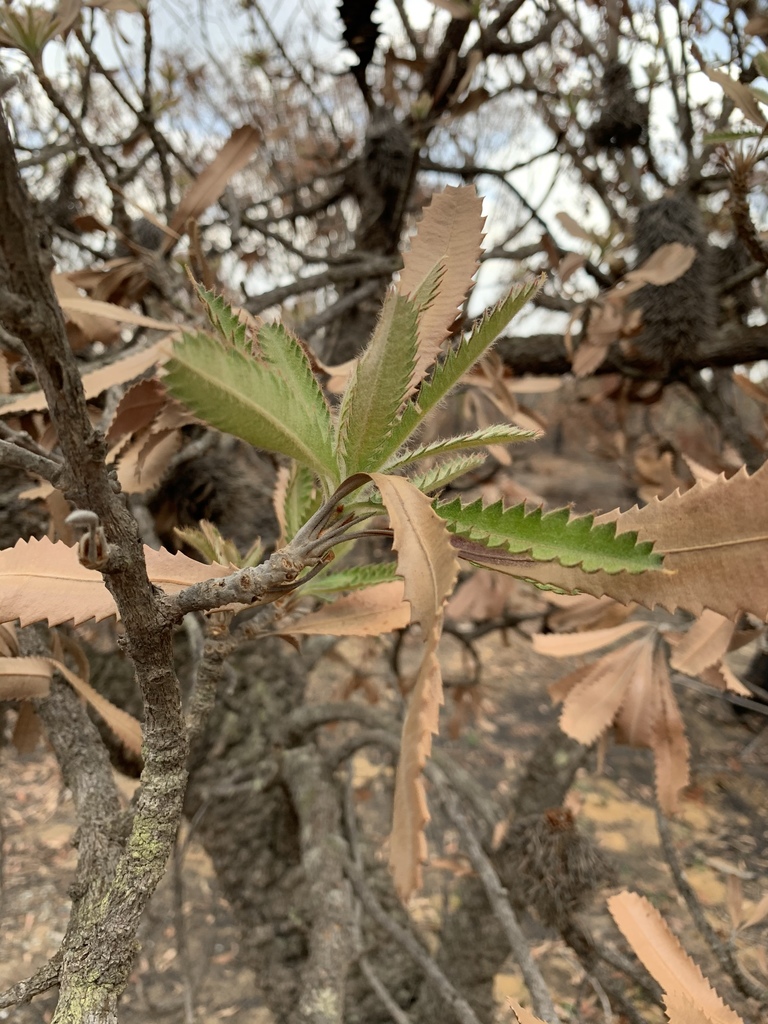
- Serrated, leathery green leaves
- Woody, cone like seed follicles
- Sturdy, gnarled tree trunk
- Height
- 4 to 10m
- Spread
- 3 to 6m
- Leaves
- dark green, evergreen
- Flowers
- yellow, cream, 7 to 12cm
- Fruit
- brown, Late summer
Problems to watch for
- PhytophthoraCommon
- Root RotCommon
- Leaf ScorchUncommon
- Myrtle RustUncommon
- Scale InsectsUncommon
Check your saw banksia from a photo
Pocket Botanist looks at a photo of your plant and tells you what's wrong and what to try first.
Scan with your phone's camera to get the app
Or go to pocketbotanist.app/get on your phone
Growing it
- Propagation
- seed
- When to plant
- spring, autumn
- Overwintering
- Ensure the plant is in a well drained spot to prevent root rot during wet winters. No special protection is needed in its preferred climate zones.
- In containers
- It is not ideal for long term container growth due to its large size and sensitive root system.
Seed propagation
- 1. Collect the woody cones after they have matured.
- 2. Place the cones in a warm oven or near a fire to trigger the follicles to open.
- 3. Shake the seeds out and sow them in a sandy, well drained seed raising mix.
- 4. Keep the soil lightly moist until germination occurs.
Group with other low phosphorus, drought tolerant Australian natives to maintain soil balance.
Grows well with
- Coastal Rosemary · It shares similar coastal environmental requirements and soil preferences.
- Grass Tree · Both plants thrive in the same nutrient poor, sandy habitats.
Similar species
- Wallum Banksia · It has a similar appearance but features different seed cone structures.
Science
- Family
- Proteaceae
- Genus
- Banksia
- Order
- Proteales
- Class
- Magnoliopsida
- Native range
- Eastern Australia, primarily along the coast.
- Conservation
- This species is common and not currently of conservation concern.
It thrives in sandy, well drained soils and relies on fire to trigger seed dispersal.
- Value to wildlife
- nectar source, habitat for small birds
- Pollinators
- bees, butterflies, birds
- Uses
- ornamental tree, coastal garden specimen, wildlife garden
Through the year
Ecological indicators
- Salinity
- 6/9
- Soil reaction
- 4/9
- Light
- 8/9
- Temperature
- 7/9
- Moisture
- 3/9
- Nutrients
- 1/9
Taxonomy resolved against GBIF.
Questions people ask
- Does it need fertilizer?
- It needs very little feeding. It is sensitive to phosphorus, so if you do fertilize, use only a low phosphorus fertilizer made for native plants.
- Can I grow it in a pot?
- It is best suited for the ground but can be grown in a very large container for a few years.
Where the name comes from
The genus is named after Sir Joseph Banks, who collected the first specimens in 1770. The species name serrata refers to the saw like teeth on the leaf edges.
Good to know
- The iconic seed cones were immortalized as the Big Bad Banksia Men in the Snugglepot and Cuddlepie children's books.
- It is commonly known as the Saw Banksia due to its distinctively serrated leaf margins.
- The plant is highly adapted to nutrient poor sandy soils.
- Indigenous Australians used the flower spikes as hairbrushes and to strain honey.
Also in
Keep your saw banksia growing
This page is a general guide. Save your plant in Pocket Botanist and you get care reminders timed for this plant, plus a care history that shows what worked.
Scan with your phone's camera to get the app
Or go to pocketbotanist.app/get on your phone
This guide was generated with AI on and checked against GBIF taxonomy. It is general information, not horticultural or veterinary advice. Read about how we build these guides.