 Pocket Botanist
Plant guide
Japanese holly.
Ilex crenata
Pronounced EYE-leks kre-NAY-tuh
Also known as Box-leaf Holly, Japanese Holly, box-leaved holly



Scan with your phone's camera to get the app
Or go to pocketbotanist.app/get on your phone

This evergreen shrub is a fantastic choice for hedges or topiary because of its dense, boxwood like appearance. It thrives in temperate climates and brings a lovely, formal structure to your garden. You will love how its small, dark leaves stay green all year long.
At a glance
- Care level
- Easy
- Plant type
- Evergreen shrub
- Light
- Full sun to partial shade
- Indoor light
- Bright indirect
- Water
- Every 5 to 10 days
- Mature size
- 3 to 10 feet
- Growth rate
- Medium
- Hardiness
- USDA 5 to 8
- Bloom time
- Late spring to early summer
Care
Keep the soil consistently moist but never soggy to prevent root issues. Watch for yellowing leaves, which often signal that your soil pH is too high. Regular trimming helps maintain its shape and encourages thicker growth.
- Watering
- Water deeply whenever the top inch of soil feels dry to the touch.
- Feeding
- Apply an acid loving fertilizer once in early spring and again in early summer.
- Pruning
- Trim lightly in late spring or early summer to maintain your desired shape.
- Repotting
- Repot only when the roots have completely filled the container.
- Soil
- Well draining, acidic soil
- Soil pH
- 5.0 to 6.5
- Temperature
- -23 to 35°C
- Humidity
- 40 to 70%
- Drought tolerance
- Moderate
- Lifespan
- Perennial, typically 30 to 50 years.
- Deer and rabbits
- Moderate
Signs it needs repotting
- Roots growing out of the drainage holes
- Water running straight through the pot without soaking in
Safety
- People
- All parts of the plant are considered toxic if ingested, causing nausea and vomiting.
- Pets
- The berries can be mildly toxic to cats and dogs if ingested.
- Children
- Keep the small black berries away from young children as they are a choking hazard and toxic.
- Contact allergens
- The leaves can cause mild skin irritation in sensitive individuals.
- Airborne allergens
- The pollen is generally not considered a significant allergen.
- Edibility
- The berries are toxic to humans and should never be consumed.
How to identify it
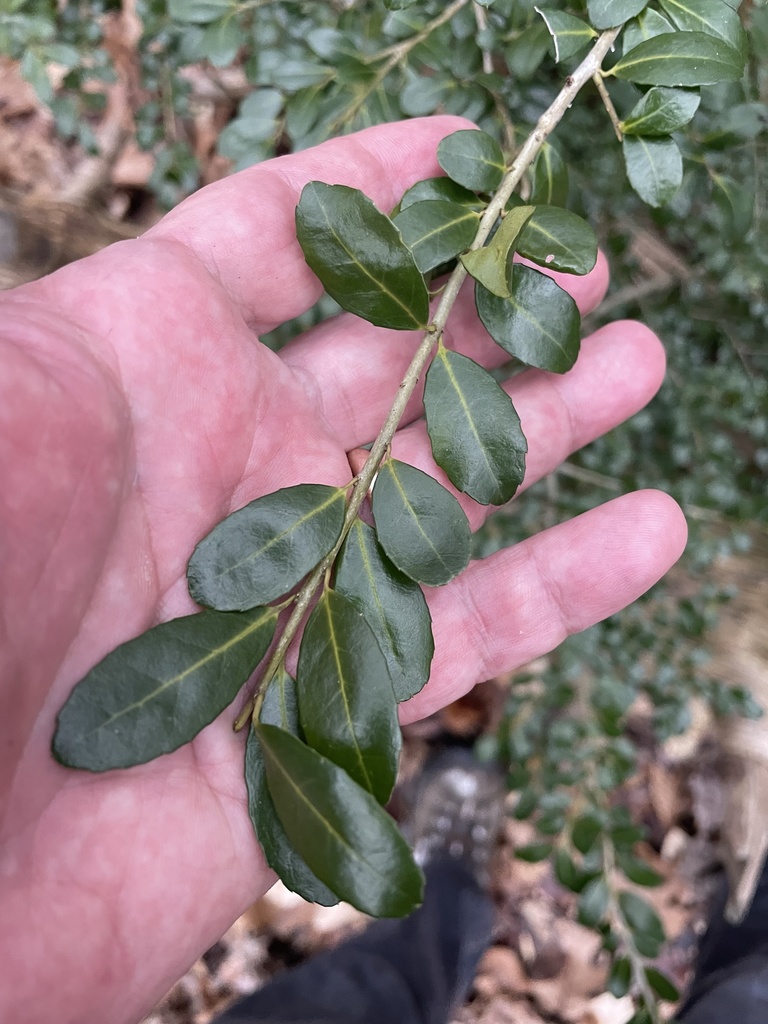
- Small, glossy, dark green leaves
- Tiny, inconspicuous white flowers
- Small black berry like fruits
- Dense, twiggy, upright growth habit
- Height
- 1.5 to 3m
- Spread
- 1 to 2m
- Leaves
- dark green, evergreen
- Flowers
- white, greenish, 0.5 to 0.8cm
- Fruit
- black, Autumn
Problems to watch for
- Black root rot · A fungal issue that causes wilting and death, often in poorly drained soil.
- Holly leaf miner · Small larvae create unsightly tunnels inside the leaves.
Check your japanese holly from a photo
Pocket Botanist looks at a photo of your plant and tells you what's wrong and what to try first.
Scan with your phone's camera to get the app
Or go to pocketbotanist.app/get on your phone
Growing it
- Propagation
- cuttings, seed
- When to plant
- spring, autumn
- Overwintering
- Apply a layer of mulch around the base to protect roots from temperature swings. Ensure the soil does not dry out completely during winter thaws.
- In containers
- It grows well in containers, provided the pot has excellent drainage and is at least 40 cm wide.
Semi-hardwood cuttings
- Take 10 cm cuttings in late summer.
- Remove lower leaves and dip the end in rooting hormone.
- Place in a moist, well draining potting mix.
- Cover with a plastic bag to maintain humidity until rooted.
Group with other acid loving plants to simplify soil management.
Grows well with
- Azalea · They share similar acidic soil requirements.
- Japanese Maple · The fine texture of the holly contrasts beautifully with maple foliage.
Similar species
- Boxwood · Often used for similar hedging purposes but has different leaf shapes.
Science
- Family
- Aquifoliaceae
- Genus
- Ilex
- Order
- Aquifoliales
- Class
- Magnoliopsida
- Native range
- East Asia, including Japan, Korea, and China.
- Conservation
- Not currently of conservation concern.
It grows in moist, well drained forests and thickets where it provides shelter for small birds.
- Value to wildlife
- nectar source, winter cover for birds
- Pollinators
- bees
- Uses
- hedging, topiary, foundation planting, container gardening
Through the year
Ecological indicators
- Salinity
- 2/9
- Soil reaction
- 4/9
- Light
- 6/9
- Temperature
- 5/9
- Moisture
- 6/9
- Nutrients
- 5/9
Taxonomy resolved against GBIF.
Questions people ask
- Does it need full sun?
- It prefers full sun to partial shade.
- How often should I prune it?
- Prune once or twice a year to maintain its shape.
Where the name comes from
Ilex is the ancient Latin name for holly, while crenata describes the scalloped leaf margins.
Good to know
- It is often used as a substitute for boxwood in landscapes.
- The species name crenata refers to the small, rounded teeth along the leaf edges.
- It is native to East Asia, including Japan and Korea.
Also in
Keep your japanese holly growing
This page is a general guide. Save your plant in Pocket Botanist and you get care reminders timed for this plant, plus a care history that shows what worked.
Scan with your phone's camera to get the app
Or go to pocketbotanist.app/get on your phone
This guide was generated with AI on and checked against GBIF taxonomy. It is general information, not horticultural or veterinary advice. Read about how we build these guides.