 Pocket Botanist
Guide botanique
Caroube.
Ceratonia siliqua
Prononciation seh-ruh-TOH-nee-uh sih-LIH-kwuh
Aussi appelée Carob, Carob Bean, Carob Tree Bean, Locust Bean, Locust Tree, St John's Bread, St. John's Bread, St. John's-bread



Le caroubier est une magnifique plante indigène méditerranéenne à feuilles persistantes, connue pour ses gousses comestibles et sucrées. Il est assez résistant et prospère dans les climats chauds et secs où il peut devenir un arbre d'ombrage substantiel. Vous aimerez son feuillage vert foncé et brillant ainsi que sa capacité à supporter la sécheresse une fois établi.
En un coup d'œil
- Niveau d'entretien
- Facile
- Type de plante
- Arbre à feuilles persistantes
- Lumière
- Plein soleil
- Lumière en intérieur
- Soleil direct
- Arrosage
- Tous les 14 à 30 jours
- Taille adulte
- 15 à 15 mètres
- Croissance
- Lente
- Rusticité
- USDA 9 à 11
- Floraison
- Late summer to early autumn
Entretien
Plantez cet arbre dans un sol bien drainé et assurez-lui beaucoup de soleil pour qu'il se sente bien. Surveillez le jaunissement des feuilles, qui peut indiquer un arrosage excessif ou un mauvais drainage. Il tolère très bien la sécheresse, alors laissez le sol sécher considérablement entre les arrosages.
- Arrosage
- Arrosez abondamment mais peu fréquemment, en laissant le sol sécher presque complètement entre les séances.
- Engrais
- Appliquez un engrais équilibré à libération lente une fois par an, au début du printemps.
- Taille
- Taille pendant la saison dormante pour enlever le bois mort et maintenir une forme désirable.
- Rempotage
- Rempotez uniquement les jeunes arbres lorsqu'ils sont à l'étroit dans leur pot, car ils préfèrent des conditions stables.
- Sol
- Loam sableux, rocheux ou bien drainé
- pH du sol
- Neutre à alcalin
- Température
- -5 à 45°C
- Humidité
- 20 à 50%
- Résistance à la sécheresse
- Élevée
- Durée de vie
- Long lived, often exceeding 100 years.
- Parfum
- Léger
- Résistance aux chevreuils et lapins
- Élevée
Signes qu'il faut rempoter
- Roots growing out of the drainage holes.
- Stunted growth despite proper care.
- Soil drying out too quickly.
Sécurité
- Humains
- The plant is non toxic, though the hard seeds pose a choking hazard.
- Enfants
- The hard, bean like seeds are a significant choking hazard for small children.
- Allergènes de contact
- None notable.
- Allergènes aéroportés
- The pollen can cause mild respiratory irritation in sensitive individuals during the flowering season.
- Comestibilité
- The pulp of the pods is edible, but the seeds are extremely hard and should not be consumed.
Comment l'identifier
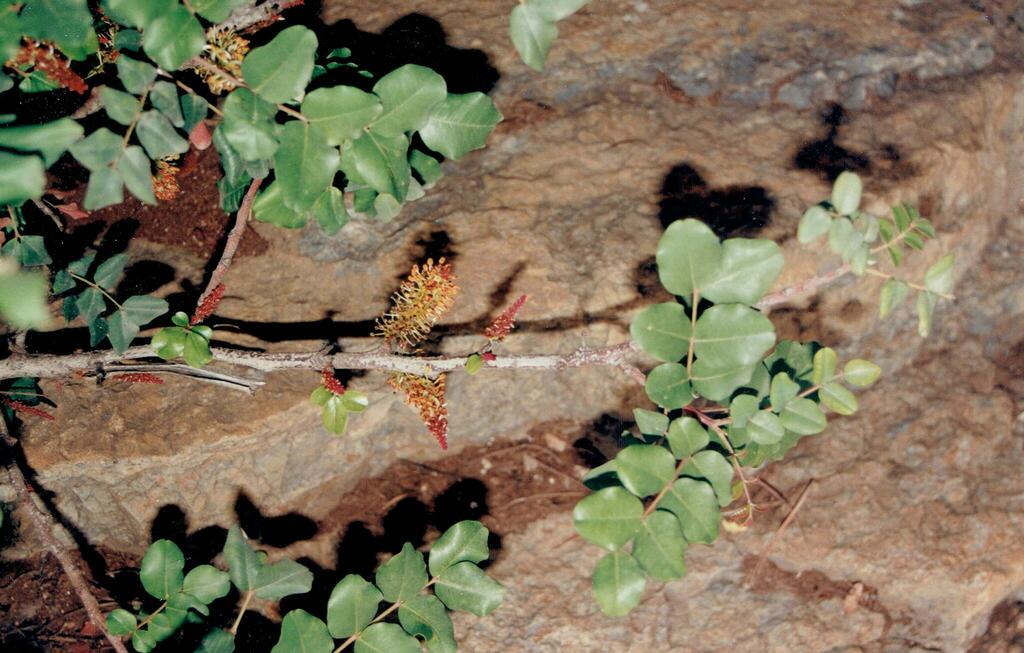
- Feuilles pennées vert foncé et brillantes
- Petites fleurs rougeâtres en grappes
- Grosses gousses de graines coriaces, brun foncé
- Canopée dense, arrondie, à croissance lente
- Hauteur
- 5 à 15m
- Envergure
- 4 à 10m
- Feuilles
- dark green, evergreen
- Fleurs
- red, yellow, 0,5 à 1cm
- Fruits
- brown, Autumn to winter
Problèmes courants
- Root rot — Occurs when the soil remains too wet for extended periods.
- Scale insects — Small sap sucking insects that can weaken the tree.
La cultiver
- Multiplication
- seed, cuttings, grafting
- Quand planter
- spring, autumn
- Hivernage
- Protect young trees from frost with a cover. Established trees are generally hardy but appreciate a layer of mulch to protect roots.
- En pot
- It grows well in large pots while young, but ensure the container has excellent drainage.
Seed
- 1. Scarify the hard seed coat with sandpaper.
- 2. Soak seeds in warm water for 24 hours.
- 3. Plant in well draining soil mix.
- 4. Keep warm until germination occurs.
Group this tree with other drought tolerant Mediterranean plants to simplify irrigation management.
Bonnes associations
- Lavande d'Angleterre — They share similar requirements for sun and well drained soil.
- Rosemary — This herb thrives in the same dry, Mediterranean conditions.
Espèces similaires
- Arbre aux haricots — Both produce long, bean like pods.
Science
- Famille
- Fabaceae
- Genre
- Ceratonia
- Ordre
- Fabales
- Classe
- Magnoliopsida
- Région d'origine
- Mediterranean basin and the Middle East.
- Préservation
- It is widely cultivated and not considered threatened in its native range.
It thrives in rocky, arid landscapes by developing a deep taproot to access groundwater.
- Intérêt pour la faune
- nectar source, provides shelter
- Pollinisateurs
- abeilles, coléoptères
- Utilisations
- ornamental shade tree, culinary flour substitute, livestock fodder
Au fil des saisons
Repères écologiques
- Salinité
- 4/9
- Réaction du sol
- 7/9
- Lumière
- 8/9
- Température
- 8/9
- Humidité
- 2/9
- Nutriments
- 3/9
Taxonomie vérifiée avec le GBIF.
Ce qu'on demande souvent
- Does carob need a lot of water?
- No, it is highly drought tolerant and prefers well drained soil.
- Can I grow carob in a container?
- It can be grown in a large container for several years but will eventually require planting in the ground.
D'où vient le nom
The name Ceratonia comes from the Greek word keration, meaning little horn, referring to the shape of the pods. Siliqua is Latin for pod.
Bon à savoir
- The term carat, used to measure gold and gemstones, comes from the Greek word for the carob seed, which was once thought to be uniform in weight.
- Carob trees are dioecious, meaning male and female flowers grow on separate trees.
- These trees are incredibly drought tolerant once established.
- Carob is often used as a caffeine free alternative to chocolate.
Aussi dans
Ta plante a mauvaise mine ?
Cette page est un guide général. Pocket Botanist diagnostique les problèmes directement à partir d'une photo de ta plante, adapte l'arrosage à sa luminosité et te prévient quand il faut t'en occuper.
Ce guide a été généré par IA et vérifié avec la taxonomie du GBIF. Il s'agit d'informations générales, et non de conseils horticoles ou vétérinaires. Découvre comment nous concevons ces guides.