 Pocket Botanist
Pflanzenratgeber
Winged Bean.
Psophocarpus tetragonolobus
Aussprache so-fo-KAR-pus tet-ra-go-no-LO-bus
Auch bekannt als Four-angled Bean, Goa Bean, Goa-bean, Winged Bean, asparagus-pea, four-angle-bean, princess-pea, winged-bean



The winged bean is a tropical legume known for its edible pods, leaves, and tubers. It thrives in warm, humid climates and grows as a vigorous climbing vine. You will love how productive this plant is in your garden.
Auf einen Blick
- Pflegestufe
- Mittel
- Pflanzenart
- Annual legume
- Licht
- Full sun
- Licht im Innenraum
- Direkte Sonne
- Gießen
- Alle 2 bis 4 Tage
- Endgröße
- 3 to 4 meters
- Wachstum
- Schnell
- Winterhärte
- USDA 9 bis 12
- Blütezeit
- Late summer to autumn
Pflege
Provide a sturdy trellis for this climber to scale as it grows quickly. Keep the soil consistently moist but not waterlogged to encourage pod production. Watch for yellowing leaves which can indicate poor drainage or nutrient deficiency.
- Gießen
- Keep the soil evenly moist throughout the growing season.
- Düngen
- Use a balanced fertilizer low in nitrogen to support flowering.
- Schneiden
- Trim back excessive foliage to improve airflow and focus energy on pod development.
- Umtopfen
- This plant is typically grown as an annual and does not require repotting.
- Boden
- Well draining loamy soil
- Boden-pH
- 6.0 to 7.0
- Temperatur
- 15 bis 35°C
- Luftfeuchtigkeit
- 60 bis 90%
- Trockenheitstoleranz
- Gering
- Lebensdauer
- Perennial, typically grown as an annual
- Duft
- Leicht
- Wildverbiss-Resistenz
- Mittel
Anzeichen fürs Umtopfen
- Roots growing out of the drainage holes.
- Water running straight through the pot without soaking in.
Sicherheit
- Menschen
- Raw consumption of the seeds or pods can cause digestive distress due to high levels of trypsin inhibitors.
- Kinder
- The seeds are small and hard, posing a potential choking hazard if left unattended.
- Kontaktallergene
- The foliage can cause mild skin irritation in sensitive individuals.
- Allergene in der Luft
- Pollen may trigger mild reactions in those with severe legume allergies.
- Essbarkeit
- Always cook the pods and seeds thoroughly to neutralize anti-nutritional factors before consumption.
So erkennst du die Pflanze
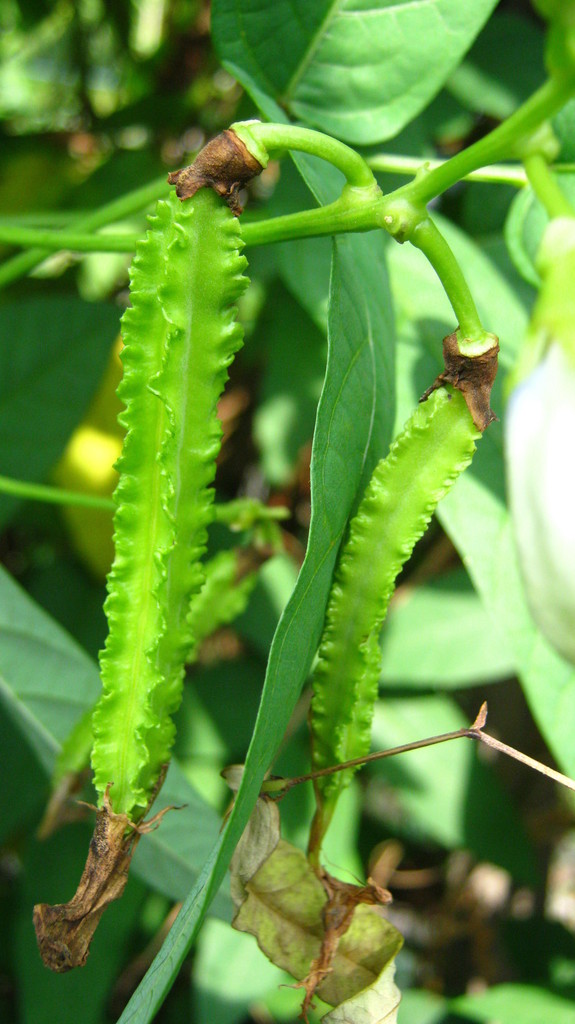
- Four distinct longitudinal wings on pods
- Compound leaves with three leaflets
- Bright blue or white pea flowers
- Vigorous climbing vine habit
- Höhe
- 3 bis 4m
- Breite
- 0,6 bis 1m
- Blätter
- green, deciduous
- Blüten
- blue, white, purple, 2 bis 4cm
- Früchte
- green, purple, Autumn
Häufige Probleme
- Powdery mildew — A white fungal growth appears on leaves during humid, stagnant conditions.
- Aphids — Small insects that cluster on new growth and suck plant sap.
Standort und Pflege
- Vermehrung
- seed
- Pflanzzeit
- Spring
- Überwinterung
- In frost-prone areas, treat it as an annual and harvest before the first freeze. In tropical zones, cut back dead vines to encourage new growth in spring.
- Im Kübel
- It can grow in large containers of at least 20 liters, provided you supply a tall trellis.
Seed Sowing
- 1. Soak seeds in water for 24 hours to soften the hard coat.
- 2. Plant seeds 2 cm deep in warm, well-draining soil.
- 3. Keep soil consistently moist until germination occurs.
Plant near tall crops to provide the necessary vertical space for the vines to spread.
Gute Pflanzpartner
Ähnliche Arten
- Gartenbohne — Both are nitrogen-fixing legumes used for their edible pods.
Botanisches
- Familie
- Fabaceae
- Gattung
- Psophocarpus
- Ordnung
- Fabales
- Klasse
- Magnoliopsida
- Ursprüngliche Heimat
- Tropical Asia and Papua New Guinea
- Artenschutz
- It is widely cultivated in tropical regions and is not considered threatened.
It is a perennial vine that acts as an annual in cooler climates, fixing nitrogen to thrive in nutrient-poor soils.
- Nutzen für Wildtiere
- nectar source
- Bestäuber
- Bienen, Schmetterlinge
- Verwendung
- culinary vegetable, nitrogen-fixing cover crop, ornamental vine
Im Jahresverlauf
Ökologische Zeigerwerte
- Salzgehalt
- 2/9
- Bodenreaktion
- 6/9
- Licht
- 8/9
- Temperatur
- 9/9
- Feuchtigkeit
- 7/9
- Nährstoffe
- 5/9
Taxonomie abgeglichen mit GBIF.
Häufige Fragen
- Do I need a trellis?
- Yes, this is a vigorous climber that requires strong support.
- Can I eat the leaves?
- Yes, they are often used like spinach in stir-fries.
Woher der Name kommt
The name Psophocarpus comes from Greek words meaning noisy fruit, referring to the sound the pods make when they dry and split.
Gut zu wissen
- The pods have four distinct wings running down their length.
- It is a nitrogen-fixing legume that improves soil health.
- The tubers are rich in protein compared to other root vegetables.
- It thrives in hot, humid climates where other beans struggle.
Probleme mit Winged Bean?
Diese Seite bietet allgemeine Infos. Pocket Botanist erkennt Probleme anhand eines Fotos deiner echten Pflanze, passt das Gießen an dein Licht und deinen Standort an und erinnert dich an die Pflege.
Dieser Ratgeber wurde mit KI erstellt und mit der GBIF-Taxonomie abgeglichen. Er dient zur allgemeinen Information und ersetzt keine gärtnerische oder tierärztliche Beratung. Hier erfährst du, wie wir diese Ratgeber erstellen.