 Pocket Botanist
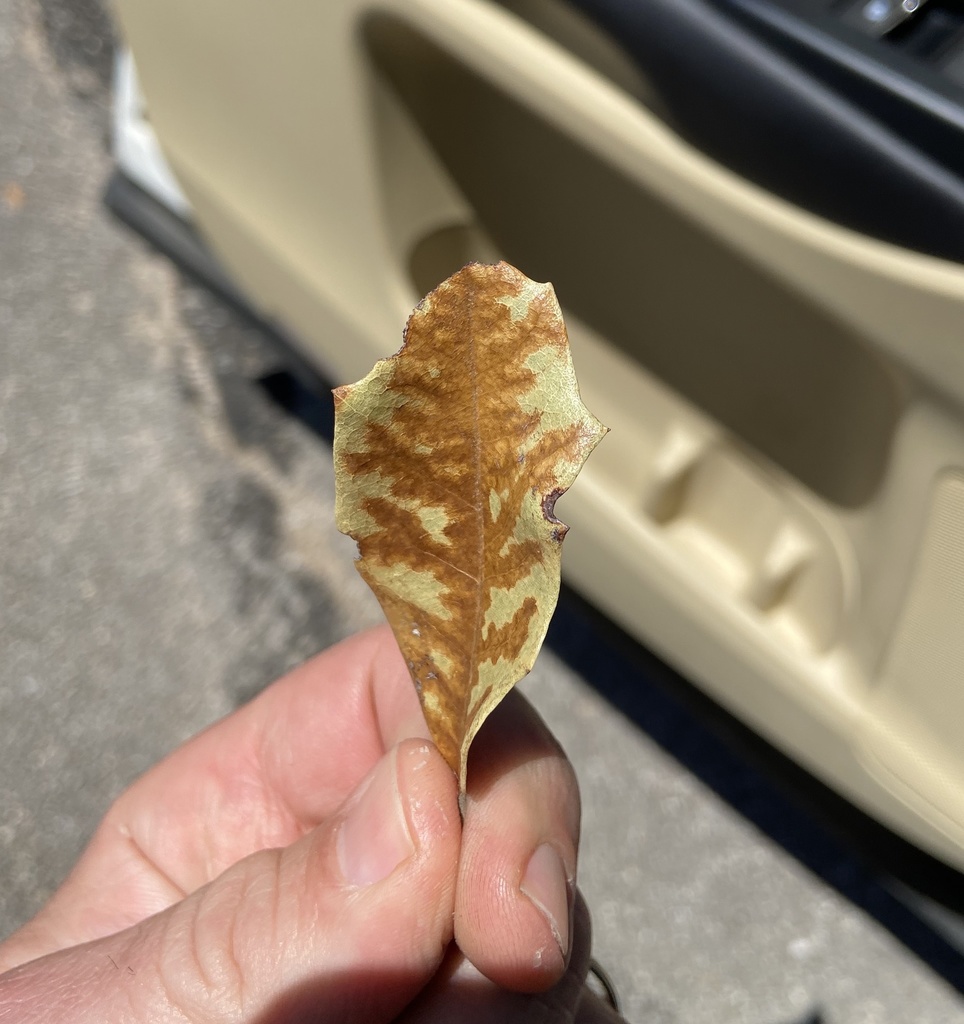
Symptoms by part
Leaves
Leaves on red oaks often show bronzing or browning starting at the margins and moving inward toward the midrib. White oaks typically show a slower progression of leaf wilting and browning that may be confined to individual branches.
Stems
Peeling back the bark on infected branches may reveal dark, water soaked streaks in the sapwood. In some cases, fungal mats form under the bark, creating a sweet, fruity odor and causing the bark to crack.
Causes
- Transmission by sap feeding beetles that carry fungal spores from infected trees to fresh wounds on healthy trees.
- Root grafting where the roots of an infected tree fuse with the roots of a nearby healthy tree, allowing the fungus to travel underground.
- Movement of infected firewood or logs into new areas.
Could be confused with
- Anthracnose · Anthracnose usually causes irregular brown spots or blotches along leaf veins rather than the uniform marginal browning seen in oak wilt.
- Drought stress · Drought stress typically causes leaves to curl and turn brown uniformly across the entire canopy rather than showing the specific pattern of marginal scorch.
- Two lined chestnut borer · This pest leaves D shaped exit holes in the bark and creates winding galleries under the bark that are not present with oak wilt.
Find out what's really wrong with your plant
Problems that look alike are easy to mix up. Pocket Botanist looks at a photo of your actual plant and tells you what's going on, how serious it is, and what to try first. Identification and a health check are free.



Scan with your phone's camera to get the app
Or go to pocketbotanist.app/get on your phone
Treatment
- Sever root connections between infected and healthy trees using a vibratory plow or trenching equipment to a depth of at least 4 feet.
- Remove and destroy infected trees immediately to prevent the formation of fungal mats.
- Dispose of wood from infected trees by burning or burying it, or by chipping it to a size of less than 3 inches to speed up drying.
Without chemicals
- Avoid pruning oak trees during the warm growing season when beetles are active.
- Paint any accidental wounds on oak trees immediately with a non toxic tree wound paint or latex paint to deter beetles.
- Consult a certified tree surgeon to perform trenching or to safely remove large infected trees.
Chemical options
- Tebuconazole, injected into the root flare of high value trees by a professional as a preventative measure, follow the label.
Preventing it
- Never move firewood from areas where oak wilt is known to occur.
- Prune oak trees only during the coldest months of the year when beetles are dormant.
- Dig a trench to cut root connections between infected areas and the healthy oaks in the rest of your landscape.
Season
The warm growing season, particularly when trees are actively growing and sap feeding beetles are most active.
Spread risk
High
Severity
High
When to act
Act immediately upon seeing symptoms of wilting or leaf discoloration to prevent the disease from spreading to nearby trees. If a tree is confirmed to have oak wilt, it should be removed by a tree surgeon as soon as possible.
Keep your plants healthy from here
Save your plants in Pocket Botanist and you get care reminders timed for each one, plus a care history that shows what worked. Identification and a health check are free.
Questions people ask
- Can my oak tree recover from oak wilt?
- Red oaks almost never recover and usually die within a few weeks to a few months. White oaks may survive longer but often remain chronically infected and continue to spread the fungus.
- Is it safe to plant new trees where an oak died from wilt?
- Yes, but avoid planting susceptible oak species in the same spot. Choose resistant species or different types of trees entirely.
- How far underground does the fungus travel?
- The fungus moves through root grafts, which can occur between trees up to 100 feet apart depending on the species and soil conditions.
Plants it affects
Answers plant by plant
This guide was generated with AI on and is general information, not horticultural advice. Read about how we build these guides.