 Pocket Botanist

Check these first
- Check if the white coating wipes off easily with your finger.
- Inspect the center of the shrub for dense, tangled branches.
- Look at the underside of the leaves for signs of insects.
Likely causes
Powdery Mildew
Most likelyHow to tell: You will see a white, floury substance covering the leaves and sometimes the stems. It usually starts in mid to late summer.
What to do: Prune out crowded branches to improve air circulation. If the infection is heavy, apply a fungicide labeled for powdery mildew or a mix of one tablespoon of baking soda in a gallon of water.
Cercospora Leaf Spot
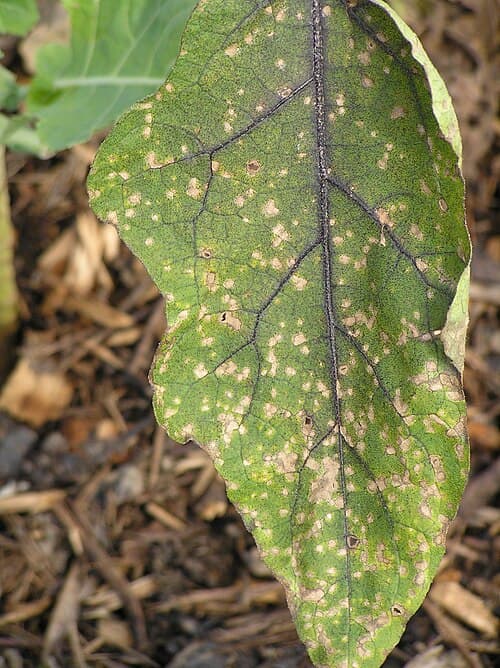
PossibleHow to tell: These appear as small, brown or gray spots with dark borders on the leaves. They often cause the leaf to yellow and drop prematurely.
What to do: Rake up and destroy all fallen leaves in the autumn to stop the fungus from overwintering. Keep the foliage dry by watering only at the base of the plant.
Find out what's wrong with your lilac
The list above covers the usual causes. Pocket Botanist looks at a photo of your actual plant and tells you the likely cause, how serious it is, and what to try first. Identification and a health check are free.



Scan with your phone's camera to get the app
Or go to pocketbotanist.app/get on your phone
When to worry
Powdery mildew is rarely fatal, but it looks unsightly. Worry if the leaves start turning brown and dropping early in the season.
Stopping it coming back
Plant your lilacs in full sun with plenty of space between them to ensure good airflow.
Lilac: spots? Check yours with a photo
Every plant is a little different. Take a photo of your lilac and Pocket Botanist tells you which cause is most likely, how serious it is, and what to try first. A few checks a day are free. Save the plant and you get care reminders timed for it.
Scan with your phone's camera to get the app
Or go to pocketbotanist.app/get on your phone
Get the app · Or check it from a photo now, free
Questions people ask
- Will powdery mildew kill my lilac?
- Usually no. It is mostly a cosmetic issue that stresses the plant but rarely causes permanent damage.
- Should I cut off all the spotted leaves?
- You can remove heavily infected leaves to slow the spread, but do not strip the entire plant as it needs leaves to make energy.
Guides to these causes
More problems with Lilac
- Why is my common lilac not producing any flowers?
- Why are there bugs on my Syringa vulgaris?
- Why is my lilac growing so leggy?
- Why are the branches on my common lilac drooping?
- Why are my lilac's leaves turning yellow?
- Why are my lilac's leaf tips turning brown?
- Why is my lilac dropping its leaves?
- Why is my lilac showing signs of root rot?
- Why are my lilac leaves curling?
This article was generated with AI on from the plant’s care profile and is general information, not horticultural advice. Read about how we build these guides.