 Pocket Botanist
Plant guide
Branched bur-reed.
Sparganium erectum
Pronounced spar-GAY-nee-um ee-REK-tum
Also known as Branched Bur-Reed, Simple-stem burr-reed, Simplestem bur-reed



Scan with your phone's camera to get the app
Or go to pocketbotanist.app/get on your phone
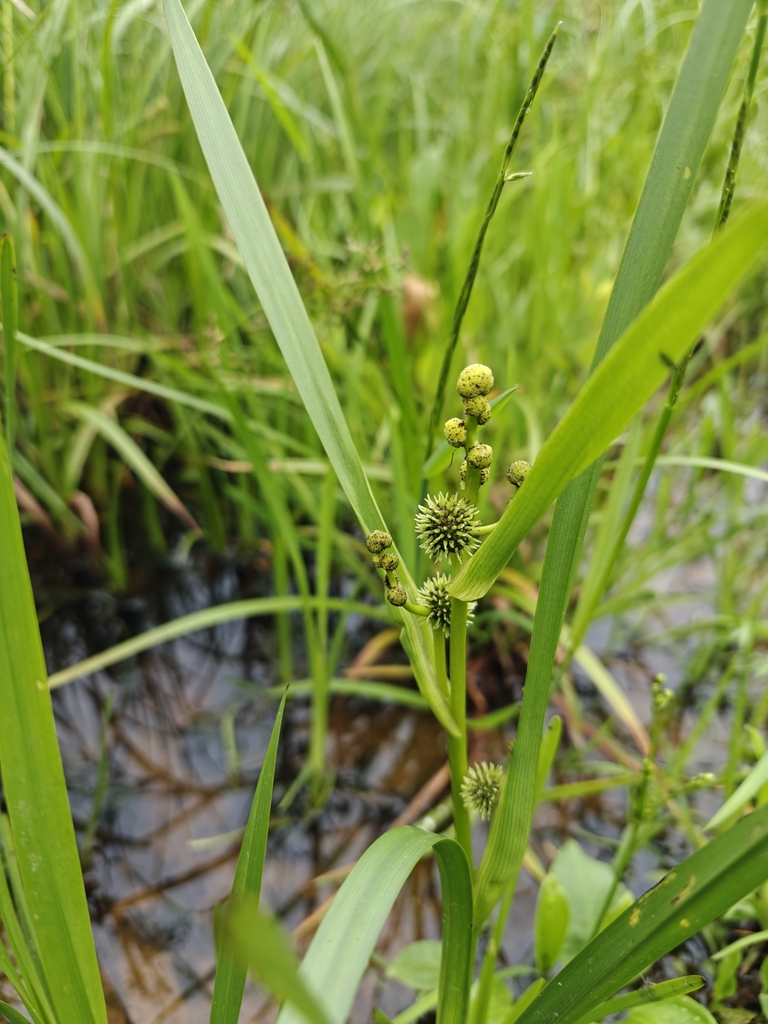
The branched bur-reed is a hardy aquatic perennial that thrives in shallow water or damp soil. It is a great choice for naturalizing along pond edges or in bog gardens. You will love how its unique, spiky fruit heads add texture to your water feature.
At a glance
- Care level
- Easy
- Plant type
- Aquatic perennial
- Light
- Full sun to partial shade
- Indoor light
- Direct sun
- Water
- Every day
- Mature size
- 3 to 4 feet
- Growth rate
- Fast
- Hardiness
- USDA 3 to 9
- Bloom time
- Mid to late summer
Care
Keep the soil consistently saturated or submerged in shallow water to mimic its natural wetland habitat. Watch for yellowing leaves, which often indicate the plant is drying out too much. You can trim back dead foliage in late autumn to keep the area tidy.
- Watering
- The soil must remain constantly wet or submerged.
- Feeding
- Use an aquatic plant fertilizer tablet during the active growing season.
- Pruning
- Cut back spent foliage once the plant goes dormant in late fall.
- Repotting
- Divide the rhizomes every couple of years if the container becomes overcrowded.
- Soil
- Heavy, nutrient-rich aquatic soil
- Soil pH
- 6.0 to 7.5
- Temperature
- -30 to 30°C
- Humidity
- 60 to 100%
Safety
- People
- There are no significant reports of toxicity in humans, but it is not typically consumed.
- Children
- The sharp leaf edges and water-based habitat pose minor safety risks for small children.
- Contact allergens
- The leaves have sharp edges that can cause minor skin abrasions if handled without gloves.
- Airborne allergens
- The pollen may cause mild reactions in sensitive individuals during the flowering season.
- Edibility
- While the tubers were historically eaten by some indigenous groups, they require careful preparation and are not considered a common food source today.
How to identify it
- Stiff, sword-shaped leaves
- Distinctive spherical, spiky fruit heads
- Tall, erect flowering stems
- Rhizomatous growth habit
- Height
- 0.6 to 1.5m
- Spread
- 0.3 to 1m
- Leaves
- green, deciduous
- Flowers
- green, white, 1 to 3cm
- Fruit
- brown, Autumn
Problems to watch for
- Aphids · Small insects that may cluster on the flower stalks during warm weather.
Check your branched bur-reed from a photo
Pocket Botanist looks at a photo of your plant and tells you what's wrong and what to try first.
Scan with your phone's camera to get the app
Or go to pocketbotanist.app/get on your phone
Growing it
- Propagation
- division, seed
- When to plant
- spring, summer
Group these with other marginal aquatic plants to create a naturalistic filter zone for your pond.
Grows well with
- Yellow Flag Iris · They share similar moisture requirements and create a nice structural contrast.
- Marsh Marigold · This plant blooms earlier in the season, providing color before the bur-reed matures.
Similar species
- Small Bur-reed · It is a much smaller, less aggressive relative that works better in tiny water features.
Science
- Family
- Typhaceae
- Genus
- Sparganium
- Order
- Poales
- Class
- Liliopsida
- Native range
- Europe, Asia, and parts of North Africa.
- Conservation
- It is widespread and not currently of conservation concern.
It thrives in shallow water and muddy margins where its roots can access constant moisture.
- Value to wildlife
- seeds eaten by waterfowl, provides nesting material, cover for aquatic life
- Pollinators
- bees, beetles
- Uses
- pond edge planting, wetland restoration, wildlife gardens
Through the year
Ecological indicators
- Salinity
- 1/9
- Soil reaction
- 6/9
- Light
- 7/9
- Temperature
- 5/9
- Moisture
- 9/9
- Nutrients
- 6/9
Taxonomy resolved against GBIF.
Questions people ask
- Can I grow this in a standard garden bed?
- No, it requires consistently wet soil or shallow standing water to thrive.
- How do I control its spread?
- You can plant it in submerged containers to prevent the rhizomes from taking over your entire pond.
Where the name comes from
The name erectum refers to the plant's upright growth habit compared to other species in the genus.
Good to know
- The plant spreads via underground rhizomes to form dense colonies.
- It is a classic indicator of healthy, nutrient-rich wetland environments.
- The name Sparganium comes from the Greek word for a swaddling band, referring to the leaf shape.
Keep your branched bur-reed growing
This page is a general guide. Save your plant in Pocket Botanist and you get care reminders timed for this plant, plus a care history that shows what worked.
Scan with your phone's camera to get the app
Or go to pocketbotanist.app/get on your phone
This guide was generated with AI on and checked against GBIF taxonomy. It is general information, not horticultural or veterinary advice. Read about how we build these guides.