 Pocket Botanist
Plant guide
Trout Lily.
Erythronium americanum
Pronounced eh-rih-THROH-nee-um uh-MEH-rih-kah-num
Also known as Amberbell, American trout lily, Dogtooth Violet, Trout-lily, Yellow Adder's-tongue, trout lily, yellow dog's-tooth violet, yellow dogtooth violet



Scan with your phone's camera to get the app
Or go to pocketbotanist.app/get on your phone
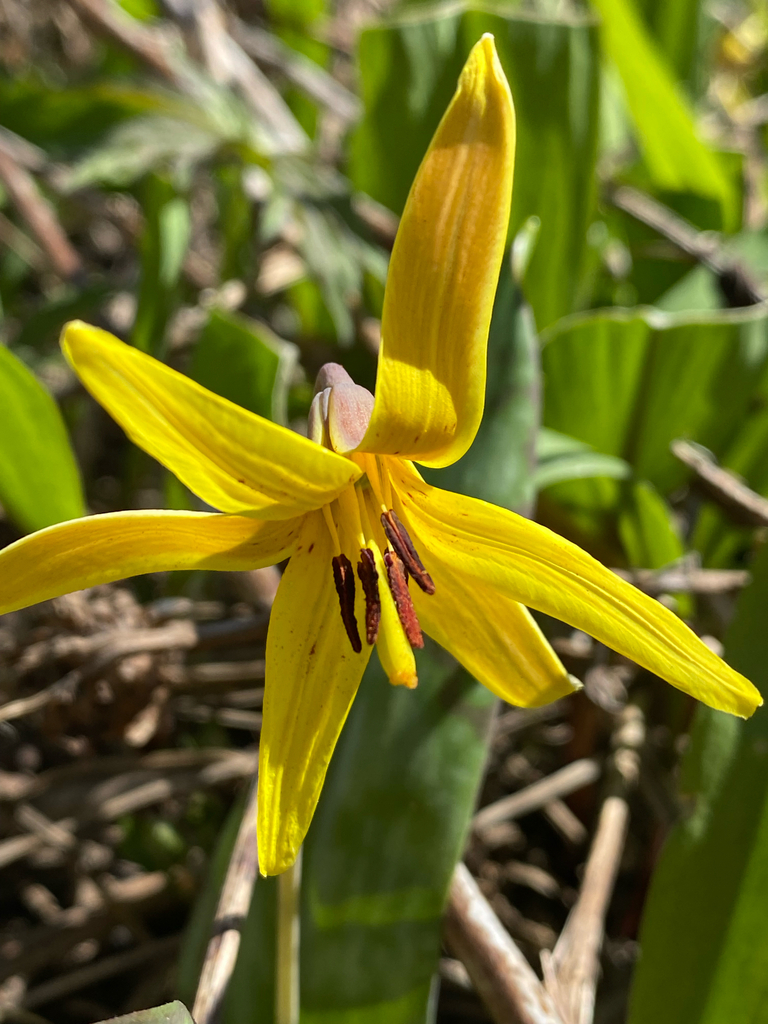
The Trout Lily is a charming spring ephemeral that carpets woodland floors with nodding, yellow flowers. It gets its name from the mottled, trout like patterns on its leaves. These plants go dormant by early summer, so you will only see them for a short window each year.

At a glance
- Care level
- Moderate
- Plant type
- Herbaceous perennial
- Light
- Partial shade
- Indoor light
- Bright indirect
- Water
- Every 3 to 7 days
- Mature size
- 15 cm tall
- Growth rate
- Slow
- Hardiness
- USDA 3 to 8
- Bloom time
- Early to mid spring
Care
Plant these in rich, moist soil where they can enjoy dappled sunlight before the forest canopy fills in. Watch for signs of dehydration if the spring is unusually dry, as they prefer consistent moisture. Once the foliage yellows and dies back in late spring, stop watering and let the bulbs rest.
- Watering
- Keep the soil consistently moist during the active growing season.
- Feeding
- Apply a light layer of compost in autumn to provide nutrients for the following spring.
- Pruning
- Simply remove any dead foliage once it has completely yellowed and withered in late spring.
- Repotting
- Divide clumps during dormancy if they become too crowded.
- Soil
- Humus rich, moist, well draining
- Soil pH
- Acidic to neutral
- Temperature
- -30 to 25°C
- Humidity
- 40 to 70%
- Drought tolerance
- Low
- Lifespan
- Perennial, long lived in ideal conditions
- Fragrance
- Light
- Deer and rabbits
- Low
Signs it needs repotting
- Bulbs pushing out of the soil
- Crowded growth reducing flower production
Safety
- People
- The plant is generally considered non toxic, but raw bulbs can cause mild stomach upset.
- Children
- The small bulbs could pose a choking hazard if dug up and handled by small children.
- Contact allergens
- There are no known skin irritants associated with this plant.
- Airborne allergens
- The pollen is not considered a significant airborne allergen.
- Edibility
- The bulbs and leaves are edible but should be harvested sparingly to avoid killing the slow growing colony.
How to identify it
- Yellow, lily like nodding flowers
- Mottled brown and green leaves
- Basal leaves in pairs
- Six pointed, recurved petals
- Emerges early in spring
- Height
- 0.1 to 0.2m
- Spread
- 0.1 to 0.15m
- Leaves
- green, bronze, mottled, deciduous
- Flowers
- yellow, 3 to 5cm
- Fruit
- tan, Late spring
Problems to watch for
- Bulb RotCommon
- Slugs and SnailsCommon
- RodentsUncommon
- Root RotUncommon
Check your trout lily from a photo
Pocket Botanist looks at a photo of your plant and tells you what's wrong and what to try first.
Scan with your phone's camera to get the app
Or go to pocketbotanist.app/get on your phone
Growing it
- Propagation
- division, seed
- When to plant
- fall
- Overwintering
- The bulbs are hardy and require no protection, but a layer of leaf mulch helps maintain consistent soil moisture.
- In containers
- They are not well suited for containers as they require specific woodland soil conditions and deep dormancy.
Division
- 1. Wait until the foliage has yellowed in late spring.
- 2. Carefully dig up the bulb cluster.
- 3. Gently separate the offsets from the main bulb.
- 4. Replant immediately at the same depth.
Plant them in large drifts under deciduous trees to mimic their natural forest floor habitat.
Grows well with
Similar species
- White Trout Lily · It is a very similar species but features white flowers.
Science
- Family
- Liliaceae
- Genus
- Erythronium
- Order
- Liliales
- Class
- Liliopsida
- Native range
- Eastern North America
- Conservation
- This species is common in its native range and is not currently listed as endangered.
It survives by storing energy in deep bulbs to fuel rapid spring growth before trees shade the forest floor.
- Value to wildlife
- early season nectar source
- Pollinators
- bees
- Uses
- woodland garden, naturalizing, edible bulb
Through the year
Ecological indicators
- Salinity
- 1/9
- Soil reaction
- 5/9
- Light
- 3/9
- Temperature
- 4/9
- Moisture
- 6/9
- Nutrients
- 5/9
Taxonomy resolved against GBIF.
Questions people ask
- Why did my plants disappear in summer?
- They are spring ephemerals and go dormant once the weather warms up.
- Can I grow these in a lawn?
- They thrive in woodland settings but struggle in frequently mowed grass.
Where the name comes from
The genus name comes from the Greek word for red, though this species has yellow flowers. The species name refers to its North American origin.
Good to know
- The leaves often feature beautiful mottled brown or purple markings.
- It is also known as the yellow adder's tongue due to the shape of its leaves.
- Colonies can take many years to reach flowering size from seed.
- The flowers close up tightly during cloudy or rainy weather.
Also in
Keep your trout lily growing
This page is a general guide. Save your plant in Pocket Botanist and you get care reminders timed for this plant, plus a care history that shows what worked.
Scan with your phone's camera to get the app
Or go to pocketbotanist.app/get on your phone
This guide was generated with AI on and checked against GBIF taxonomy. It is general information, not horticultural or veterinary advice. Read about how we build these guides.