 Pocket Botanist
Plant guide
Silverberry.
Elaeagnus commutata
Pronounced el-ee-AG-nus kom-yoo-TAY-tuh
Also known as silverberry, wolf-willow, American silverberry, silver elaeagnus, wolfberry


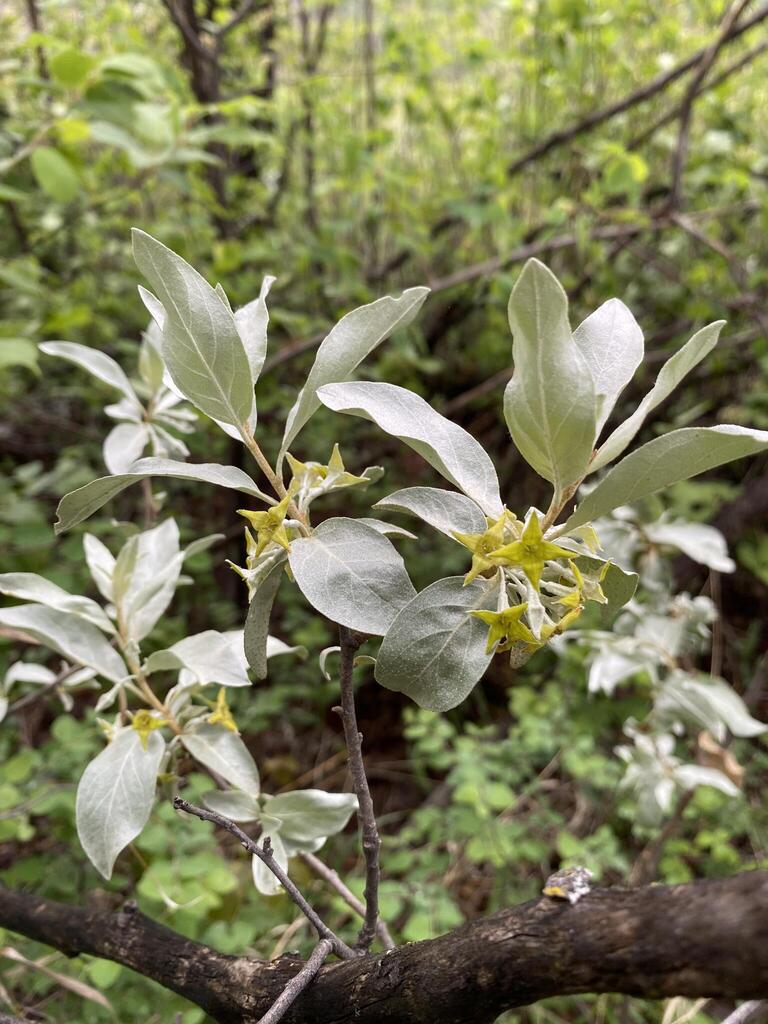
Silverberry is a hardy deciduous shrub known for its striking silvery foliage and fragrant yellow flowers. It thrives in tough conditions and is often used for erosion control or as a windbreak. Its unique metallic appearance makes it a standout choice for naturalistic landscapes.
At a glance
- Care level
- Easy
- Plant type
- Deciduous shrub
- Light
- Full sun to partial shade
- Indoor light
- direct
- Water
- Every 7 to 14 days
- Mature size
- 3 to 4 meters
- Growth rate
- medium
- Hardiness
- USDA 2 to 6
- Bloom time
- Late spring to early summer
Care
This shrub is very low maintenance once established in your garden. Watch for excessive suckering if you want to keep it contained to a specific area. Ensure it has plenty of space to spread as it naturally forms thickets.
- Watering
- Water regularly during the first year until the root system is established.
- Feeding
- Apply a balanced fertilizer in early spring if growth seems sluggish.
- Pruning
- Prune in late winter to remove dead wood or control the spread of suckers.
- Repotting
- Repot only if container grown and the plant becomes root bound.
- Soil
- Well-draining sandy or rocky soil
- Soil pH
- Neutral to slightly alkaline
- Temperature
- -40 to 30°C
- Humidity
- 20 to 60%
- Drought tolerance
- high
- Lifespan
- Perennial, typically 20 to 50 years.
- Fragrance
- strong
- Deer and rabbits
- high
Signs it needs repotting
- Roots growing out of the drainage holes.
- Water running straight through the pot without soaking in.
- Stunted growth despite adequate light.
Safety
- People
- There are no reports of this plant being toxic to humans.
- Children
- The small, dry fruits could pose a minor choking hazard if ingested in large quantities by small children.
- Contact allergens
- The silvery scales on the leaves and stems can occasionally cause mild skin irritation in sensitive individuals.
- Airborne allergens
- The pollen produced by the flowers may cause mild seasonal allergy symptoms for some people.
- Edibility
- While the fruits are technically edible, they are often dry, mealy, and astringent, making them unpalatable for most people.
How to identify it
- Silvery metallic scales on leaves
- Fragrant small yellow bell flowers
- Oval leaves with wavy margins
- Silvery brown scaly fruit
- Suckering habit forming thickets
- Height
- 1 to 4m
- Spread
- 1 to 3m
- Leaves
- silver, grey-green, deciduous
- Flowers
- yellow, 0.5 to 1cm
- Fruit
- silver, brown, Late summer to autumn
Common problems
- Rust — Fungal infections can cause orange or brown spots on the leaves during humid weather.
- Aphids — Small insects may cluster on new growth and suck sap from the plant.
Growing it
- Propagation
- seed, cuttings, division
- When to plant
- spring, autumn
- Overwintering
- This plant is extremely cold hardy and requires no special protection during the winter months. Simply leave the foliage to drop naturally in autumn.
- In containers
- It is not well suited for containers due to its extensive root system and tendency to spread by suckers.
Softwood Cuttings
- Take 4 to 6 inch cuttings in early summer.
- Remove the lower leaves and dip the base in rooting hormone.
- Place in a well draining potting mix and keep moist until roots form.
Sucker Division
- Identify a healthy sucker growing away from the main plant in spring.
- Carefully dig down to find the connection to the parent root.
- Sever the root and transplant the sucker to a new location.
Plant this shrub on the edge of a garden bed to act as a natural windbreak for more delicate perennials.
Grows well with
- Common Juniper — They share similar drought tolerance and thrive in the same sunny, open conditions.
- Quaking Aspen — This tree provides a nice vertical contrast to the shrubby, spreading habit of the silverberry.
Similar species
- Russian Olive — It looks very similar but is considered highly invasive in many regions.
- Autumn Olive — Another relative that is often confused with silverberry but has different fruit ripening times.
Science
- Family
- Elaeagnaceae
- Genus
- Elaeagnus
- Order
- Rosales
- Class
- Magnoliopsida
- Native range
- It is native to much of North America, ranging from Alaska across Canada and down into the northern United States.
- Conservation
- It is not currently listed as endangered or threatened and is considered common throughout its native range.
This shrub thrives in open, sunny areas and is often one of the first plants to colonize disturbed or nutrient poor sites.
- Value to wildlife
- nectar source, provides cover for birds, fruit for songbirds
- Pollinators
- bees, butterflies
- Uses
- ornamental shrub, erosion control, windbreak, wildlife habitat
Through the year
Ecological indicators
- Salinity
- 4/9
- Soil reaction
- 6/9
- Light
- 8/9
- Temperature
- 4/9
- Moisture
- 3/9
- Nutrients
- 2/9
Taxonomy resolved against GBIF.
Questions people ask
- Is it invasive?
- It can be aggressive in some areas due to its suckering habit, so give it plenty of space.
- Does it need fertilizer?
- No, it fixes its own nitrogen and actually prefers leaner soils.
Where the name comes from
The genus name Elaeagnus comes from Greek words meaning olive and chaste tree, while the species name commutata refers to its variable or changing appearance.
Good to know
- It is also known as silverberry due to the metallic sheen on its foliage.
- The plant is highly adaptable to poor, sandy, or rocky soils.
- It spreads via underground runners and can form dense thickets over time.
- The flowers are small but pack a surprisingly strong, sweet fragrance.
Is your silverberry looking unwell?
This page is a general guide. Pocket Botanist diagnoses problems from a photo of your actual plant, works out watering for your light and conditions, and reminds you when care is due.
This guide was generated with AI and checked against GBIF taxonomy. It is general information, not horticultural or veterinary advice. Read about how we build these guides.