 Pocket Botanist
Plant guide
Striped wintergreen.
Chimaphila maculata
Pronounced ky-MAF-ih-luh mak-yoo-LAY-tuh
Also known as Spotted Pipsissewa, Spotted-wintergreen, Striped Prince's Pine, Striped pipsissewa, mottled pipsissewa, pipsissewa, rat's bane, spotted wintergreen


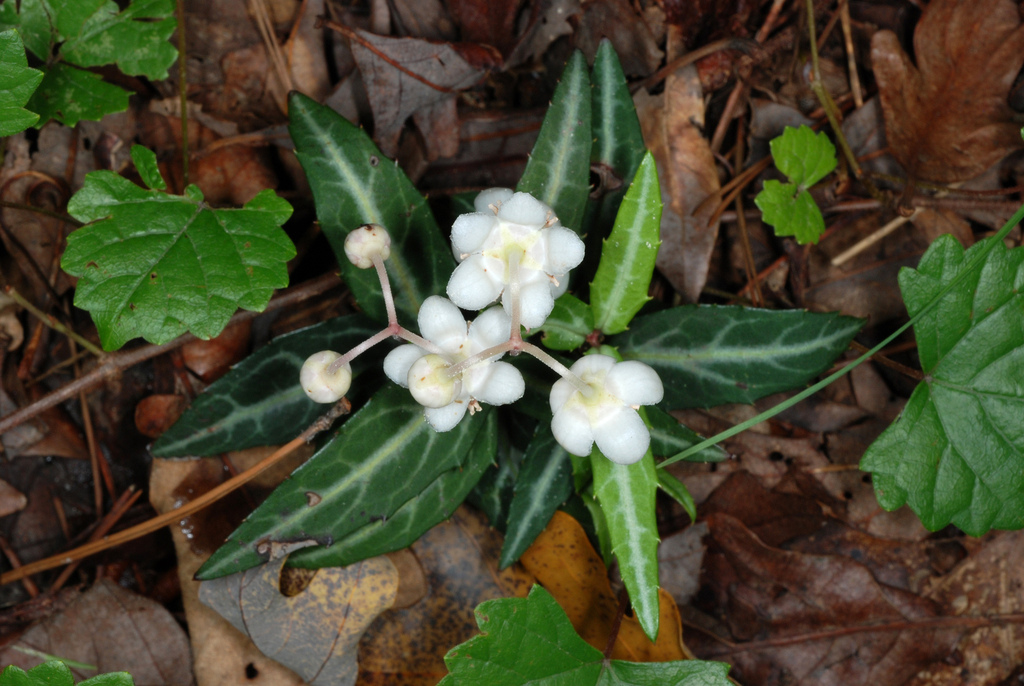
Striped wintergreen is a charming woodland perennial that stays green all year round. It thrives in the dappled shade of forest floors where the soil is rich and acidic. You will often find it growing in small colonies among pine needles.

At a glance
- Care level
- Difficult
- Plant type
- Perennial
- Light
- Partial shade to full shade
- Indoor light
- Medium light
- Water
- Every 5 to 10 days
- Mature size
- 10 inches
- Growth rate
- Slow
- Hardiness
- USDA 4 to 8
- Bloom time
- Early to mid summer
Care
This plant is quite picky and prefers to stay in its natural woodland environment. Keep the soil consistently moist but never soggy to mimic forest conditions. Watch for yellowing leaves which often signal that the soil is too dry or lacks proper acidity.
- Watering
- Keep the soil evenly moist but ensure it never sits in standing water.
- Feeding
- Use a light application of acid loving plant fertilizer during the growing season.
- Pruning
- Only remove dead or damaged foliage in early spring.
- Repotting
- This plant prefers not to be disturbed and grows best when left alone in a stable environment.
- Soil
- Acidic, sandy, well draining loam
- Soil pH
- 4.5 to 6.0
- Temperature
- -30 to 30°C
- Humidity
- 50 to 80%
- Drought tolerance
- Low
- Lifespan
- Perennial, typically long lived in stable conditions.
- Fragrance
- Light
- Deer and rabbits
- Moderate
Signs it needs repotting
- Roots circling the bottom of the pot
- Stunted growth during the active season
Safety
- People
- The plant contains compounds that can be irritating if ingested in quantity.
- Children
- Keep this plant away from small children as ingestion of any part may cause discomfort.
- Contact allergens
- The foliage may cause mild skin irritation in sensitive individuals.
- Airborne allergens
- There are no notable airborne allergy risks associated with this plant.
- Edibility
- This plant is not intended for consumption and may cause digestive upset.
How to identify it
- Dark green leaves with white veins
- Lance shaped leaves with serrated edges
- Nodding white or pinkish flowers
- Low growing evergreen habit
- Height
- 0.1 to 0.25m
- Spread
- 0.15 to 0.3m
- Leaves
- dark green, white, evergreen
- Flowers
- white, pink, 1 to 2cm
- Fruit
- brown, Autumn
Common problems
- Root rot — Occurs when the soil remains too wet for extended periods.
Growing it
- Propagation
- division, rhizome cuttings
- When to plant
- spring, autumn
- Overwintering
- Leave the foliage intact as it remains green through winter. Ensure the soil does not dry out completely during mild spells.
- In containers
- It is very difficult to maintain in containers due to its specific fungal requirements.
Rhizome Division
- 1. Carefully dig around the colony in early spring.
- 2. Gently tease apart the rhizomes while keeping soil attached.
- 3. Replant immediately in a similar woodland environment.
Always plant this species in groups with other acid loving woodland plants to maintain soil health.
Grows well with
- Partridgeberry — They share similar light and moisture requirements in woodland settings.
- Christmas Fern — This fern provides the perfect structural contrast and shade.
Similar species
- Pipsissewa — It is a close relative with similar growth habits but lacks the white leaf markings.
Science
- Family
- Ericaceae
- Genus
- Chimaphila
- Order
- Ericales
- Class
- Magnoliopsida
- Native range
- Eastern North America
- Conservation
- It is considered a species of concern in some parts of its range due to habitat loss.
It grows in acidic, well drained forest soils where it forms small colonies via underground rhizomes.
- Value to wildlife
- nectar source
- Pollinators
- bees
- Uses
- woodland garden, native plant restoration, ground cover
Through the year
Ecological indicators
- Salinity
- 0/9
- Soil reaction
- 3/9
- Light
- 2/9
- Temperature
- 4/9
- Moisture
- 4/9
- Nutrients
- 2/9
Taxonomy resolved against GBIF.
Questions people ask
- Can I grow this in a sunny border?
- No, it requires the dappled shade of a woodland setting to survive.
- Why is it hard to transplant?
- It has a symbiotic relationship with soil fungi that is easily disrupted.
Where the name comes from
The genus name comes from the Greek words for winter and loving, referring to its evergreen nature. The species name maculata means spotted or marked, describing the leaf pattern.
Good to know
- It is a member of the heath family.
- The leaves feature a distinct white stripe along the midrib.
- It relies on specific soil fungi to thrive in the wild.
- The flowers are nodding and quite fragrant.
Also in
Is your striped wintergreen looking unwell?
This page is a general guide. Pocket Botanist diagnoses problems from a photo of your actual plant, works out watering for your light and conditions, and reminds you when care is due.
This guide was generated with AI and checked against GBIF taxonomy. It is general information, not horticultural or veterinary advice. Read about how we build these guides.