 Pocket Botanist
Plant guide
Coast Banksia.
Banksia integrifolia
Pronounced BANK-see-uh in-teg-ri-FOH-lee-uh
Also known as White-honeysuckle, coast banksia, honeysuckle-oak, white banksia, white bottlebrush



Scan with your phone's camera to get the app
Or go to pocketbotanist.app/get on your phone
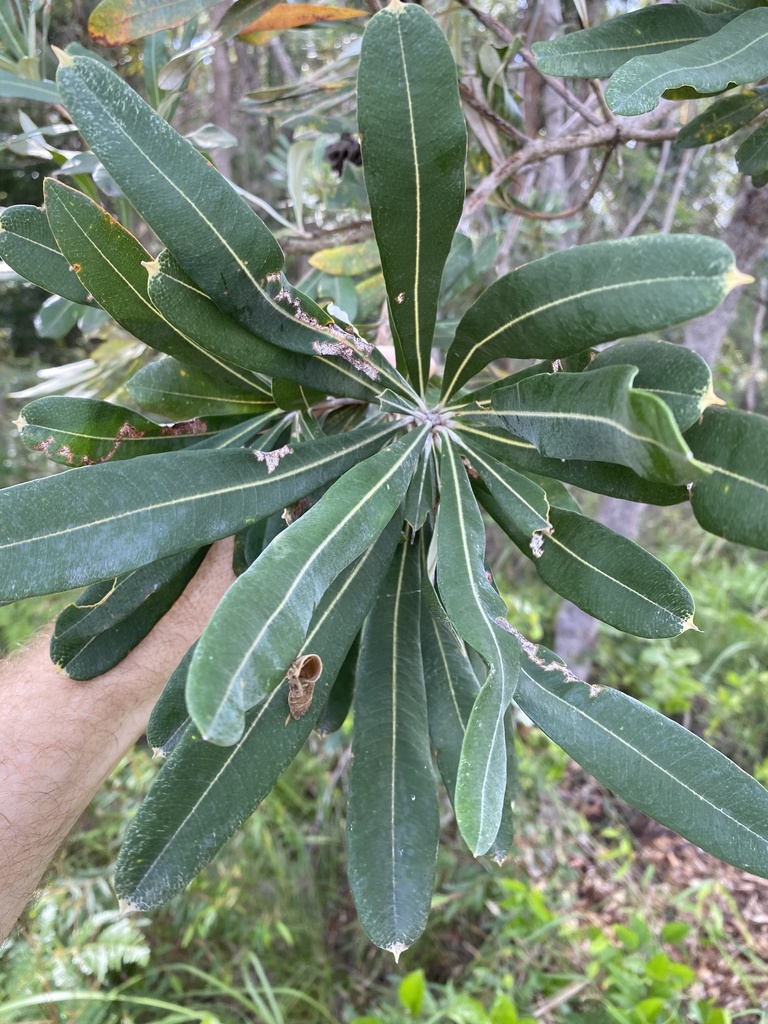
The Coast Banksia is a hardy, iconic Australian tree that handles salt spray and coastal winds with ease. It features lovely yellow flowers that provide a great food source for local birds. You will find it is a fantastic choice for adding a touch of native beauty to your garden.

At a glance
- Care level
- Easy
- Plant type
- Evergreen tree
- Light
- Full sun
- Indoor light
- Direct sun
- Water
- Every 7 to 14 days
- Mature size
- 15 meters
- Growth rate
- Medium
- Hardiness
- USDA 9 to 11
- Bloom time
- Throughout the year, peaking in autumn and winter.
Care
Plant this tree in a spot with plenty of sun and well draining soil. Keep an eye out for yellowing leaves, which might suggest the soil is too alkaline or lacks proper drainage. It is quite tough once established and does not need much fuss.
- Watering
- Water deeply while young, but let the soil dry out between sessions once the tree is mature.
- Feeding
- Use a low phosphorus native plant fertilizer to avoid damaging the roots.
- Pruning
- Lightly trim after flowering to keep the shape tidy and encourage denser growth.
- Repotting
- Repot young plants when they become root bound, though they prefer being in the ground.
- Soil
- Sandy or well drained loam
- Soil pH
- 5.5 to 7.0
- Temperature
- -5 to 35°C
- Humidity
- 40 to 70%
- Drought tolerance
- High
- Lifespan
- Long lived, often 50 plus years.
- Fragrance
- Light
- Deer and rabbits
- High
Safety
- People
- There is no known toxicity to humans.
- Children
- The woody seed cones are hard and can be a choking hazard if left on the ground.
- Contact allergens
- The foliage can be slightly abrasive to sensitive skin.
- Airborne allergens
- The pollen may cause mild reactions in sensitive individuals.
- Edibility
- The flowers contain nectar that is safe to consume, but the plant itself is not considered a food source.
How to identify it
- Large, cylindrical yellow flower spikes
- Leathery, dark green leaves
- Silvery white undersides on leaves
- Woody, cone like seed follicles
- Rough, greyish bark
- Height
- 5 to 15m
- Spread
- 3 to 8m
- Leaves
- dark green, silvery white, evergreen
- Flowers
- pale yellow, 5 to 15cm
- Fruit
- brown, Year round
Problems to watch for
- Phytophthora root rot · A soil borne water mold that causes root decay in poorly drained soils.
Check your coast banksia from a photo
Pocket Botanist looks at a photo of your plant and tells you what's wrong and what to try first.
Scan with your phone's camera to get the app
Or go to pocketbotanist.app/get on your phone
Growing it
- Propagation
- seed, cuttings
- When to plant
- spring, autumn
- Overwintering
- Keep the soil well drained during wet winters to prevent root rot. No special protection is needed in its preferred climate zones.
- In containers
- It is not well suited for long term container growth due to its large size and deep root system.
Group this tree with other coastal plants that tolerate salt spray and sandy conditions.
Grows well with
- Coastal Rosemary · They share similar requirements for sun and well drained soil.
- Grevillea · Both are Australian natives that attract similar pollinators.
Similar species
- Saw Banksia · It has similar flower spikes but features serrated leaf edges.
Science
- Family
- Proteaceae
- Genus
- Banksia
- Order
- Proteales
- Class
- Magnoliopsida
- Native range
- Eastern coast of Australia.
- Conservation
- This species is common and not of conservation concern.
It thrives in sandy coastal soils where it acts as a primary stabilizer against erosion.
- Value to wildlife
- nectar source, habitat for birds
- Pollinators
- bees, butterflies, birds
- Uses
- coastal windbreak, ornamental tree, honey production
Through the year
Ecological indicators
- Salinity
- 7/9
- Soil reaction
- 6/9
- Light
- 8/9
- Temperature
- 7/9
- Moisture
- 4/9
- Nutrients
- 2/9
Taxonomy resolved against GBIF.
Questions people ask
- Does it need fertilizer?
- It is sensitive to phosphorus, so use only native plant fertilizers if necessary.
- Can I grow it in a pot?
- It is best kept in the ground, but young plants can survive in large containers for a few years.
Where the name comes from
The genus honors Sir Joseph Banks, who collected the first specimens in 1770, while the species name refers to its smooth leaf edges.
Good to know
- It is commonly known as the Coast Banksia.
- The scientific name integrifolia means entire leaved.
- It can tolerate salt spray better than most other trees.
- Indigenous Australians used the nectar as a sweet drink.
Also in
Keep your coast banksia growing
This page is a general guide. Save your plant in Pocket Botanist and you get care reminders timed for this plant, plus a care history that shows what worked.
Scan with your phone's camera to get the app
Or go to pocketbotanist.app/get on your phone
This guide was generated with AI on and checked against GBIF taxonomy. It is general information, not horticultural or veterinary advice. Read about how we build these guides.