 Pocket Botanist
Plant guide
Quiver Tree.
Aloidendron dichotomum
Pronounced al-oh-ih-DEN-dron dy-KOT-oh-mum
Also known as Aloe-Tree, Quiver Tree, Quivertree Aloe



Scan with your phone's camera to get the app
Or go to pocketbotanist.app/get on your phone

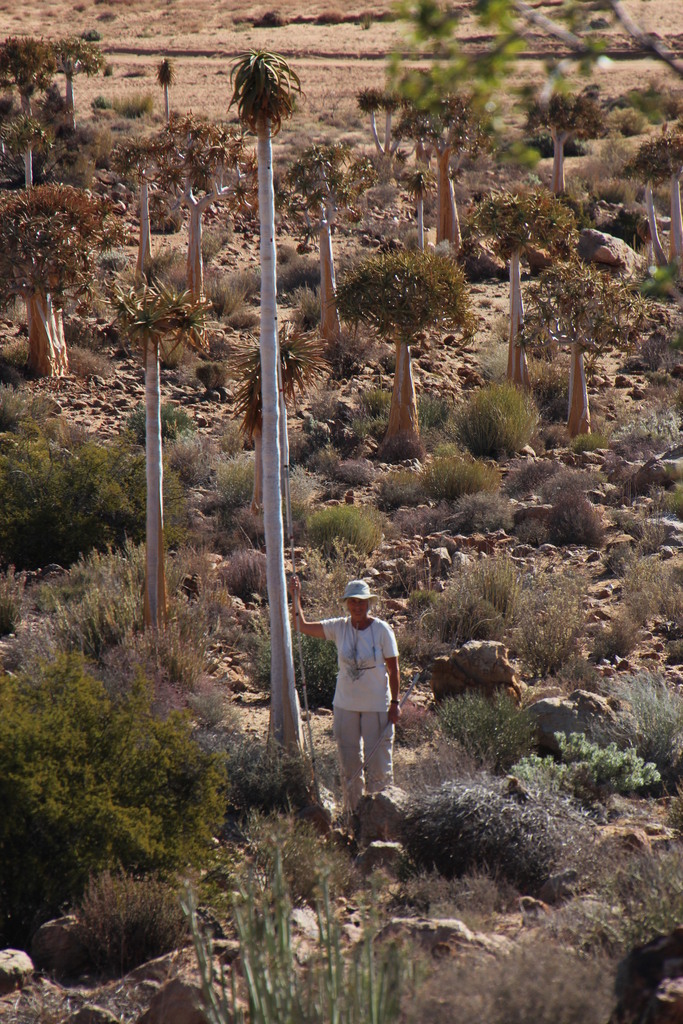
The Quiver Tree is a striking succulent that grows into a tree-like form with a distinct, branching crown. It is native to arid regions of Southern Africa and is well adapted to intense heat and dry conditions. Its name comes from the San people, who used the hollowed branches to store their arrows.
At a glance
- Care level
- Easy
- Plant type
- Succulent tree
- Light
- Full sun
- Indoor light
- Direct sun
- Water
- Every 14 to 30 days
- Mature size
- Up to 7 meters tall
- Growth rate
- Slow
- Hardiness
- USDA 9 to 11
- Bloom time
- Mid winter
Care
Provide plenty of direct sunlight and ensure the soil dries out completely between waterings. Watch for soft or mushy stems, which indicate overwatering or poor drainage. Keep the plant in a very well-draining, gritty cactus mix to prevent root rot.
- Watering
- Allow the soil to dry out entirely before watering again.
- Feeding
- Feed sparingly with a balanced succulent fertilizer during the growing season.
- Pruning
- Pruning is rarely needed, but you can remove dead or damaged branches for aesthetics.
- Repotting
- Repot only when the plant has clearly outgrown its container.
- Soil
- Gritty, well-draining cactus soil
- Soil pH
- Neutral to slightly alkaline
- Temperature
- -4 to 45°C
- Humidity
- 10 to 40%
- Drought tolerance
- High
- Lifespan
- Perennial, typically 80 to 150 years
- Deer and rabbits
- High
Signs it needs repotting
- Roots growing out of the drainage holes
- Stunted growth despite proper care
Safety
- People
- The sap is mildly toxic and can cause irritation if ingested or touched.
- Pets
- The sap is considered toxic to cats and dogs if ingested.
- Children
- Keep children away from the sharp, serrated leaf edges to avoid scratches.
- Contact allergens
- The sap may cause skin irritation in sensitive individuals.
- Airborne allergens
- There are no notable respiratory allergens associated with this plant.
- Edibility
- This plant is not intended for consumption and may cause digestive distress.
How to identify it
- Tree-like succulent habit
- Smooth, pale greyish bark
- Dichotomous branching pattern
- Blue-green fleshy leaves
- Sharp, serrated leaf margins
- Height
- 3 to 7m
- Spread
- 2 to 4m
- Leaves
- blue-green, evergreen
- Flowers
- yellow, 2 to 4cm
- Fruit
- brown, Late spring
Problems to watch for
- MealybugsCommon
- Root RotCommon
- DehydrationUncommon
- Scale InsectsUncommon
Check your quiver tree from a photo
Pocket Botanist looks at a photo of your plant and tells you what's wrong and what to try first.
Scan with your phone's camera to get the app
Or go to pocketbotanist.app/get on your phone
Growing it
- Propagation
- seed, cuttings
- When to plant
- spring, autumn
- Overwintering
- Protect from heavy frost and keep the soil completely dry during the winter months.
- In containers
- It grows well in large terracotta pots with excellent drainage, but it is best suited for the ground.
Cuttings
- 1. Take a cutting from a healthy branch.
- 2. Allow the cut end to callous for two weeks.
- 3. Plant in dry, sandy soil.
- 4. Wait for roots to form before watering.
Group with other slow growing succulents that do not require frequent soil disturbance.
Grows well with
- Desert Rose · They share similar water and light requirements.
- Blue Agave · They provide a striking architectural contrast in a desert garden.
Similar species
- Aloe barberae · Another tree like aloe that grows much larger.
- Aloe pillansii · A closely related species with a similar growth habit.
Science
- Family
- Asphodelaceae
- Genus
- Aloidendron
- Order
- Asparagales
- Class
- Liliopsida
- Native range
- Namibia and South Africa
- Conservation
- This species is listed as vulnerable in its native habitat due to climate change and habitat loss.
It thrives in rocky, arid desert environments by storing water in its fibrous trunk.
- Value to wildlife
- nectar source
- Pollinators
- bees, birds
- Uses
- ornamental specimen, xeriscaping
Through the year
Ecological indicators
- Salinity
- 2/9
- Soil reaction
- 6/9
- Light
- 8/9
- Temperature
- 8/9
- Moisture
- 1/9
- Nutrients
- 2/9
Taxonomy resolved against GBIF.
Questions people ask
- How often should I water it?
- Water sparingly, allowing the soil to dry out completely between waterings.
- Can I grow it in a pot?
- Yes, but it requires a very large, well draining container and will grow much slower.
Where the name comes from
The name dichotomum refers to the way the branches fork into two equal parts, while Aloidendron describes its tree like aloe appearance.
Good to know
- It is a succulent tree that can live for over 100 years.
- The tree is a symbol of the arid landscapes of the Northern Cape.
- It stores water in its trunk to survive extreme droughts.
- The bark is covered in sharp, papery scales.
Also in
Keep your quiver tree growing
This page is a general guide. Save your plant in Pocket Botanist and you get care reminders timed for this plant, plus a care history that shows what worked.
Scan with your phone's camera to get the app
Or go to pocketbotanist.app/get on your phone
This guide was generated with AI on and checked against GBIF taxonomy. It is general information, not horticultural or veterinary advice. Read about how we build these guides.