 Pocket Botanist
Plant guide
Queen Victoria Agave.
Agave victoriae-reginae
Pronounced uh-GAH-vee vik-toh-ree-AY ree-JIN-ay
Also known as Queen Victoria Agave, royal agave



Scan with your phone's camera to get the app
Or go to pocketbotanist.app/get on your phone
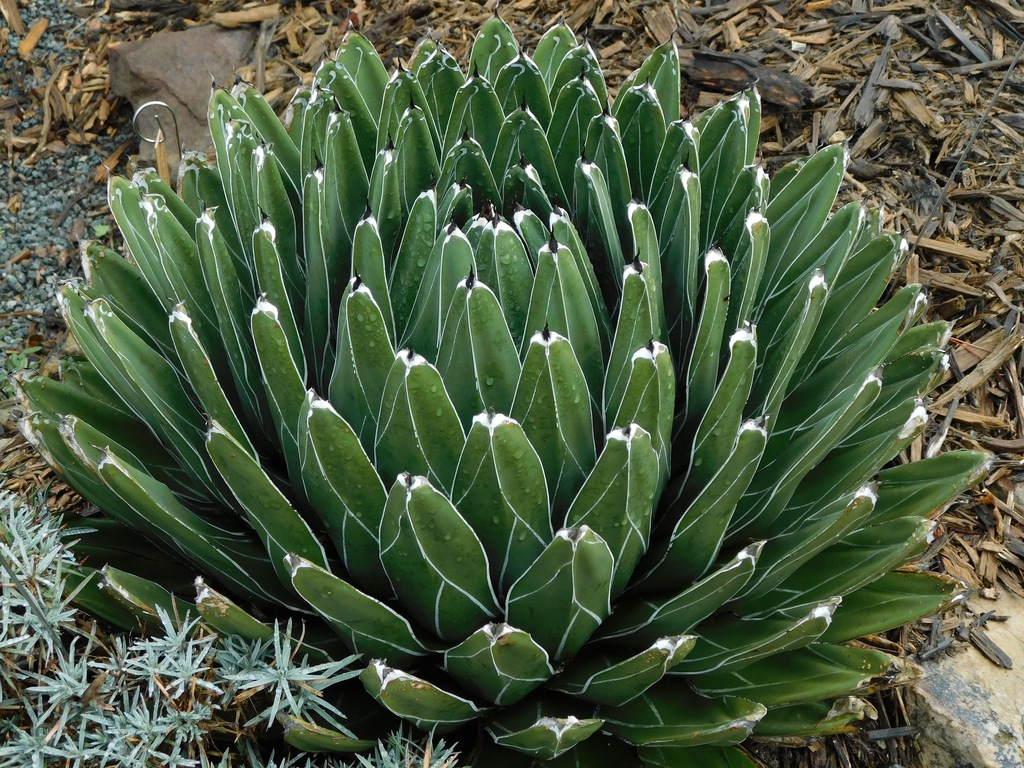
The Queen Victoria Agave is a slow growing, architectural succulent that forms a tight, spherical rosette. Its dark green leaves are adorned with striking white markings and sharp terminal spines. It is a prized specimen for collectors who appreciate its geometric beauty.
At a glance
- Care level
- Easy
- Plant type
- Succulent
- Light
- Full sun
- Indoor light
- Direct sun
- Water
- Every 14 to 30 days
- Mature size
- 45 cm tall by 45 cm wide
- Growth rate
- Slow
- Hardiness
- USDA 9 to 11
- Bloom time
- Late spring to early summer
Care
Provide plenty of direct sunlight to maintain its compact shape and prevent stretching. Allow the soil to dry out completely between waterings to avoid root rot. Watch for soft, mushy leaves which indicate overwatering.
- Watering
- Water sparingly during the growing season and keep almost dry in winter.
- Feeding
- Use a balanced, diluted fertilizer only during the active growing season.
- Pruning
- Remove only dead or damaged lower leaves as needed.
- Repotting
- Repot only when the plant has clearly outgrown its container.
- Soil
- Well draining cactus mix
- Soil pH
- 6.0 to 7.5
- Temperature
- -7 to 40°C
- Humidity
- 10 to 40%
- Drought tolerance
- High
- Lifespan
- Perennial, typically 15 to 20 years before flowering.
- Deer and rabbits
- High
Signs it needs repotting
- Roots growing out of the drainage holes
- Plant becomes top heavy and unstable
- Growth slows significantly over multiple seasons
Safety
- People
- The sap contains calcium oxalate crystals which cause significant irritation to skin and mucous membranes.
- Pets
- This plant is toxic to cats and dogs if ingested.
- Children
- Keep this plant away from children due to the extremely sharp, needle like spines at the leaf tips.
- Contact allergens
- The sharp terminal spines can puncture skin and the sap is a known irritant.
- Airborne allergens
- None known.
- Edibility
- The sap can cause severe skin irritation and the plant is not considered edible.
How to identify it
- Tight, spherical rosette shape
- Dark green leaves with white margins
- Sharp, dark terminal spine
- Geometric leaf patterns
- Height
- 0.3 to 0.5m
- Spread
- 0.4 to 0.6m
- Leaves
- dark green, white, evergreen
- Flowers
- cream, yellow, purple, 2 to 4cm
- Fruit
- black, Late summer
Problems to watch for
- Agave Snout WeevilCommon
- Root RotCommon
- Leaf ScorchUncommon
- MealybugsUncommon
- Scale InsectsUncommon
- Soft RotUncommon
Check your queen victoria agave from a photo
Pocket Botanist looks at a photo of your plant and tells you what's wrong and what to try first.
Scan with your phone's camera to get the app
Or go to pocketbotanist.app/get on your phone
Growing it
- Propagation
- seed, offsets
- When to plant
- spring, early summer
- Overwintering
- Keep the plant dry during winter months to prevent rot. If temperatures drop below freezing, protect it from frost or move it to a sheltered location.
- In containers
- It is excellent for containers, provided you use a well draining cactus mix and a pot with large drainage holes.
Offsets
- Wait for the mother plant to produce small offsets at the base.
- Carefully remove the offset with a clean, sharp knife.
- Allow the cut end to callous for several days in a dry spot.
- Plant the offset in a gritty, well draining succulent soil mix.
- Keep the soil barely moist until roots establish.
Group with other slow growing succulents to ensure they do not compete for space or light.
Grows well with
- Desert Spoon · They share similar water and light requirements in a xeriscape setting.
- Blue Fescue · The soft texture of the grass contrasts beautifully with the rigid agave leaves.
Similar species
- Parry's Agave · It offers a similar architectural form but with a more rounded, blue-toned habit.
Science
- Family
- Asparagaceae
- Genus
- Agave
- Order
- Asparagales
- Class
- Liliopsida
- Native range
- Chihuahuan Desert in northeastern Mexico.
- Conservation
- This species is considered near threatened in its native habitat due to overcollection.
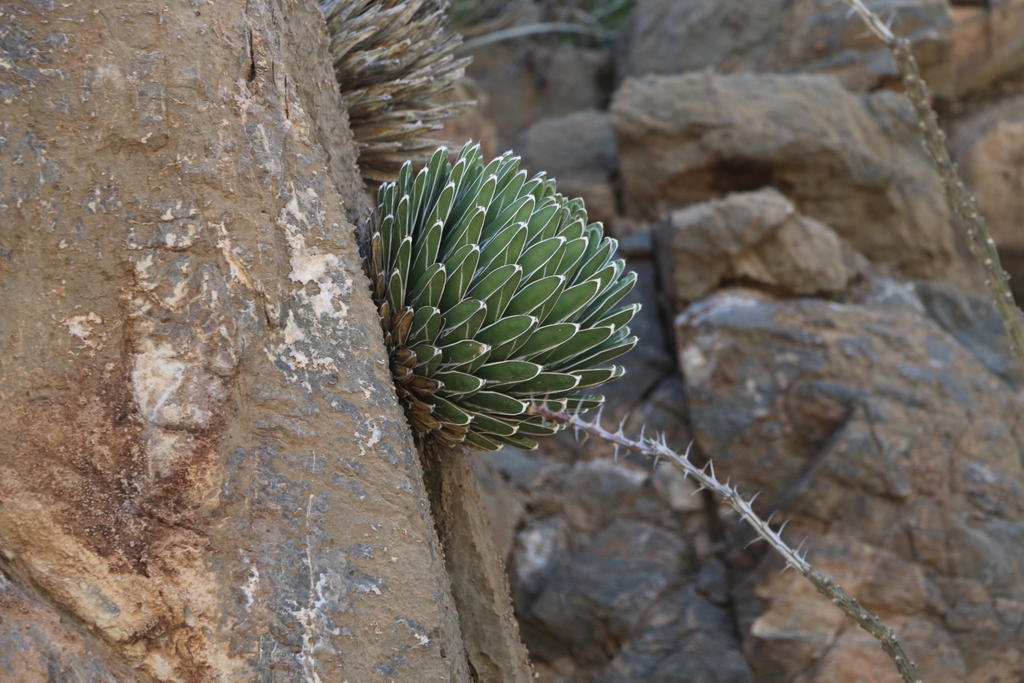
It grows in rocky, limestone outcrops where it relies on its deep root system to access moisture.
- Value to wildlife
- nectar source
- Pollinators
- bees, butterflies, hummingbirds
- Uses
- ornamental specimen, container plant, rock garden accent
Through the year
Ecological indicators
- Salinity
- 3/9
- Soil reaction
- 7/9
- Light
- 8/9
- Temperature
- 7/9
- Nutrients
- 2/9
- Moisture
- 2/9
Taxonomy resolved against GBIF.
Questions people ask
- How often should I water it?
- Water sparingly, allowing the soil to dry out completely between sessions.
- Does it need full sun?
- Yes, it thrives in bright, direct sunlight for most of the day.
Where the name comes from
The specific epithet victoriae-reginae honors Queen Victoria, reflecting the plant's regal and symmetrical appearance.
Good to know
- It is named in honor of Queen Victoria of the United Kingdom.
- The white lines on the leaves are actually impressions from the neighboring leaves as they unfurl.
- It is a monocarpic species, meaning it dies after flowering once.
- It can take over a decade to reach maturity and produce its first bloom.
Also in
Keep your queen victoria agave growing
This page is a general guide. Save your plant in Pocket Botanist and you get care reminders timed for this plant, plus a care history that shows what worked.
Scan with your phone's camera to get the app
Or go to pocketbotanist.app/get on your phone
This guide was generated with AI on and checked against GBIF taxonomy. It is general information, not horticultural or veterinary advice. Read about how we build these guides.