 Pocket Botanist
Guide botanique
Calla.
Zantedeschia aethiopica
Prononciation zan-te-DES-kee-uh ee-thee-OH-pih-kuh
Aussi appelée Altar-Lily, Arum Lily, Arum Lily, Calla lily, Arum commun, Arum d'eau, Egyption Lily, Calla des fleuristes



Le Calla est une plante magnifique connue pour ses élégantes spathes en forme de trompette. Elle prospère dans les environnements humides et ajoute une touche de sophistication à n'importe quel espace. Ces plantes sont en fait des vivaces rhizomateuses qui apprécient une humidité constante.
En un coup d'œil
- Niveau d'entretien
- Moyenne
- Type de plante
- Vivace
- Lumière
- Lumière vive indirecte
- Lumière en intérieur
- Lumière vive indirecte
- Arrosage
- Tous les 3 à 7 jours
- Taille adulte
- 90 à 120 cm
- Croissance
- Moyenne
- Rusticité
- USDA 7 à 10
- Floraison
- Fin du printemps au début de l'été
Entretien
Gardez le sol constamment humide mais jamais détrempé pour éviter la pourriture. Surveillez le jaunissement des feuilles, qui signale souvent un arrosage excessif ou un mauvais drainage. Assurez-vous que la plante reçoive beaucoup de lumière vive pour encourager ces belles floraisons.
- Arrosage
- Gardez le sol uniformément humide en tout temps, sans le laisser sécher complètement.
- Engrais
- Appliquez un engrais liquide équilibré pendant la saison de croissance active.
- Taille
- Retirez les fleurs fanées et le feuillage jaunissant pour garder la plante nette.
- Rempotage
- Rempotez au printemps si les rhizomes deviennent trop serrés dans le pot.
- Sol
- Mélange de terreau riche et bien drainant
- pH du sol
- 6,0 à 6,5
- Température
- -5 à 35°C
- Humidité
- 60 à 90%
- Résistance à la sécheresse
- Faible
- Durée de vie
- Vivace, généralement de 5 à 10 ans.
- Parfum
- Léger
- Résistance aux chevreuils et lapins
- Moyenne
Signes qu'il faut rempoter
- Des racines sortent des trous de drainage.
- La plante est devenue à l'étroit et ne fleurit plus bien.
- L'eau traverse le pot sans s'infiltrer.
Sécurité
- Humains
- La plante est toxique pour l'homme et les animaux domestiques en raison de cristaux d'oxalate de calcium insolubles qui provoquent des brûlures et un gonflement de la bouche et de la gorge.
- Animaux
- Cette plante est toxique pour les chats et les chiens si ingérée car elle contient des cristaux d'oxalate de calcium.
- Enfants
- Tenez cette plante à l'écart des jeunes enfants et des animaux domestiques, car la mastication de n'importe quelle partie de la plante provoque une irritation immédiate et douloureuse.
- Allergènes de contact
- La sève peut provoquer une irritation cutanée ou une dermatite chez les personnes sensibles.
- Allergènes aéroportés
- Le pollen n'est généralement pas considéré comme un allergène aérien majeur.
- Comestibilité
- Toutes les parties de cette plante contiennent des cristaux d'oxalate de calcium, qui provoquent une irritation et un gonflement sévères en cas d'ingestion.
Comment l'identifier
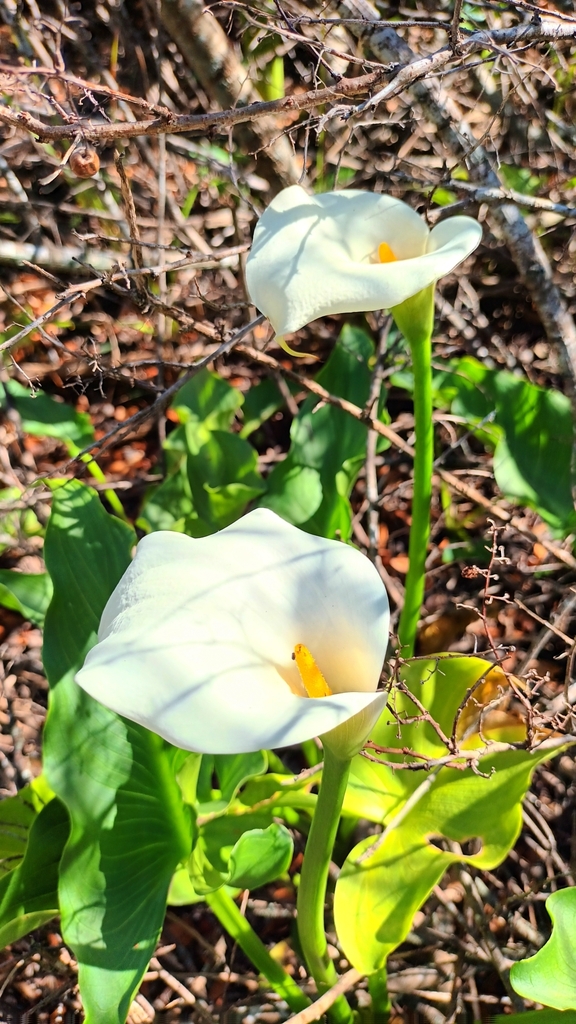
- Grandes feuilles vertes profondes en forme de flèche
- Spathes voyantes en forme d'entonnoir blanc
- Spathe centrale jaune vif
- Tiges robustes semblables à des succulentes
- Hauteur
- 0,6 à 1,2m
- Envergure
- 0,3 à 0,6m
- Feuilles
- vert, evergreen
- Fleurs
- blanc, 10 à 25cm
- Fruits
- green, yellow, Late summer
Problèmes à surveiller
- Brunissement du bord des feuillesCourant
- Pourriture des racinesCourant
- Pourriture molleCourant
- PuceronsCourant
- BotrytisPeu courant
- Limaces et escargotsPeu courant
- ThripsPeu courant
Par symptôme
Vérifie la santé de ta plante en photo
Pocket Botanist analyse une photo de ta plante et te dit ce qui ne va pas et quoi essayer en premier.
La cultiver
- Multiplication
- division, semis
- Quand planter
- printemps
- Hivernage
- Dans les régions plus froides, déterrez les rhizomes après le premier gel, nettoyez-les et conservez-les dans un endroit frais et sec jusqu'au printemps.
- En pot
- Elle pousse très bien en conteneur, à condition d'utiliser un grand pot qui conserve bien l'humidité.
Division de rhizomes
- Dégagez délicatement la plante pendant sa période de dormance.
- Séparez doucement les touffes de rhizomes avec un couteau propre et tranchant.
- Assurez-vous que chaque section a au moins un point de croissance sain.
- Replantez les divisions dans un sol humide et riche.
Associez cette plante à d'autres espèces aimant l'humidité qui apprécient un sol riche et organique.
Bonnes associations
- Hosta — Ils partagent des exigences similaires en matière d'ombre et d'humidité.
- Polystic à feuilles de sabre — Les fougères offrent un joli contraste textuel dans les endroits humides et ombragés.
À éloigner de
- Orpin — Les succulentes nécessitent un sol sec et pourriront si elles sont plantées avec cette plante aimant l'humidité.
Espèces similaires
- Zantedeschia elliottiana — Il a une structure florale similaire mais présente des spathes jaunes et des feuilles tachetées.
Science
- Famille
- Araceae
- Genre
- Zantedeschia
- Ordre
- Alismatales
- Classe
- Liliopsida
- Région d'origine
- Afrique australe.
- Préservation
- Elle n'est actuellement pas préoccupante en matière de conservation, bien qu'elle soit considérée comme envahissante dans certaines régions en dehors de son aire de répartition naturelle.
Elle pousse naturellement dans les marais et le long des berges des cours d'eau où ses racines peuvent rester constamment humides.
- Intérêt pour la faune
- source de nectar
- Pollinisateurs
- abeilles, papillons
- Utilisations
- fleur coupée ornementale, plante pour jardin marécageux, spécimen en pot
Au fil des saisons
Repères écologiques
- Salinité
- 2/9
- Humidité
- 8/9
- Nutriments
- 6/9
- Réaction du sol
- 5/9
- Lumière
- 6/9
- Température
- 7/9
Taxonomie vérifiée avec le GBIF.
Ce qu'on demande souvent
- A-t-elle besoin de plein soleil ?
- Elle préfère une lumière vive et indirecte ou une ombre partielle.
- Puis-je la faire pousser dans l'eau ?
- Oui, elle pousse bien dans une eau peu profonde ou dans un sol très humide.
D'où vient le nom
Le genre honore le botaniste italien Giovanni Zantedeschi, tandis que le nom de l'espèce aethiopica fait référence à son origine en Afrique australe.
Bon à savoir
- Malgré son nom, ce n'est pas un vrai lys.
- C'est la fleur nationale de l'Éthiopie.
- La plante est un choix populaire pour les bouquets de mariage.
- Elle prospère dans un sol très humide, voire détrempé.
Aussi dans
Garde ta plante en pleine forme
Cette page est un guide général. Enregistre ta plante dans Pocket Botanist et tu reçois des rappels d'entretien adaptés à cette plante, ainsi qu'un historique d'entretien qui montre ce qui a marché.
Ce guide a été généré par IA et vérifié avec la taxonomie du GBIF. Il s'agit d'informations générales, et non de conseils horticoles ou vétérinaires. Découvre comment nous concevons ces guides.