 Pocket Botanist
Guide botanique
Camélia.
Camellia
Prononciation kuh-MEE-lee-uh juh-PON-ih-kuh
Aussi appelée Camélias, Thé, camélia, camélias



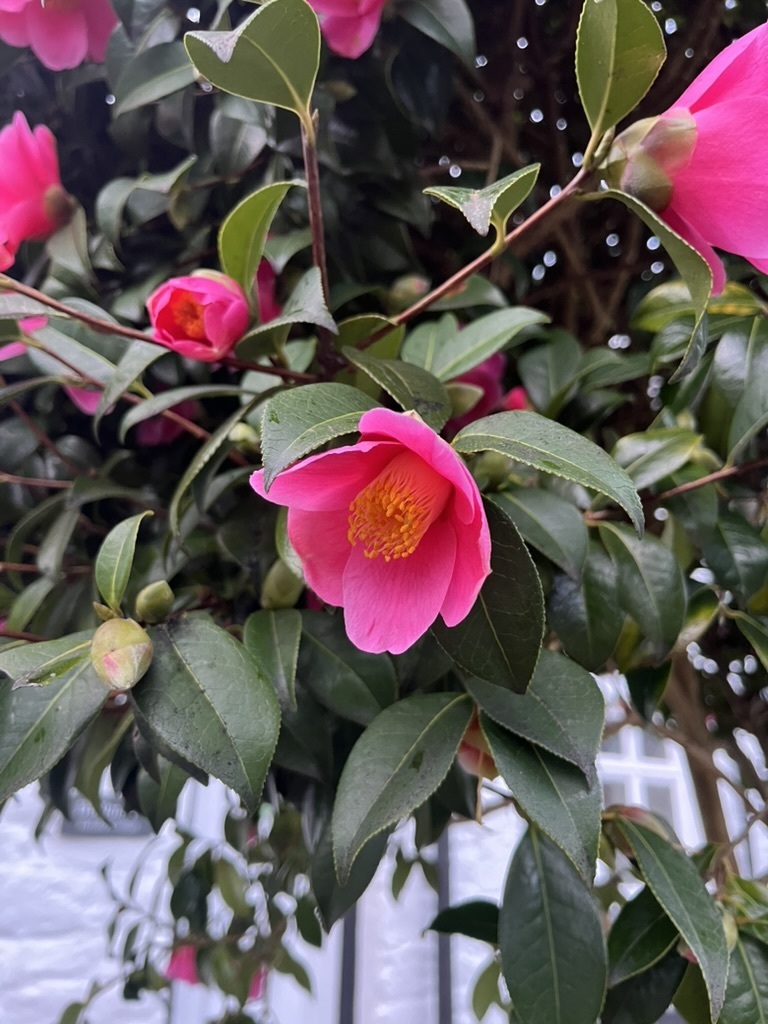
Les camélias sont d'élégants arbustes persistants appréciés pour leur feuillage luisant et leurs magnifiques fleurs ressemblant à des roses. Ils prospèrent dans les climats doux et ajoutent une touche de beauté classique à tout jardin. Ces plantes préfèrent les conditions fraîches et humides ainsi qu'une humidité constante.
En un coup d'œil
- Niveau d'entretien
- Moyenne
- Type de plante
- Arbuste persistant
- Lumière
- Mi-ombre à soleil tacheté
- Lumière en intérieur
- Lumière vive indirecte
- Arrosage
- Tous les 7 à 14 jours
- Taille adulte
- 6 à 12 pieds
- Croissance
- Lente
- Rusticité
- USDA 7 à 9
- Floraison
- De la fin de l'automne au début du printemps
Entretien
Gardez le sol constamment humide, mais jamais détrempé, pour éviter les problèmes de racines. Surveillez le jaunissement des feuilles qui indique souvent un mauvais drainage ou un pH du sol incorrect. Offrez un endroit abrité pour protéger les bourgeons des gelées tardives.
- Arrosage
- Gardez le sol constamment humide mais pas détrempé ; réduisez l'arrosage en hiver.
- Engrais
- Appliquez un engrais pour plantes acidophiles pendant la saison de croissance active.
- Taille
- Taillez immédiatement après la fin de la floraison pour former la plante et encourager une nouvelle croissance.
- Rempotage
- Rempotez uniquement lorsque la plante est à l'étroit dans son pot, en utilisant un terreau acide de haute qualité.
- Sol
- Sol acide, bien drainé et riche en matière organique
- pH du sol
- 5.5 à 6.5
- Température
- -10 à 30°C
- Humidité
- 60 à 90%
- Résistance à la sécheresse
- Faible
- Durée de vie
- Vivace, peut vivre plus de 50 ans avec des soins appropriés.
- Parfum
- Léger
- Résistance aux chevreuils et lapins
- Moyenne
Signes qu'il faut rempoter
- racines sortant des trous de drainage
- l'eau passe directement à travers le pot
- croissance ralentie
Sécurité
- Humains
- La plante est généralement considérée comme non toxique pour l'homme.
- Animaux
- Les camélias sont généralement considérés comme non toxiques pour les chats et les chiens.
- Enfants
- La plante est sans danger pour les enfants, bien que les tiges ligneuses puissent être pointues si elles se cassent.
- Allergènes de contact
- La manipulation du feuillage ou des fleurs provoque rarement une irritation cutanée chez les personnes sensibles.
- Allergènes aéroportés
- Les camélias ne sont pas considérés comme des contributeurs significatifs aux allergies saisonnières au pollen.
- Comestibilité
- Bien que certaines espèces soient utilisées pour le thé, la plupart des camélias d'ornement ne sont pas destinés à la consommation et peuvent causer des troubles digestifs.
Comment l'identifier
- Feuilles luisantes vert foncé, semblables à du cuir
- Fleurs voyantes avec de nombreux pétales
- Habitude de croissance d'arbuste persistant dense
- Bords de feuilles dentelés
- Hauteur
- 1,5 à 4,5m
- Envergure
- 1,2 à 3m
- Feuilles
- vert foncé, brillant, evergreen
- Fleurs
- blanc, rose, rouge, 5 à 12cm
Problèmes à surveiller
- CochenillesCourant
- Pourriture des fleurs du caméliaCourant
- Brûlures du feuillagePeu courant
- ChlorosePeu courant
- Chute des boutons florauxPeu courant
- FumaginePeu courant
- Pourriture des racinesPeu courant
- PuceronsPeu courant
- Pourriture des pétales de camélia — Une infection fongique qui fait brunir les fleurs et tomber prématurément.
Par symptôme
Vérifie la santé de ta plante en photo
Pocket Botanist analyse une photo de ta plante et te dit ce qui ne va pas et quoi essayer en premier.
La cultiver
- Multiplication
- bouturage, marcottage, semis
- Quand planter
- printemps, début de l'automne
- Hivernage
- Appliquez une épaisse couche de paillis autour de la base pour protéger les racines du gel. Par temps très froid, couvrez la plante de toile de jute pour éviter les brûlures dues au vent.
- En pot
- Ils poussent bien dans de grands pots, à condition que le conteneur mesure au moins 40 cm de large et qu'il ait un excellent drainage.
Boutures semi-aoûtées
- Prenez une bouture de 10 cm à partir de la nouvelle croissance à la fin de l'été.
- Retirez les feuilles inférieures et trempez l'extrémité dans de l'hormone d'enracinement.
- Plantez dans un mélange de terreau humide et sableux.
- Couvrez d'un sac en plastique pour maintenir l'humidité.
- Conservez à la lumière vive indirecte jusqu'à la formation des racines.
Regroupez-les avec d'autres plantes aimant les sols acides pour simplifier la gestion du sol.
Bonnes associations
- Rhododendron — Ils partagent des exigences similaires en matière de sol acide et d'ombre.
- Érable du Japon — Il fournit l'ombre tachetée que les camélias préfèrent.
- Hosta — Ces plantes vivaces remplissent l'espace sous l'arbuste avec un feuillage luxuriant.
Espèces similaires
- Thé — C'est un proche parent cultivé principalement pour ses feuilles plutôt que pour ses fleurs.
Science
- Famille
- Theaceae
- Genre
- Camellia
- Ordre
- Ericales
- Classe
- Magnoliopsida
- Région d'origine
- Asie de l'Est et du Sud
- Préservation
- Certaines espèces sauvages sont menacées par la perte d'habitat, mais les variétés de jardin courantes sont largement cultivées.
Ils poussent naturellement comme des arbustes de sous-étage dans les environnements boisés humides et ombragés.
- Intérêt pour la faune
- source de nectar de fin de saison
- Pollinisateurs
- abeilles
- Utilisations
- arbuste d'ornement, haie, plante en pot
Au fil des saisons
Repères écologiques
- Salinité
- 1/9
- Réaction du sol
- 3/9
- Lumière
- 4/9
- Nutriments
- 5/9
- Température
- 5/9
- Humidité
- 6/9
Taxonomie vérifiée avec le GBIF.
Ce qu'on demande souvent
- Pourquoi mes boutons tombent-ils ?
- Ceci est souvent causé par un arrosage irrégulier ou des fluctuations extrêmes de température.
- Ont-ils besoin d'un sol acide ?
- Oui, ils prospèrent dans un sol acide, bien drainé et riche en matière organique.
D'où vient le nom
Le genre a été nommé par Linné en l'honneur de Georg Joseph Kamel, un missionnaire jésuite et botaniste.
Bon à savoir
- Les camélias sont souvent appelés la rose de l'hiver.
- Ils ont été introduits en Europe depuis l'Asie au 18ème siècle.
- Les fleurs peuvent durer plusieurs semaines sur l'arbuste.
Aussi dans
Garde ta plante en pleine forme
Cette page est un guide général. Enregistre ta plante dans Pocket Botanist et tu reçois des rappels d'entretien adaptés à cette plante, ainsi qu'un historique d'entretien qui montre ce qui a marché.
Ce guide a été généré par IA et vérifié avec la taxonomie du GBIF. Il s'agit d'informations générales, et non de conseils horticoles ou vétérinaires. Découvre comment nous concevons ces guides.