 Pocket Botanist
Pflanzenratgeber
Watercress.
Nasturtium officinale
Aussprache nas-TUR-shee-um oh-fiss-ih-NAH-lee
Auch bekannt als Watercress


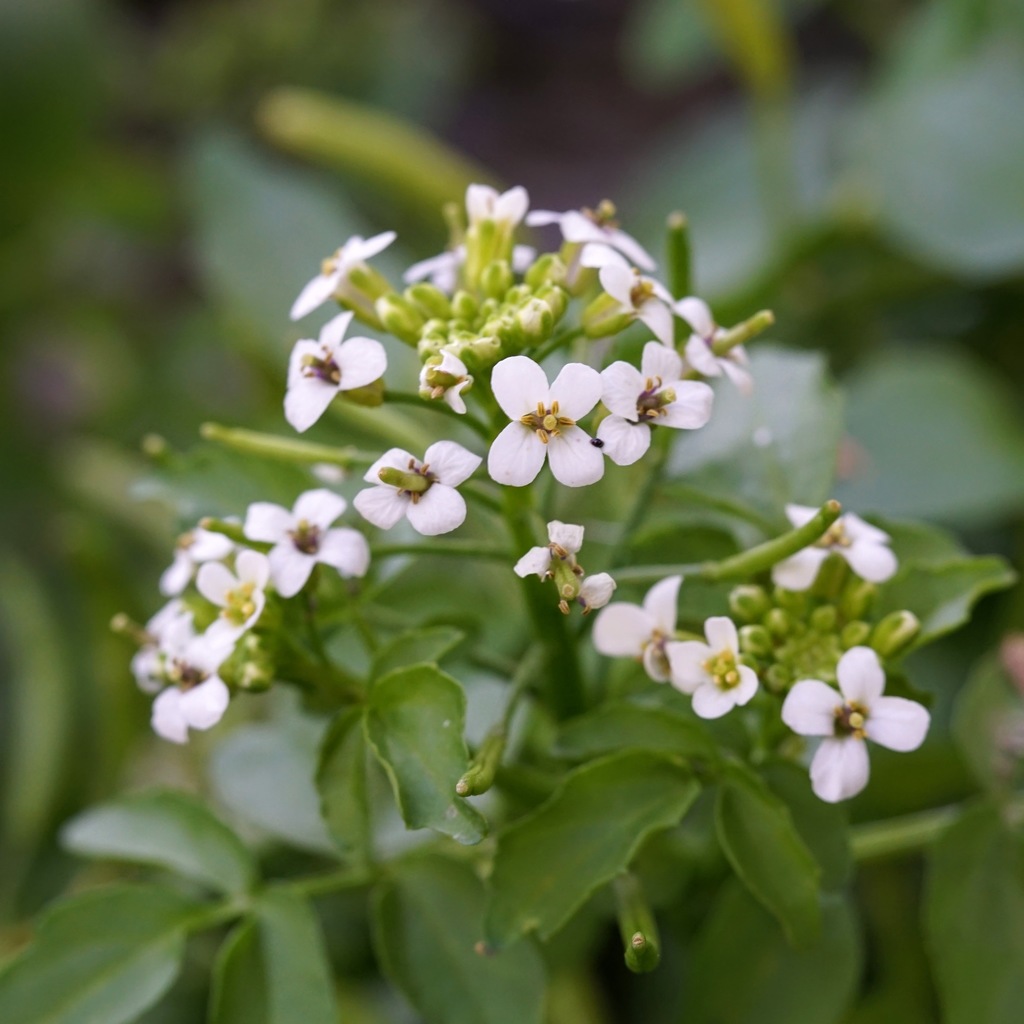
Watercress is a delightful, peppery aquatic plant that loves to grow in cool, running water. It is a fast growing perennial that brings a fresh, spicy kick to salads and sandwiches. You will find it thrives best when its roots are kept consistently wet or even submerged.

Auf einen Blick
- Pflegestufe
- Einfach
- Pflanzenart
- Aquatic perennial
- Licht
- Partial shade to full sun
- Licht im Innenraum
- Hell, indirekt
- Gießen
- Jeden Tag
- Endgröße
- 1 to 2 feet
- Wachstum
- Schnell
- Winterhärte
- USDA 4 bis 9
- Blütezeit
- Late spring to early autumn
Pflege
Keep the soil or growing medium constantly saturated to mimic its natural stream habitat. Watch for yellowing leaves, which often signal that the water is not fresh enough or the plant is too dry. Ensure the water remains cool and clean to prevent rot.
- Gießen
- The roots must remain submerged or in waterlogged soil at all times.
- Düngen
- Use a balanced liquid fertilizer sparingly if the plants appear stunted.
- Schneiden
- Regularly harvest the stems to encourage bushier growth and prevent flowering.
- Umtopfen
- Refresh the growing medium or move to a larger container if the roots become too crowded.
- Boden
- Aquatic or very moist soil
- Boden-pH
- 6.5 to 7.5
- Temperatur
- 0 bis 25°C
- Luftfeuchtigkeit
- 60 bis 90%
- Trockenheitstoleranz
- Gering
- Lebensdauer
- Perennial, typically 2 to 3 years.
- Wildverbiss-Resistenz
- Mittel
Anzeichen fürs Umtopfen
- Roots growing out of the bottom of the pot.
- Stunted growth despite adequate water.
- Water in the tray drying out too quickly.
Sicherheit
- Menschen
- It is generally safe to eat, but excessive consumption may cause stomach irritation.
- Kinder
- There are no specific safety concerns for children, though they should be supervised near water sources.
- Kontaktallergene
- The sap can occasionally cause mild skin irritation in sensitive individuals.
- Allergene in der Luft
- Pollen is not typically a significant airborne allergen.
- Essbarkeit
- Watercress must be harvested from clean, flowing water to avoid contamination by liver flukes or harmful bacteria.
So erkennst du die Pflanze
- Small, rounded, dark green leaves
- Hollow, succulent, branching stems
- Tiny, four petaled white flowers
- Peppery, mustard like flavor profile
- Höhe
- 0,1 bis 0,3m
- Breite
- 0,3 bis 1m
- Blätter
- green, semi-evergreen
- Blüten
- white, 0,5 bis 1cm
- Früchte
- green, Summer to autumn
Häufige Probleme
- Whitefly — Small white insects that feed on the undersides of leaves.
- Leaf spot — Fungal infection causing dark spots on foliage.
Standort und Pflege
- Vermehrung
- seed, cuttings
- Pflanzzeit
- spring, autumn
- Überwinterung
- In cold climates, move containers indoors to a bright, cool spot or ensure the water does not freeze solid.
- Im Kübel
- It grows well in containers if kept constantly wet in a deep saucer of water.
Stem Cuttings
- 1. Take a 10 cm cutting from a healthy stem.
- 2. Place the cutting in a glass of clean water.
- 3. Wait for roots to appear after a few days.
- 4. Transplant into a wet medium or keep in water.
Group watercress with other moisture loving herbs to simplify your watering routine.
Gute Pflanzpartner
- Minze — Both plants enjoy consistent moisture and similar growing conditions.
Ähnliche Arten
- Cardamine hirsuta — It shares a similar peppery flavor and appearance but prefers drier soil.
Botanisches
- Familie
- Brassicaceae
- Gattung
- Nasturtium
- Ordnung
- Brassicales
- Klasse
- Magnoliopsida
- Ursprüngliche Heimat
- Europe and parts of Asia.
- Artenschutz
- It is a common plant and not of conservation concern.
It grows in shallow, cool, flowing water where it filters nutrients through its roots.
- Nutzen für Wildtiere
- larval host plant, nectar source
- Bestäuber
- Bienen, Schmetterlinge
- Verwendung
- culinary herb, garnish, salad green
Im Jahresverlauf
Ökologische Zeigerwerte
- Salzgehalt
- 2/9
- Bodenreaktion
- 7/9
- Licht
- 6/9
- Temperatur
- 4/9
- Feuchtigkeit
- 9/9
- Nährstoffe
- 7/9
Taxonomie abgeglichen mit GBIF.
Häufige Fragen
- Can I grow it in a pot?
- Yes, keep the pot sitting in a tray of water to mimic its natural habitat.
- How do I harvest it?
- Snip the stems just above the water line, leaving the roots to regrow.
Woher der Name kommt
The name Nasturtium comes from the Latin nasus tortus, meaning twisted nose, referring to the pungent reaction to its peppery leaves.
Gut zu wissen
- Watercress is a member of the mustard family.
- It was once used as a remedy for scurvy due to high vitamin C content.
- The plant grows best in cold, clear, running water.
Probleme mit Watercress?
Diese Seite bietet allgemeine Infos. Pocket Botanist erkennt Probleme anhand eines Fotos deiner echten Pflanze, passt das Gießen an dein Licht und deinen Standort an und erinnert dich an die Pflege.
Dieser Ratgeber wurde mit KI erstellt und mit der GBIF-Taxonomie abgeglichen. Er dient zur allgemeinen Information und ersetzt keine gärtnerische oder tierärztliche Beratung. Hier erfährst du, wie wir diese Ratgeber erstellen.