 Pocket Botanist
Symptoms by part
Leaves
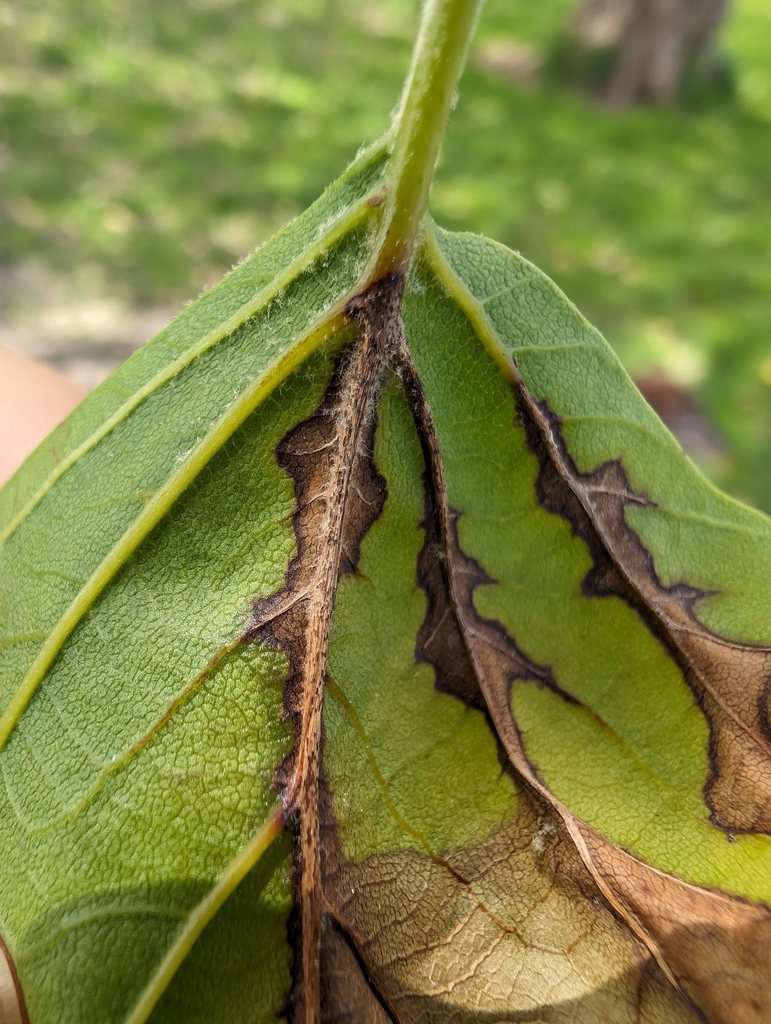
Irregular brown spots or blotches appear along the leaf veins, often causing the leaves to curl, wither, and drop prematurely.
Stems
Small twigs die back suddenly, and you may see sunken, dark cankers forming on larger branches that can eventually girdle and kill the limb.
Causes
- Extended periods of cool, wet weather during the early spring leaf emergence.
- Poor air circulation around the tree canopy.
- Overwintering fungal spores residing in fallen leaves and infected twigs.
Could be confused with
- Frost damage · Frost damage typically affects all new growth uniformly across the tree, whereas anthracnose appears as patchy, vein-associated lesions.
- Leaf scorch · Scorch usually appears as browning on the leaf edges or between veins during hot, dry weather, while anthracnose is linked to cool, damp conditions.
Find out what's really wrong with your plant
Problems that look alike are easy to mix up. Pocket Botanist looks at a photo of your actual plant and tells you what's going on, how serious it is, and what to try first. Identification and a health check are free.



Scan with your phone's camera to get the app
Or go to pocketbotanist.app/get on your phone
Treatment
- Rake up and destroy all fallen leaves and twigs beneath the tree as soon as they drop to remove the primary source of spores.
- Prune out dead or cankered twigs during the dormant season to reduce the amount of fungus surviving on the tree.
- Thin out the canopy to improve air circulation and allow sunlight to dry the foliage more quickly.
Without chemicals
- Sanitation by removing and disposing of infected plant debris.
- Pruning to improve airflow.
- Providing adequate water and mulch to help the tree recover from stress.
Preventing it
- Keep the area beneath the tree clear of leaf litter throughout the year.
- Choose resistant varieties when planting new trees.
- Ensure the tree is planted in a location with good sunlight and airflow.
Season
The growing season, specifically during the cool and damp conditions of early spring.
Spread risk
Moderate
Severity
Moderate
When to act
Act by cleaning up debris as soon as you notice symptoms to prevent the fungus from spreading further. If you notice large, structural branches dying back, contact a tree surgeon to safely remove the damaged wood.
Keep your plants healthy from here
Save your plants in Pocket Botanist and you get care reminders timed for each one, plus a care history that shows what worked. Identification and a health check are free.
Questions people ask
- Will my sycamore tree die from anthracnose?
- Usually no, the tree will often recover and push out a new set of leaves once the weather warms up and dries out.
- Should I spray my tree with fungicide?
- Chemical treatments are rarely practical for large trees and are generally not recommended for home gardeners.
- Why does my tree look like it is dying every spring?
- The fungus thrives in the cool, wet spring weather, so if your local climate has a damp spring, the tree will likely show symptoms every year.
Plants it affects
Answers plant by plant
This guide was generated with AI on and is general information, not horticultural advice. Read about how we build these guides.