 Pocket Botanist
Plant guide
Common buckthorn.
Rhamnus cathartica
Pronounced RAM-nus ka-THAR-ti-ka
Also known as Buckthorn, Carolina buckthorn, Common Buckthorn, European buckthorn, European waythorn, Hart's thorn



Scan with your phone's camera to get the app
Or go to pocketbotanist.app/get on your phone
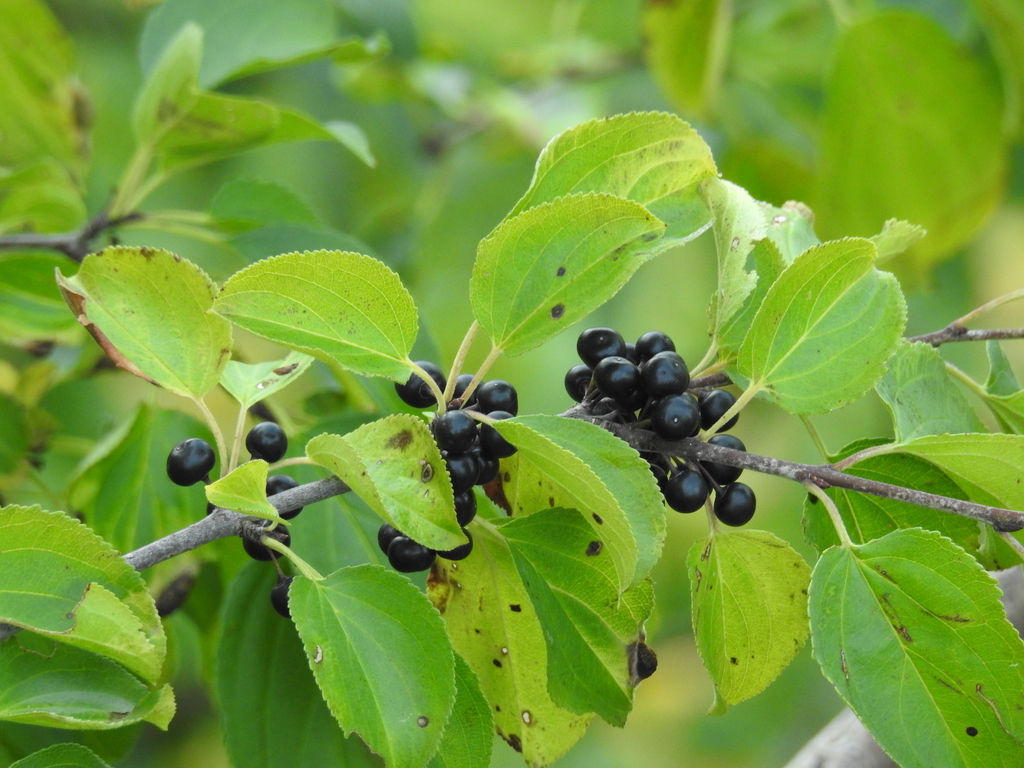
The common buckthorn is a hardy, deciduous shrub or small tree often found in woodlands and hedgerows. It is known for its dark berries and thorny twigs. Please note that this plant is considered highly invasive in many parts of North America.

At a glance
- Care level
- Easy
- Plant type
- Deciduous shrub
- Light
- Full sun to partial shade
- Indoor light
- Bright indirect
- Water
- Every 7 to 14 days
- Mature size
- 20 to 25 feet
- Growth rate
- Fast
- Hardiness
- USDA 3 to 7
- Bloom time
- Late spring to early summer
Care
This plant is incredibly resilient and thrives in almost any soil condition. Keep an eye out for its aggressive spread, as it can quickly crowd out native species. Regular monitoring is essential to prevent it from taking over your garden.
- Watering
- Water regularly until established, then it becomes quite drought tolerant.
- Feeding
- It rarely needs extra food, but a balanced fertilizer in spring helps if growth is sluggish.
- Pruning
- Prune in late winter or early spring to maintain shape and remove dead wood.
- Repotting
- If kept in a container, move to a larger pot every few years as it grows.
- Soil
- Well-draining, adaptable to various types
- Soil pH
- Neutral to slightly alkaline
- Temperature
- -35 to 30°C
- Humidity
- 40 to 70%
- Drought tolerance
- Moderate
- Lifespan
- Perennial, typically 20 to 50 years
- Deer and rabbits
- Moderate
Safety
- People
- All parts of the plant are considered toxic if ingested, causing severe gastrointestinal distress.
- Pets
- The berries and foliage are toxic to pets if ingested, causing gastrointestinal distress.
- Children
- The dark berries are attractive to children but are poisonous and cause severe vomiting if eaten.
- Contact allergens
- The bark and sap may cause skin irritation in sensitive individuals.
- Airborne allergens
- The pollen can trigger mild allergic reactions in some people.
- Edibility
- The berries are strongly purgative and should not be consumed by humans.
How to identify it
- Opposite or sub-opposite dark green leaves
- Small, inconspicuous yellow-green flowers
- Thorny, sharp-tipped branch ends
- Small, round, black-ripening berries
- Distinctive curved leaf veins
- Height
- 2 to 6m
- Spread
- 1.5 to 4m
- Leaves
- dark green, yellow, deciduous
- Flowers
- greenish yellow, 0.5 to 0.8cm
- Fruit
- black, Late summer to autumn
Problems to watch for
- Crown rust · A fungal infection that uses the shrub as an alternate host.
Check your common buckthorn from a photo
Pocket Botanist looks at a photo of your plant and tells you what's wrong and what to try first.
Scan with your phone's camera to get the app
Or go to pocketbotanist.app/get on your phone
Growing it
- Propagation
- seed, cuttings
- When to plant
- spring, autumn
- Overwintering
- No special care is needed as it is fully hardy in its range. It naturally drops its leaves and enters dormancy.
- In containers
- It is not recommended for containers due to its large size and invasive potential.
Seed
- 1. Collect ripe berries in autumn.
- 2. Clean the seeds from the pulp.
- 3. Sow immediately in a cold frame or outdoors.
Because this plant is invasive, it is best to avoid planting it near native ecosystems.
Similar species
- Glossy buckthorn · It is another invasive shrub with similar growth habits and ecological impact.
Science
- Family
- Rhamnaceae
- Genus
- Rhamnus
- Order
- Rosales
- Class
- Magnoliopsida
- Native range
- Europe, western Asia, and northwestern Africa.
- Conservation
- It is not endangered and is often targeted for removal due to its invasive nature.
It thrives in disturbed areas and forest edges, where it quickly forms dense thickets that shade out other plants.
- Value to wildlife
- nectar source, bird food source
- Pollinators
- bees
- Uses
- hedging, wildlife habitat, erosion control
Through the year
Ecological indicators
- Salinity
- 2/9
- Soil reaction
- 6/9
- Light
- 5/9
- Temperature
- 5/9
- Moisture
- 5/9
- Nutrients
- 5/9
Taxonomy resolved against GBIF.
Questions people ask
- Is it safe to plant in my garden?
- It is generally discouraged due to its aggressive, invasive nature.
- How do I control it?
- Small plants can be pulled, while larger ones often require cutting and stump treatment.
Where the name comes from
The genus name Rhamnus comes from the Greek word for a thorny shrub, while cathartica refers to its historical use as a purgative.
Good to know
- It was introduced to North America as an ornamental hedge.
- The berries are a primary food source for birds, which then spread the seeds.
- It can tolerate a wide variety of soil types and light conditions.
Also in
Keep your common buckthorn growing
This page is a general guide. Save your plant in Pocket Botanist and you get care reminders timed for this plant, plus a care history that shows what worked.
Scan with your phone's camera to get the app
Or go to pocketbotanist.app/get on your phone
This guide was generated with AI on and checked against GBIF taxonomy. It is general information, not horticultural or veterinary advice. Read about how we build these guides.