 Pocket Botanist
Plant guide
Sugarbush.
Protea
Pronounced PRO-tee-uh
Also known as Proteas, Sugarbush, protea



Scan with your phone's camera to get the app
Or go to pocketbotanist.app/get on your phone
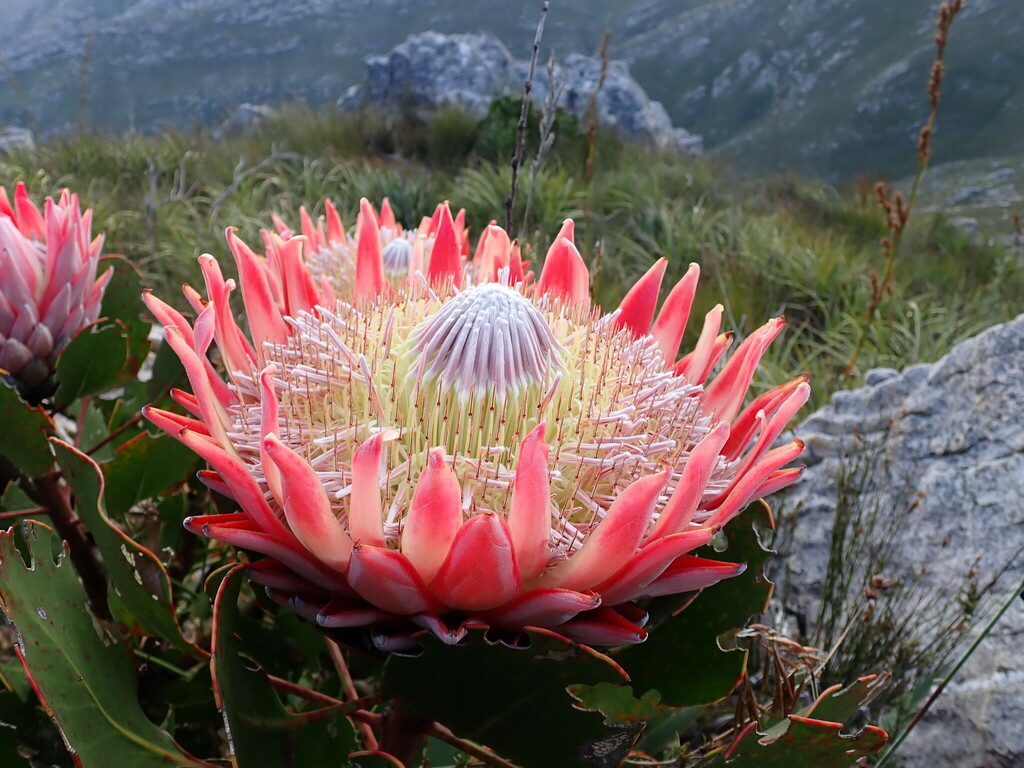
Proteas are stunning flowering shrubs native to South Africa that bring a dramatic, exotic flair to any garden. They are famous for their large, intricate flower heads that look like they belong in a prehistoric landscape. These plants thrive in sunny, well-draining spots and are quite rewarding for patient gardeners.
At a glance
- Care level
- Difficult
- Plant type
- Shrub
- Light
- Full sun
- Indoor light
- Direct sun
- Water
- Every 7 to 14 days
- Mature size
- 3 to 15 feet
- Growth rate
- Medium
- Hardiness
- USDA 9 to 11
- Bloom time
- Late winter to early summer
Care
These plants need excellent drainage and plenty of airflow to stay healthy. Watch for yellowing leaves or wilting, which often signal root rot from poor drainage or overwatering. They prefer lean, acidic soil and do not like to be disturbed once planted.
- Watering
- Allow the top few inches of soil to dry out completely between waterings.
- Feeding
- Use a low-phosphorus fertilizer specifically formulated for proteas or native plants.
- Pruning
- Prune back stems after flowering to encourage a bushy shape and more blooms next season.
- Repotting
- Only repot when absolutely necessary as they have sensitive root systems that dislike being moved.
- Soil
- Sandy, acidic, well-draining soil
- Soil pH
- 5.0 to 6.0
- Temperature
- -2 to 35°C
- Humidity
- 30 to 50%
- Drought tolerance
- High
- Lifespan
- Perennial, typically 10 to 20 years
- Deer and rabbits
- High
Signs it needs repotting
- Roots growing out of the drainage holes
- Water sitting on the surface for too long
- Stunted growth during the active season
Safety
- People
- The plant is generally non-toxic, but the stiff, sharp bracts can cause mechanical injury to skin.
- Pets
- Proteas are generally considered non-toxic to cats and dogs.
- Children
- The sharp, woody bracts of the flower heads can be prickly and should be kept out of reach of small children.
- Contact allergens
- The stiff, serrated edges of some leaves and bracts can cause minor skin abrasions.
- Airborne allergens
- Pollen may trigger mild allergic reactions in sensitive individuals during the peak flowering season.
- Edibility
- Protea flowers are not considered edible and may cause digestive upset if consumed.
How to identify it
- Large, woody, cone-like flower heads
- Stiff, leathery, evergreen leaves
- Prominent, colorful, petal-like bracts
- Sturdy, shrubby growth habit
- Height
- 1 to 3m
- Spread
- 1 to 2.5m
- Leaves
- dark green, leathery, evergreen
- Flowers
- pink, white, red, cream, 10 to 25cm
- Fruit
- brown, woody, Late summer
Problems to watch for
- Root rot · Caused by poor drainage or overwatering in heavy soils.
- Powdery mildew · Appears as white dust on leaves when air circulation is poor.
Check your sugarbush from a photo
Pocket Botanist looks at a photo of your plant and tells you what's wrong and what to try first.
Scan with your phone's camera to get the app
Or go to pocketbotanist.app/get on your phone
Growing it
- Propagation
- seed, cuttings
- When to plant
- spring, early autumn
- Overwintering
- Move containers to a frost-free, bright location if temperatures drop below freezing. Keep the soil on the drier side during the winter months to prevent root rot.
- In containers
- Proteas grow well in large, well-draining pots at least 40 cm wide to accommodate their sensitive root systems.
Semi-hardwood cuttings
- Take 10 cm cuttings from healthy, non-flowering stems in late summer.
- Remove the lower leaves and dip the base in rooting hormone.
- Plant in a sandy, well-draining medium and keep in a humid, bright spot.
Group plants with similar low-nutrient and low-water needs to ensure they all stay healthy together.
Grows well with
- Leucadendron · They share similar soil and water requirements.
- Erica · These plants thrive in the same acidic, well-draining conditions.
- Restio · They provide a natural, grass-like texture that complements the bold Protea flowers.
Similar species
- King Protea · It is the most iconic species with the largest flower heads.
- Sugarbush · It is a popular, hardy species known for its nectar-rich flowers.
Science
- Family
- Proteaceae
- Genus
- Protea
- Order
- Proteales
- Class
- Magnoliopsida
- Native range
- Southern Africa
- Conservation
- Many Protea species are protected in their native habitats and wild collection is strictly regulated.
Proteas have evolved to thrive in nutrient-poor, acidic soils and are adapted to survive periodic fire events.
- Value to wildlife
- nectar source
- Pollinators
- bees, butterflies, beetles
- Uses
- cut flowers, xeriscaping, focal point plant
Through the year
Ecological indicators
- Salinity
- 2/9
- Soil reaction
- 3/9
- Light
- 8/9
- Temperature
- 7/9
- Moisture
- 3/9
- Nutrients
- 1/9
Taxonomy resolved against GBIF.
Questions people ask
- Do Proteas need fertilizer?
- They are very sensitive to phosphorus and require low-phosphorus, slow-release fertilizers.
- Can I grow Protea in a pot?
- Yes, they thrive in containers if you use a well-draining, acidic potting mix.
Where the name comes from
The genus is named after the Greek god Proteus, reflecting the wide variety of forms found within the group.
Good to know
- The Protea is the national flower of South Africa.
- They are named after Proteus, a Greek god who could change his shape.
- Protea flowers are actually a collection of many small flowers clustered together.
- They are highly adapted to survive wildfires in their native habitat.
Also in
Keep your sugarbush growing
This page is a general guide. Save your plant in Pocket Botanist and you get care reminders timed for this plant, plus a care history that shows what worked.
Scan with your phone's camera to get the app
Or go to pocketbotanist.app/get on your phone
This guide was generated with AI on and checked against GBIF taxonomy. It is general information, not horticultural or veterinary advice. Read about how we build these guides.