 Pocket Botanist
Plant guide
Wild Blue Phlox.
Phlox divaricata
Pronounced floks di-var-i-KAY-tuh
Also known as blue phlox, blue woodland phlox, forest phlox, timber phlox, wild blue phlox, wild sweet-William, woodland phlox, Louisiana Phlox



Scan with your phone's camera to get the app
Or go to pocketbotanist.app/get on your phone
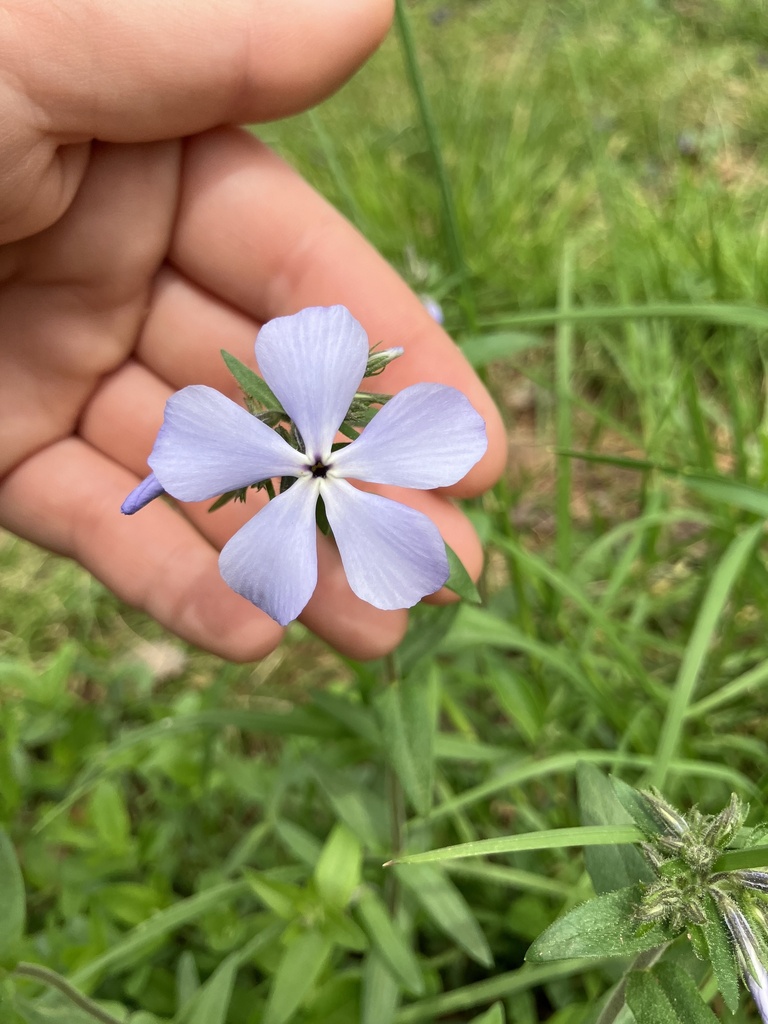
Wild blue phlox is a lovely woodland wildflower that brings a soft touch of color to shady spots in the spring. It spreads gently through your garden to create a natural, carpeted look. You will love how its fragrant, star shaped flowers attract butterflies and bees.

At a glance
- Care level
- Easy
- Plant type
- Perennial
- Light
- Partial shade to full shade
- Indoor light
- Medium light
- Water
- Every 3 to 7 days
- Mature size
- 12 to 18 inches
- Growth rate
- Medium
- Hardiness
- USDA 3 to 8
- Bloom time
- Mid to late spring
Care
Plant this phlox in rich, moist soil that mimics its native forest floor home. Keep an eye out for powdery mildew on the leaves if the air circulation is poor. It appreciates a layer of mulch to keep its roots cool and moist during the warmer months.
- Watering
- Keep the soil consistently moist but never soggy.
- Feeding
- Apply a balanced organic fertilizer once in early spring.
- Pruning
- Trim back the stems after flowering to keep the plant tidy.
- Repotting
- Divide the clumps every few years to maintain plant vigor.
- Soil
- Moist, well draining, organic rich soil
- Soil pH
- 6.0 to 7.5
- Temperature
- -30 to 30°C
- Humidity
- 40 to 70%
- Drought tolerance
- Low
- Lifespan
- Perennial, typically 3 to 5 years.
- Fragrance
- Light
- Deer and rabbits
- Low
Signs it needs repotting
- Roots growing out of the drainage holes.
- Water sitting on the surface for too long.
- Plant growth slowing down significantly.
Safety
- People
- This plant is generally considered non-toxic, but ingestion is not recommended.
- Children
- The plant is not known to pose a specific risk to children, but it is always best to discourage eating garden plants.
- Edibility
- This plant is not intended for consumption.
How to identify it
- Clusters of fragrant lavender flowers
- Five notched petals per flower
- Opposite lance shaped green leaves
- Stems that spread by nodes
- Low growing woodland habit
- Height
- 0.25 to 0.45m
- Spread
- 0.3 to 0.6m
- Leaves
- green, semi-evergreen
- Flowers
- blue, lavender, violet, 2 to 3cm
Problems to watch for
- Powdery mildew · A white fungal growth on leaves often caused by poor air circulation.
Check your wild blue phlox from a photo
Pocket Botanist looks at a photo of your plant and tells you what's wrong and what to try first.
Scan with your phone's camera to get the app
Or go to pocketbotanist.app/get on your phone
Growing it
- Propagation
- division, cuttings, seed
- When to plant
- spring, fall
- Overwintering
- Leave the foliage intact to protect the crown during winter. A light layer of mulch can help if you live in a very cold area.
- In containers
- It grows well in containers if provided with a rich, well draining potting mix and consistent moisture.
Division
- 1. Dig up the clump in early spring or fall.
- 2. Gently pull the root mass apart into smaller sections.
- 3. Replant immediately at the same depth.
Plant these in groups of three or more to create a drift of color that mimics a natural woodland floor.
Grows well with
Similar species
- Creeping Phlox · It is a much lower, sun loving relative.
Science
- Family
- Polemoniaceae
- Genus
- Phlox
- Order
- Ericales
- Class
- Magnoliopsida
- Native range
- Eastern and central North America.
- Conservation
- It is secure across most of its range, though it may be rare in some peripheral areas.
It grows naturally in moist, deciduous woodlands where it benefits from the light before the tree canopy fully closes.
- Value to wildlife
- nectar source
- Pollinators
- bees, butterflies, moths, hummingbirds
- Uses
- woodland gardens, pollinator borders, ground cover
Through the year
Ecological indicators
- Salinity
- 1/9
- Soil reaction
- 6/9
- Light
- 4/9
- Temperature
- 5/9
- Moisture
- 6/9
- Nutrients
- 5/9
Taxonomy resolved against GBIF.
Questions people ask
- Does it need full sun?
- No, it prefers partial to full shade.
- Will it spread aggressively?
- It spreads slowly and is generally well behaved in the garden.
Where the name comes from
The genus name Phlox is Greek for flame, while the species name divaricata refers to the spreading or straggling habit of the stems.
Good to know
- It is commonly called woodland phlox because it thrives in the dappled shade of trees.
- The flowers have five petals that form a distinct star shape.
- It spreads slowly by stolons to form nice clumps over time.
Also in
Keep your wild blue phlox growing
This page is a general guide. Save your plant in Pocket Botanist and you get care reminders timed for this plant, plus a care history that shows what worked.
Scan with your phone's camera to get the app
Or go to pocketbotanist.app/get on your phone
This guide was generated with AI on and checked against GBIF taxonomy. It is general information, not horticultural or veterinary advice. Read about how we build these guides.