 Pocket Botanist
Plant guide
Siberian rocket.
Hesperis sibirica
Pronounced HES-per-is si-BEER-ih-kuh



Scan with your phone's camera to get the app
Or go to pocketbotanist.app/get on your phone
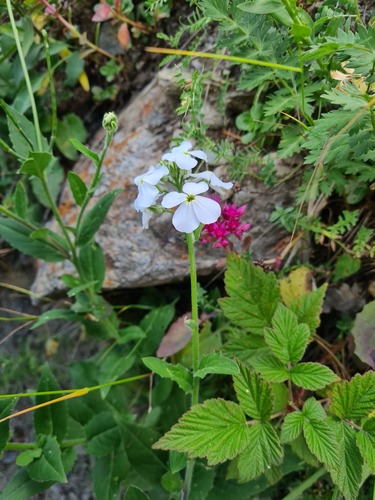
Siberian rocket is a lovely perennial that brings a touch of wild charm to your garden. It produces clusters of fragrant, pale purple or white flowers that really stand out in the spring. It is a hardy plant that thrives in cooler climates.
At a glance
- Care level
- Easy
- Plant type
- Perennial
- Light
- Partial shade to full sun
- Indoor light
- Bright indirect
- Water
- Every 3 to 7 days
- Mature size
- 3 feet
- Growth rate
- Medium
- Hardiness
- USDA 3 to 8
- Bloom time
- Late spring to mid summer
Care
Keep the soil consistently moist but not waterlogged to support healthy blooming. Watch for wilting leaves which often signal that the plant needs a drink. Deadhead spent flowers to encourage a second flush of blooms.
- Watering
- Water when the top inch of soil feels dry to the touch.
- Feeding
- Apply a balanced liquid fertilizer during the active growing season.
- Pruning
- Trim back faded flower stalks to keep the plant tidy and encourage new growth.
- Repotting
- Move to a slightly larger container once the roots begin to crowd the pot.
- Soil
- Well draining loamy soil
- Soil pH
- 6.0 to 7.5
- Temperature
- -30 to 25°C
- Humidity
- 40 to 70%
- Drought tolerance
- Moderate
- Lifespan
- Short lived perennial, typically 2 to 4 years.
- Fragrance
- Strong
- Deer and rabbits
- Moderate
Signs it needs repotting
- Roots growing out of the drainage holes.
- Water draining through the pot too quickly.
Safety
- People
- The plant is generally considered non-toxic but may cause mild stomach irritation if ingested in large quantities.
- Children
- Keep away from small children as the seeds can be a choking hazard.
- Contact allergens
- The foliage can cause mild skin irritation in sensitive individuals.
- Airborne allergens
- The flowers produce a sweet scent that may trigger mild hay fever in some people.
- Edibility
- While often listed as edible, the seeds and foliage can cause digestive upset in some people and should be avoided.
How to identify it
- Clusters of fragrant purple flowers
- Lance shaped toothed leaves
- Upright branching stems
- Four petaled cruciform flowers
- Height
- 0.4 to 1m
- Spread
- 0.3 to 0.45m
- Leaves
- green, deciduous
- Flowers
- purple, lavender, white, 1 to 2cm
- Fruit
- brown, late summer
Problems to watch for
- Powdery mildew · A white fungal growth on leaves often caused by poor air circulation.
Check your siberian rocket from a photo
Pocket Botanist looks at a photo of your plant and tells you what's wrong and what to try first.
Scan with your phone's camera to get the app
Or go to pocketbotanist.app/get on your phone
Growing it
- Propagation
- seed
- When to plant
- spring, autumn
- Overwintering
- Cut back the dead foliage in late autumn to keep the garden tidy. A light layer of mulch helps protect the crown during harsh freezes.
- In containers
- It grows well in containers at least 30 cm deep with good drainage.
Seed
- 1. Collect seeds in late summer.
- 2. Sow directly into the garden in autumn.
- 3. Keep the soil moist until germination.
Plant in groups to create a drift of color that attracts pollinators to your garden.
Grows well with
- Columbine · They share similar light and moisture requirements in woodland settings.
- Ferns · The contrasting textures look beautiful in a shaded border.
Similar species
- Dame's Rocket · A very similar looking plant that is considered invasive in many areas.
Science
- Family
- Brassicaceae
- Genus
- Hesperis
- Order
- Brassicales
- Class
- Magnoliopsida
- Native range
- Northern Asia and parts of Eastern Europe.
- Conservation
- Not currently of conservation concern.
It grows naturally in moist meadows and along forest edges where it benefits from dappled light.
- Value to wildlife
- nectar source
- Pollinators
- bees, butterflies, moths
- Uses
- cottage gardens, pollinator gardens, woodland borders
Through the year
Ecological indicators
- Salinity
- 1/9
- Soil reaction
- 6/9
- Light
- 5/9
- Temperature
- 3/9
- Moisture
- 6/9
- Nutrients
- 5/9
Taxonomy resolved against GBIF.
Questions people ask
- Is this plant invasive?
- It is much less aggressive than Hesperis matronalis but should still be monitored.
- Does it need full sun?
- It prefers partial shade but will tolerate full sun in cooler regions.
Where the name comes from
The genus name Hesperis comes from the Greek word for evening, referring to the scent of the flowers, while sibirica denotes its Siberian origins.
Good to know
- It is closely related to the common Dame's Rocket.
- The flowers are notably fragrant in the evening.
- It thrives in cooler climates where other species might struggle.
Keep your siberian rocket growing
This page is a general guide. Save your plant in Pocket Botanist and you get care reminders timed for this plant, plus a care history that shows what worked.
Scan with your phone's camera to get the app
Or go to pocketbotanist.app/get on your phone
This guide was generated with AI on and checked against GBIF taxonomy. It is general information, not horticultural or veterinary advice. Read about how we build these guides.