 Pocket Botanist
Plant guide
Hare's tail cottongrass.
Eriophorum vaginatum
Pronounced eh-ree-OH-for-um va-jin-AY-tum
Also known as Cottongrass, Hare's-Tail Cottongrass, Hare's-tail Cotton Sedge, Harestail, Tussock cottonsedge, dense cotton-grass, hare-tail cotton-grass



Scan with your phone's camera to get the app
Or go to pocketbotanist.app/get on your phone
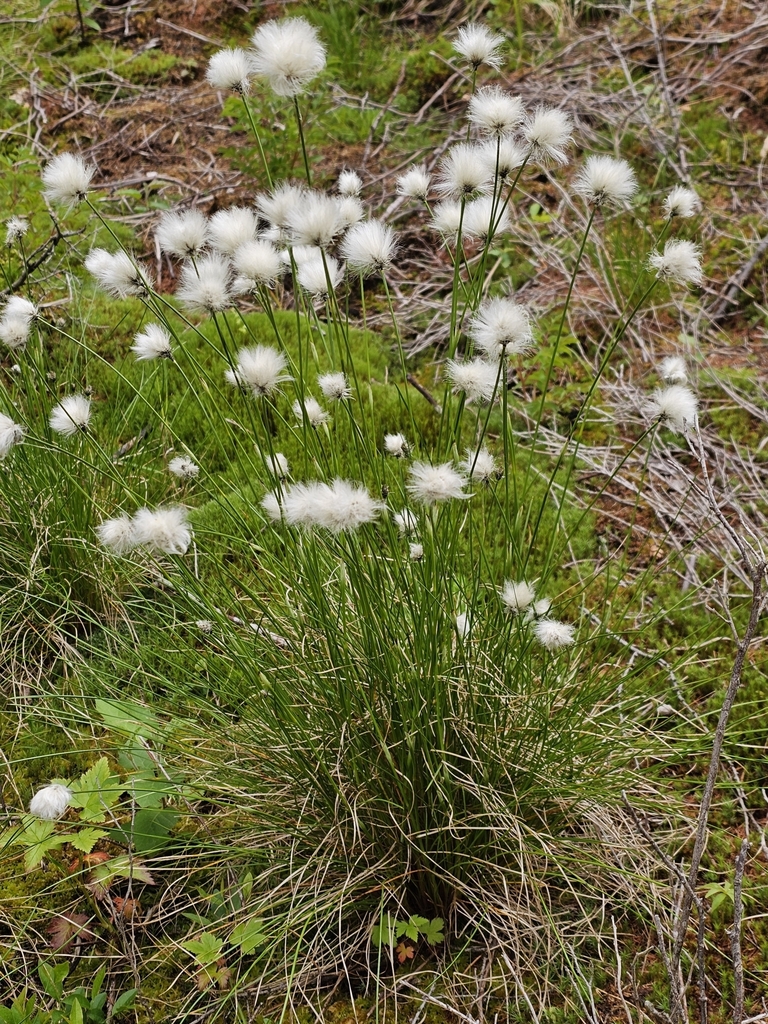
This charming sedge is a staple of boggy landscapes and wetlands. It produces distinctive, fluffy white seed heads that look just like little cotton tufts. It is a hardy perennial that brings a soft, wild texture to any damp garden spot.

At a glance
- Care level
- Moderate
- Plant type
- Sedge
- Light
- Full sun
- Indoor light
- Direct sun
- Water
- Every 1 to 3 days
- Mature size
- 2 feet
- Growth rate
- Medium
- Hardiness
- USDA 3 to 7
- Bloom time
- Late spring to early summer
Care
Keep the soil consistently saturated or standing in shallow water to mimic its natural wetland home. Watch for browning leaf tips, which often signal that the soil has dried out too much. Ensure it gets plenty of sun to encourage those signature fluffy heads.
- Watering
- Keep the soil constantly moist or submerged in shallow water.
- Feeding
- Usually does not need fertilizer, as it is adapted to nutrient poor bog soil.
- Pruning
- Cut back dead foliage in late winter or early spring.
- Repotting
- Divide the clumps every few years to keep the plant vigorous.
- Soil
- Peaty, acidic, wet soil
- Soil pH
- Acidic
- Temperature
- -40 to 25°C
- Humidity
- 60 to 100%
- Drought tolerance
- Low
- Lifespan
- Perennial, typically 5 to 10 years
- Deer and rabbits
- High
Signs it needs repotting
- Roots growing out of the drainage holes
- Stunted growth
- Center of the clump dying back
Safety
- People
- There is no evidence of toxicity in humans.
- Children
- The sharp, grass-like leaves can cause paper-cut style injuries, so keep it away from play areas.
- Contact allergens
- The leaves have sharp edges that can cause minor skin abrasions if handled without gloves.
- Airborne allergens
- The wind-dispersed pollen may cause mild respiratory irritation for sensitive individuals.
- Edibility
- This plant is not considered edible and is primarily grown for its ornamental value in bog gardens.
How to identify it
- Clump forming perennial sedge
- Tufted white cottony seed heads
- Slender grass like basal leaves
- Stiff upright flowering stems
- Height
- 0.3 to 0.6m
- Spread
- 0.2 to 0.4m
- Leaves
- green, blue-green, evergreen
- Flowers
- white, 1 to 3cm
- Fruit
- white, Late summer
Problems to watch for
- Root rot · Occurs if the soil lacks proper aeration in stagnant water.
Check your hare's tail cottongrass from a photo
Pocket Botanist looks at a photo of your plant and tells you what's wrong and what to try first.
Scan with your phone's camera to get the app
Or go to pocketbotanist.app/get on your phone
Growing it
- Propagation
- division, seed
- When to plant
- spring, autumn
- Overwintering
- Leave the foliage intact as it is evergreen and provides structure through the winter. It is fully hardy and does not require special protection from cold.
- In containers
- It grows well in containers as long as they are kept in a water tray to maintain constant moisture.
Division
- 1. Carefully lift the clump in spring.
- 2. Use a sharp spade to divide the root mass into smaller sections.
- 3. Replant immediately into wet, acidic soil.
Group plants that require constant moisture and acidic soil to ensure they all thrive in the same bog environment.
Grows well with
- Bog Rosemary · It shares the same affinity for acidic, wet bog conditions.
- Sundew · These small carnivorous plants thrive in the same nutrient-poor, wet environments.
- Marsh Marigold · It provides a bright yellow contrast to the white cotton heads.
Similar species
- Common Cottongrass · It has multiple flower heads per stem rather than the single head of E. vaginatum.
Science
- Family
- Cyperaceae
- Genus
- Eriophorum
- Order
- Poales
- Class
- Liliopsida
- Native range
- Circumpolar regions of the Northern Hemisphere.
- Conservation
- It is widespread in its native range and not currently of conservation concern.
It survives in waterlogged, acidic peat bogs by forming dense tussocks that stabilize the soil.
- Value to wildlife
- nesting material for birds, seeds for small mammals
- Pollinators
- bees, beetles
- Uses
- bog gardens, pond edges, naturalistic landscapes, dried floral arrangements
Through the year
Ecological indicators
- Salinity
- 1/9
- Soil reaction
- 2/9
- Light
- 8/9
- Temperature
- 2/9
- Moisture
- 9/9
- Nutrients
- 2/9
Taxonomy resolved against GBIF.
Questions people ask
- Does it need to be in water?
- It prefers very wet, boggy soil but does not need to be fully submerged.
- Can I grow it in a regular garden bed?
- Only if you have a dedicated bog area or a container that holds water, as it will die in dry soil.
Where the name comes from
The genus name Eriophorum comes from the Greek words for wool and bearing, referring to the cottony seed heads, while the species name vaginatum refers to the sheath-like leaves.
Good to know
- It is a sedge, not a true grass.
- The white tufts are actually modified bristles that help with wind dispersal.
- It thrives in acidic, nutrient-poor peat bogs.
- It is a classic plant for recreating a moorland aesthetic.
Also in
Keep your hare's tail cottongrass growing
This page is a general guide. Save your plant in Pocket Botanist and you get care reminders timed for this plant, plus a care history that shows what worked.
Scan with your phone's camera to get the app
Or go to pocketbotanist.app/get on your phone
This guide was generated with AI on and checked against GBIF taxonomy. It is general information, not horticultural or veterinary advice. Read about how we build these guides.