 Pocket Botanist
Plant guide
Black Bryony.
Dioscorea communis
Pronounced dy-oh-SKOR-ee-uh kom-YOO-nis
Also known as Black Bryony



Scan with your phone's camera to get the app
Or go to pocketbotanist.app/get on your phone
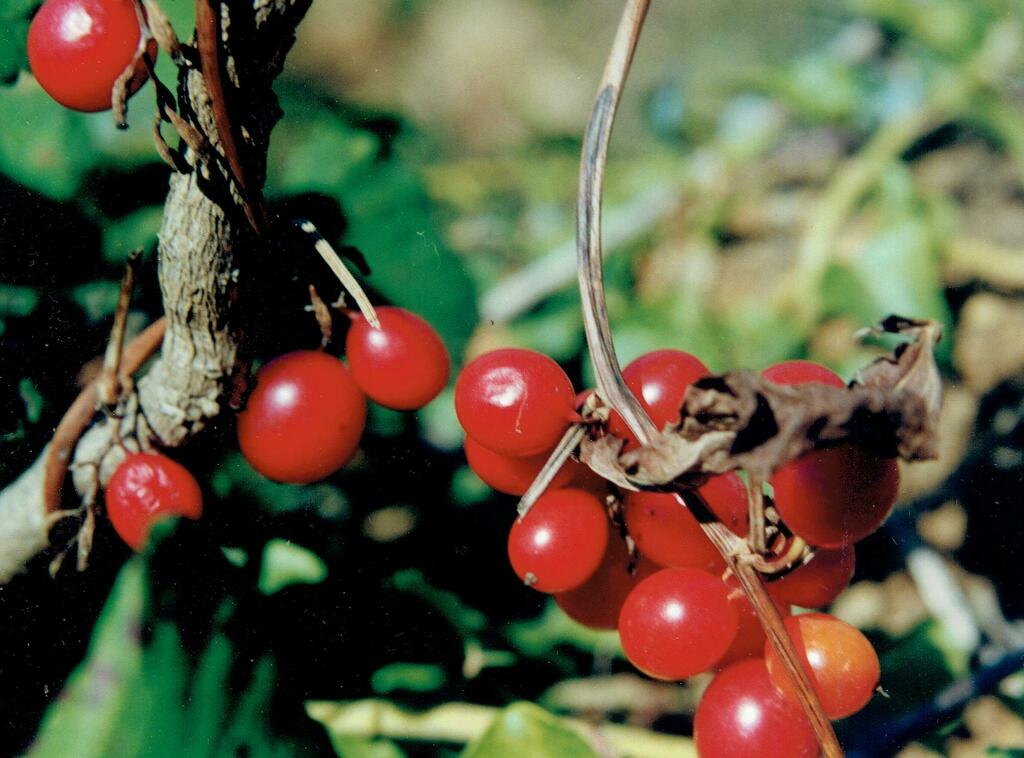
The black bryony is a fascinating climbing vine native to Europe and parts of North Africa. It is known for its heart shaped leaves and bright red berries that appear in late summer. You will often find it scrambling through hedgerows in the wild.
At a glance
- Care level
- Moderate
- Plant type
- Herbaceous perennial climber
- Light
- Partial shade to full sun
- Indoor light
- Bright indirect
- Water
- Every 5 to 10 days
- Mature size
- 3 to 4 meters
- Growth rate
- Fast
- Hardiness
- USDA 6 to 9
- Bloom time
- Late spring to early summer
Care
Provide a sturdy trellis for this vigorous climber to wrap its stems around. Watch for yellowing leaves which often indicate the plant is entering its natural dormancy period. Keep the soil consistently moist but ensure it drains well to prevent tuber rot.
- Watering
- Keep the soil moist during the active growing season but allow it to dry out slightly during winter dormancy.
- Feeding
- Apply a balanced liquid fertilizer once a month during the spring and summer months.
- Pruning
- Cut back dead stems to the ground once the foliage dies back completely in late autumn.
- Repotting
- Repot only when the tuberous roots have completely filled the container.
- Soil
- Well draining loamy soil
- Soil pH
- Neutral to alkaline
- Temperature
- -15 to 30°C
- Humidity
- 40 to 70%
- Drought tolerance
- Moderate
Signs it needs repotting
- Roots growing out of the drainage holes.
- Stunted growth during the active season.
Safety
- People
- The plant contains calcium oxalate crystals and saponins which cause severe irritation and poisoning.
- Pets
- This plant is toxic to cats and dogs if ingested, causing severe irritation and digestive upset.
- Children
- The bright red berries are highly attractive to children but are poisonous if eaten.
- Contact allergens
- The sap can cause severe skin irritation or contact dermatitis in sensitive individuals.
- Airborne allergens
- There is no significant evidence of respiratory allergies associated with this plant.
- Edibility
- All parts of this plant are toxic if ingested, especially the berries and tubers.
How to identify it
- Heart shaped glossy green leaves
- Twining stems that climb clockwise
- Clusters of small greenish flowers
- Bright red poisonous berries
- Large tuberous root system
- Height
- 2 to 4m
- Spread
- 0.3 to 0.6m
- Leaves
- green, deciduous
- Flowers
- greenish-yellow, 0.5 to 1cm
- Fruit
- red, Autumn
Problems to watch for
- Leaf spot · Fungal spots may appear on leaves during wet seasons.
Check your black bryony from a photo
Pocket Botanist looks at a photo of your plant and tells you what's wrong and what to try first.
Scan with your phone's camera to get the app
Or go to pocketbotanist.app/get on your phone
Growing it
- Propagation
- seed, division
- When to plant
- spring, autumn
- Overwintering
- The foliage dies back completely in winter. Leave the roots in the ground and mulch if you live in a very cold area.
Seed
- 1. Collect ripe red berries in autumn.
- 2. Clean the seeds from the pulp.
- 3. Sow immediately in pots outdoors to allow for natural cold stratification.
Provide sturdy woody shrubs for this plant to climb so it does not smother smaller perennials.
Grows well with
- Common Hazel · It naturally climbs through the branches of hazel trees in the wild.
- English Ivy · They share similar woodland edge habitats.
Similar species
- White Bryony · It shares a similar climbing habit and red berries but belongs to a different family.
Science
- Family
- Dioscoreaceae
- Genus
- Dioscorea
- Order
- Dioscoreales
- Class
- Liliopsida
- Native range
- Europe, North Africa, and Western Asia.
- Conservation
- This plant is common and not of conservation concern.
It grows in hedgerows and woodland edges where it climbs through shrubs for light.
- Value to wildlife
- nectar source, bird food
- Pollinators
- bees, beetles
- Uses
- ornamental climber, wildlife garden plant
Through the year
Ecological indicators
- Salinity
- 1/9
- Soil reaction
- 6/9
- Light
- 5/9
- Temperature
- 5/9
- Moisture
- 5/9
- Nutrients
- 5/9
Taxonomy resolved against GBIF.
Questions people ask
- Is it a true yam?
- No, it is in the same family as yams but is not edible and is toxic.
- Does it need a trellis?
- Yes, it is a climber that needs support to reach its full potential.
Where the name comes from
The genus name honors the Greek physician Dioscorides, while the species name means common.
Good to know
- It is the only member of the yam family native to Europe.
- The tubers can grow quite large and deep underground.
- It uses twining stems to climb over other vegetation.
Also in
Keep your black bryony growing
This page is a general guide. Save your plant in Pocket Botanist and you get care reminders timed for this plant, plus a care history that shows what worked.
Scan with your phone's camera to get the app
Or go to pocketbotanist.app/get on your phone
This guide was generated with AI on and checked against GBIF taxonomy. It is general information, not horticultural or veterinary advice. Read about how we build these guides.