 Pocket Botanist
Plant guide
Western marsh orchid.
Dactylorhiza majalis
Pronounced dak-tih-loh-RYE-zah mah-JAH-liss
Also known as Western Marsh-orchid, marsh orchid, salep



Scan with your phone's camera to get the app
Or go to pocketbotanist.app/get on your phone

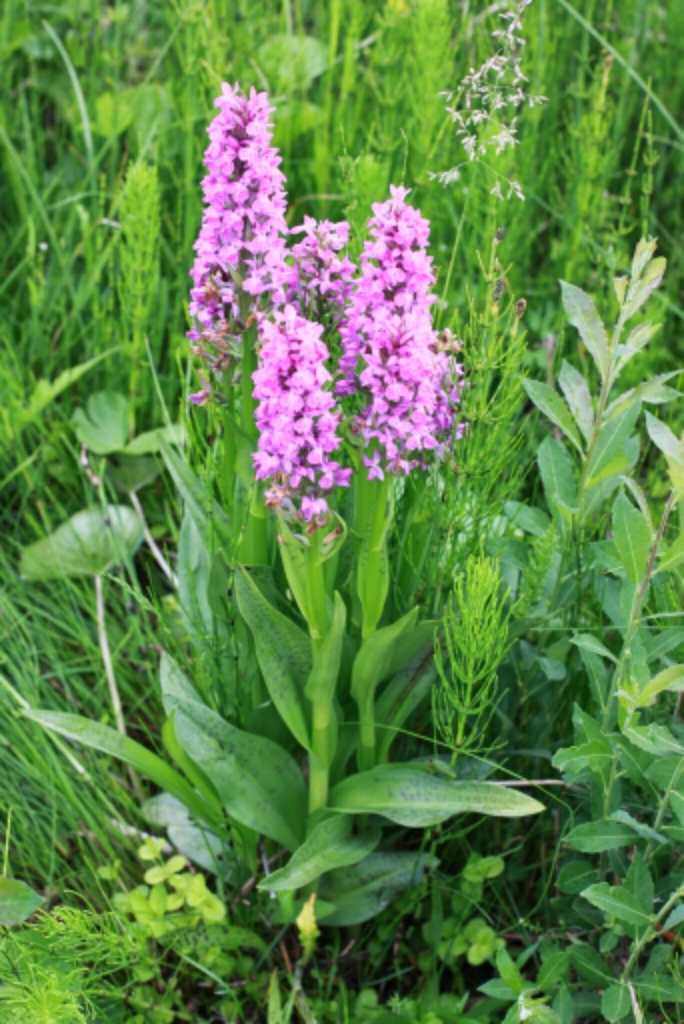
The western marsh orchid is a beautiful perennial that thrives in damp meadows and fens. It produces striking spikes of purple flowers in late spring. You will love how its spotted leaves add interest even when it is not in bloom.
At a glance
- Care level
- Moderate
- Plant type
- Terrestrial orchid
- Light
- Partial shade to full sun
- Indoor light
- Bright indirect
- Water
- Every 2 to 5 days
- Mature size
- 15 to 40 cm
- Growth rate
- Slow
- Hardiness
- USDA 4 to 8
- Bloom time
- Late spring to early summer
Care
Keep the soil consistently moist to mimic its natural boggy habitat. Watch for yellowing leaves which often signal that the soil has dried out too much. Ensure the plant gets plenty of light but protect it from harsh afternoon sun.
- Watering
- Keep the soil damp at all times but avoid letting the plant sit in stagnant water.
- Feeding
- Use a weak, balanced liquid fertilizer during the active growing season.
- Pruning
- Remove dead flower stalks after the plant has finished blooming.
- Repotting
- Repot only when the plant has clearly outgrown its container or the soil has degraded.
- Soil
- Moist, neutral to alkaline soil
- Soil pH
- 6.0 to 8.0
- Temperature
- -34 to 25°C
- Humidity
- 60 to 90%
Safety
- People
- There is no evidence of significant toxicity, but it is not intended for human consumption.
- Children
- The plant is not inherently dangerous, but children should be supervised to prevent accidental ingestion of garden plants.
- Edibility
- This plant is not considered edible and should not be consumed.
How to identify it
- Spikes of purple flowers
- Dark purple leaf spots
- Hollow flowering stems
- Palmate tuberous roots
- Height
- 0.2 to 0.5m
- Spread
- 0.15 to 0.3m
- Leaves
- green, spotted, deciduous
- Flowers
- purple, pink, 1 to 2cm
Problems to watch for
- Slugs · Slugs can feed on the tender new growth in spring.
Check your western marsh orchid from a photo
Pocket Botanist looks at a photo of your plant and tells you what's wrong and what to try first.
Scan with your phone's camera to get the app
Or go to pocketbotanist.app/get on your phone
Growing it
- Propagation
- division, seed
- When to plant
- spring, autumn
Group these with other moisture loving perennials to create a stable wetland microclimate.
Grows well with
- Marsh Marigold · They share similar requirements for wet, boggy soil conditions.
- Ragged Robin · This companion thrives in the same damp meadow habitats.
Similar species
- Common Spotted Orchid · It is a closely related species with similar growth habits and appearance.
Science
- Family
- Orchidaceae
- Genus
- Dactylorhiza
- Order
- Asparagales
- Class
- Liliopsida
- Native range
- Europe and parts of western Asia.
- Conservation
- It is protected in many parts of its native range due to habitat loss.
It relies on specific soil fungi to provide nutrients to its tiny seeds during germination.
- Value to wildlife
- attracts bumblebees (flowers offer no nectar)
- Pollinators
- bees, butterflies
- Uses
- bog gardens, wildlife meadows, wetland restoration
Through the year
Ecological indicators
- Salinity
- 1/9
- Soil reaction
- 6/9
- Light
- 6/9
- Temperature
- 4/9
- Moisture
- 8/9
- Nutrients
- 2/9
Taxonomy resolved against GBIF.
Questions people ask
- Does it need full sun?
- It prefers full sun to partial shade in consistently moist soil.
- Can I grow it in a regular garden bed?
- Only if you can maintain very high soil moisture levels year round.
Where the name comes from
Dactylorhiza comes from the Greek words for finger and root, referring to the tuber shape, while majalis means blooming in May.
Good to know
- It is a terrestrial orchid that thrives in damp meadows.
- The leaves often feature dark purple spots.
- It requires specific mycorrhizal fungi in the soil to germinate from seed.
Keep your western marsh orchid growing
This page is a general guide. Save your plant in Pocket Botanist and you get care reminders timed for this plant, plus a care history that shows what worked.
Scan with your phone's camera to get the app
Or go to pocketbotanist.app/get on your phone
This guide was generated with AI on and checked against GBIF taxonomy. It is general information, not horticultural or veterinary advice. Read about how we build these guides.