 Pocket Botanist
Plant guide
American beautyberry.
Callicarpa americana
Pronounced kal-li-KAR-pa uh-mer-i-KAH-nuh
Also known as American Beautyberry, American beauty-berry, French-mulberry, beauty-berry, turkey berry



Scan with your phone's camera to get the app
Or go to pocketbotanist.app/get on your phone
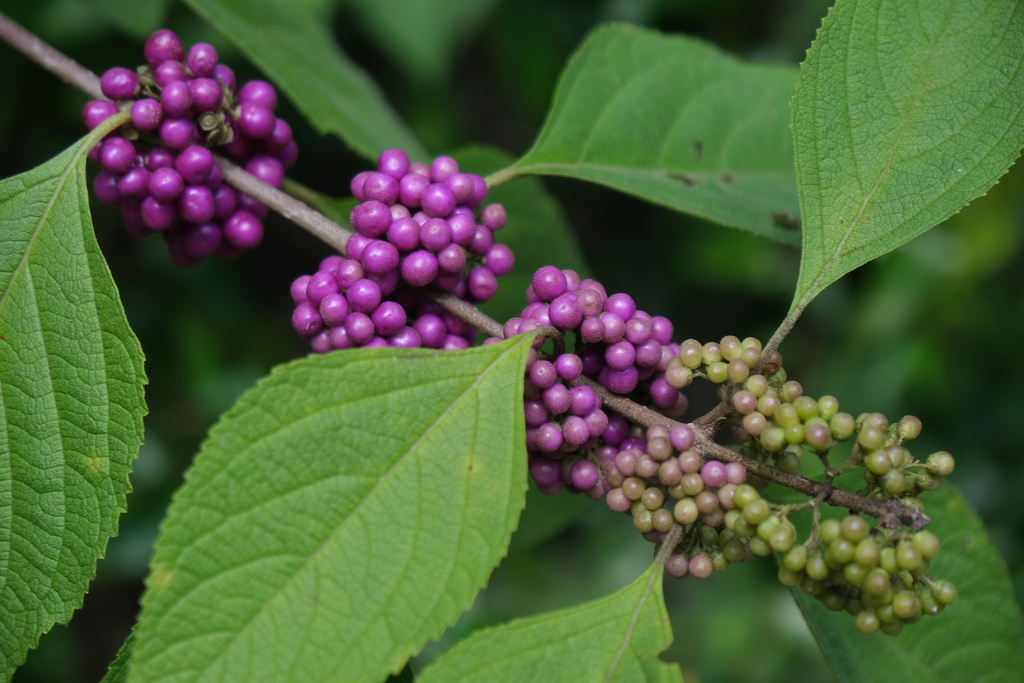
The American beautyberry is a lovely native shrub known for its clusters of vibrant, magenta berries. It adds a wonderful splash of color to woodland gardens during the late summer and fall. Birds absolutely adore the fruit, making it a fantastic choice for wildlife enthusiasts.
At a glance
- Care level
- Easy
- Plant type
- Deciduous shrub
- Light
- Partial shade to full sun
- Indoor light
- Bright indirect
- Water
- Every 5 to 10 days
- Mature size
- 2 to 3 meters
- Growth rate
- Fast
- Hardiness
- USDA 6 to 10
- Bloom time
- Late spring to early summer
Care
This shrub prefers a spot with dappled shade and consistent moisture. Prune it back in late winter to encourage a bushier shape and more berries for the following season. Watch for leaf spot or scale if the air circulation is poor.
- Watering
- Keep the soil consistently moist but never waterlogged.
- Feeding
- Apply a balanced, slow release fertilizer once in early spring.
- Pruning
- Prune back hard in late winter to stimulate new growth.
- Repotting
- Repot only if the shrub is container grown and becomes root bound.
- Soil
- Well draining, organic rich soil
- Soil pH
- Acidic to neutral
- Temperature
- -23 to 35°C
- Humidity
- 40 to 70%
- Drought tolerance
- Moderate
- Lifespan
- Perennial, typically 10 to 20 years
- Deer and rabbits
- Moderate
Signs it needs repotting
- Roots growing out of drainage holes
- Water running straight through the pot
- Stunted growth during the active season
Safety
- People
- The plant is generally considered non toxic to humans, though ingestion of large amounts of raw berries is not recommended.
- Pets
- This plant is not known to be toxic to cats or dogs.
- Children
- The bright berries might look like candy to small children, so supervise them to prevent accidental ingestion.
- Contact allergens
- There are no significant reports of skin irritation from handling this shrub.
- Airborne allergens
- The pollen may cause mild reactions in sensitive individuals during the flowering season.
- Edibility
- While the berries are often used in jellies, they should not be consumed raw in large quantities due to potential digestive upset.
How to identify it
- Clusters of bright magenta berries
- Opposite, large, serrated green leaves
- Loose, arching, open growth habit
- Small, light pink or lavender flowers
- Height
- 1.2 to 2.4m
- Spread
- 1.2 to 2.4m
- Leaves
- green, deciduous
- Flowers
- pink, lavender, 0.3 to 0.5cm
- Fruit
- magenta, purple, Late summer to autumn
Problems to watch for
- Leaf SpotCommon
- CaterpillarsUncommon
- Root RotUncommon
- Sooty MoldRare
Check your american beautyberry from a photo
Pocket Botanist looks at a photo of your plant and tells you what's wrong and what to try first.
Scan with your phone's camera to get the app
Or go to pocketbotanist.app/get on your phone
Growing it
- Propagation
- seed, cuttings
- When to plant
- spring, autumn
- Overwintering
- Mulch the base in late autumn to protect the roots from extreme temperature fluctuations. Prune back dead wood in late winter before new growth begins.
- In containers
- It can grow in large containers, but it prefers being planted in the ground to reach its full size.
Softwood Cuttings
- Take 15 cm cuttings in early summer.
- Remove lower leaves.
- Dip in rooting hormone and place in moist soil.
Plant this shrub in groups to ensure better cross pollination and a heavier crop of berries.
Grows well with
- Oakleaf Hydrangea · They share similar light and moisture requirements in woodland settings.
- Christmas Fern · This fern provides a nice evergreen contrast to the deciduous shrub.
Similar species
- Japanese Beautyberry · It is a smaller, more compact relative often used in smaller gardens.
Science
- Family
- Lamiaceae
- Genus
- Callicarpa
- Order
- Lamiales
- Class
- Magnoliopsida
- Native range
- Southeastern United States
- Conservation
- This species is common and secure throughout its native range.
It thrives in the understory of woodlands where it benefits from dappled light and moist soil conditions.
- Value to wildlife
- nectar source, provides winter food for birds
- Pollinators
- bees, butterflies
- Uses
- ornamental shrub, wildlife garden, jelly making
Through the year
Ecological indicators
- Salinity
- 2/9
- Light
- 5/9
- Temperature
- 6/9
- Soil reaction
- 6/9
- Moisture
- 6/9
- Nutrients
- 5/9
Taxonomy resolved against GBIF.
Questions people ask
- Does it need full sun?
- It grows best in partial shade but will tolerate full sun if the soil stays moist.
- How do I prune it?
- Prune it back in late winter to encourage new growth and more berries.
Where the name comes from
The genus name Callicarpa comes from Greek words meaning beautiful fruit, while the species name americana denotes its origin in the Americas.
Good to know
- The berries are a favorite food source for northern mockingbirds.
- It is commonly known as French mulberry despite not being a true mulberry.
- The crushed leaves have been used historically as a natural mosquito repellent.
Keep your american beautyberry growing
This page is a general guide. Save your plant in Pocket Botanist and you get care reminders timed for this plant, plus a care history that shows what worked.
Scan with your phone's camera to get the app
Or go to pocketbotanist.app/get on your phone
This guide was generated with AI on and checked against GBIF taxonomy. It is general information, not horticultural or veterinary advice. Read about how we build these guides.