 Pocket Botanist
Plant guide
Queensland kauri.
Agathis robusta
Pronounced AG-uh-thiss roh-BUS-tuh
Also known as Dundathu-pine, North Queensland kauri, North Queensland kauri-pine, Queensland Kauri, Queensland kauri-pine, South Queensland kauri, South Queensland kauri-pine, australian-kauri



Scan with your phone's camera to get the app
Or go to pocketbotanist.app/get on your phone
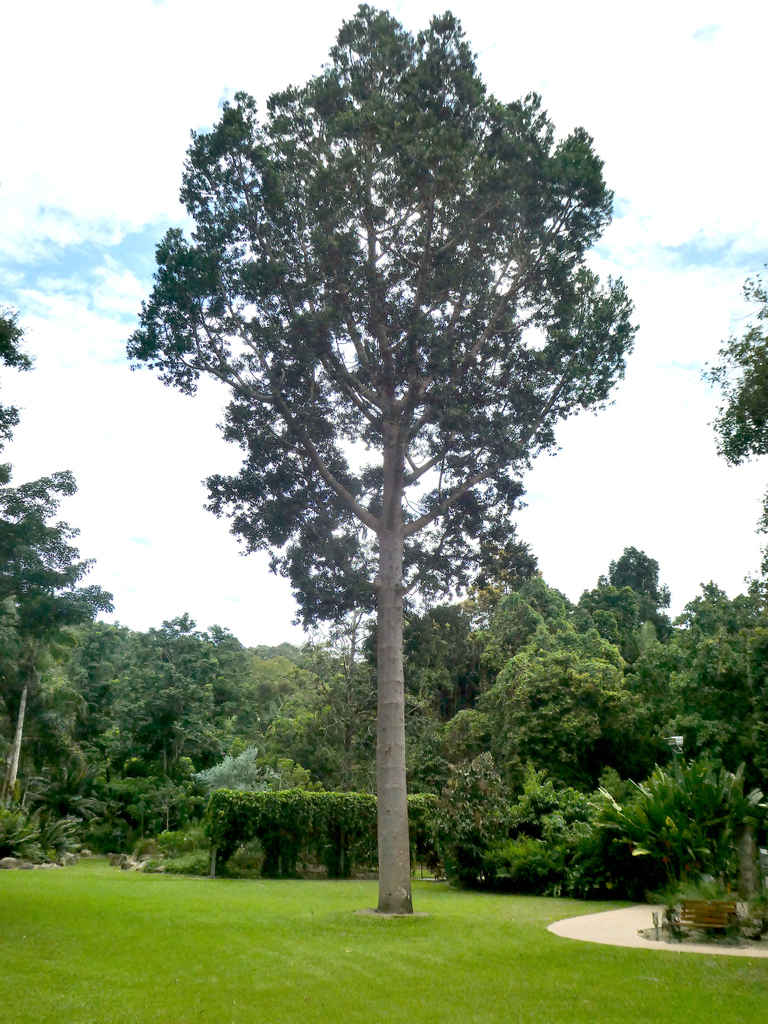
The Queensland kauri is a magnificent, towering conifer native to the rainforests of Australia. It is known for its massive, straight trunk and unique, leathery leaves. This tree is best suited for large outdoor landscapes where it has plenty of room to grow.
At a glance
- Care level
- Moderate
- Plant type
- Conifer
- Light
- Full sun to partial shade
- Indoor light
- Bright indirect
- Water
- Every 7 to 14 days
- Mature size
- 30 to 50 meters
- Growth rate
- Slow
- Hardiness
- USDA 9 to 11
- Bloom time
- Late spring to early summer
Care
Provide deep, well-draining soil and consistent moisture to keep this tree happy. Watch for yellowing leaves which can indicate poor drainage or nutrient issues. It prefers a humid environment, so keep it away from harsh, drying winds.
- Watering
- Keep the soil consistently moist but never waterlogged.
- Feeding
- Apply a balanced slow-release fertilizer during the growing season.
- Pruning
- Prune only to remove dead or damaged branches.
- Repotting
- Repot only if the tree is in a container and has become root-bound.
- Soil
- Deep, fertile, well-draining soil
- Soil pH
- Acidic to neutral
- Temperature
- 5 to 35°C
- Humidity
- 60 to 90%
Safety
- People
- There is no known toxicity in this plant for humans.
- Children
- The large, heavy cones can pose a falling hazard to children playing beneath the tree.
- Contact allergens
- The resin may cause mild skin irritation in sensitive individuals.
- Airborne allergens
- Pollen can be a minor irritant during the flowering season.
- Edibility
- The seeds are not considered a food source and should not be eaten.
How to identify it
- Massive straight grey trunk
- Leathery oval shaped leaves
- Large woody seed cones
- Smooth peeling bark
- Height
- 15 to 50m
- Spread
- 6 to 15m
- Leaves
- dark green, evergreen
- Flowers
- yellowish, 1 to 3cm
- Fruit
- brown, Autumn
Problems to watch for
- Root rot · Occurs in poorly drained soils where water pools around the base.
Check your queensland kauri from a photo
Pocket Botanist looks at a photo of your plant and tells you what's wrong and what to try first.
Scan with your phone's camera to get the app
Or go to pocketbotanist.app/get on your phone
Growing it
- Propagation
- seed
- When to plant
- spring, autumn
Plant shade loving ferns around the base to help retain soil moisture and mimic the forest floor.
Grows well with
- Bird's Nest Fern · It enjoys the dappled shade provided by the Kauri canopy.
- Bangalow Palm · This palm shares similar moisture requirements and thrives in the same subtropical environment.
Similar species
- New Zealand Kauri · It is a close relative with a similar growth habit and historical significance.
Science
- Family
- Araucariaceae
- Genus
- Agathis
- Order
- Pinales
- Class
- Pinopsida
- Native range
- Coastal regions of Queensland, Australia.
- Conservation
- It is not currently listed as endangered, though habitat loss remains a concern in its native range.
It thrives in subtropical rainforests where it competes for light by growing tall above the canopy.
- Value to wildlife
- provides nesting habitat, seeds eaten by birds
- Uses
- ornamental specimen, timber production, shade tree
Through the year
Ecological indicators
- Salinity
- 2/9
- Soil reaction
- 5/9
- Light
- 8/9
- Temperature
- 8/9
- Moisture
- 6/9
- Nutrients
- 5/9
Taxonomy resolved against GBIF.
Questions people ask
- How fast does it grow?
- It is a relatively slow grower in its early years but picks up speed once established.
- Can I grow this in a small garden?
- No, it is a massive forest tree that requires significant space to reach maturity.
Where the name comes from
The genus name Agathis comes from the Greek word for a ball of thread, referring to the shape of the female cones. The species name robusta highlights the sturdy and impressive stature of this tree.
Good to know
- It is commonly known as the Queensland Kauri.
- The bark peels off in large flakes as the tree grows.
- It can live for several hundred years in ideal conditions.
- The wood is highly prized for its fine grain and strength.
Keep your queensland kauri growing
This page is a general guide. Save your plant in Pocket Botanist and you get care reminders timed for this plant, plus a care history that shows what worked.
Scan with your phone's camera to get the app
Or go to pocketbotanist.app/get on your phone
This guide was generated with AI on and checked against GBIF taxonomy. It is general information, not horticultural or veterinary advice. Read about how we build these guides.