 Pocket Botanist
Guide botanique
Mock orange.
Philadelphus
Prononciation fill-uh-DELL-fuss
Aussi appelée mock orange, mock oranges, mock-orange, mock-oranges, mockorange, syringa



Le Jasmin d'été est un arbuste à feuilles caduques merveilleux, connu pour ses fleurs blanches incroyablement parfumées qui fleurissent à la fin du printemps. Il constitue un ajout classique à tout jardin, surtout près des fenêtres ou des allées où vous pouvez profiter de son parfum. Ces arbustes sont assez résistants et apportent une touche charmante et traditionnelle à votre paysage.
En un coup d'œil
- Niveau d'entretien
- Facile
- Type de plante
- Arbuste à feuilles caduques
- Lumière
- Plein soleil à ombre partielle
- Lumière en intérieur
- Lumière vive indirecte
- Arrosage
- Tous les 7 à 14 jours
- Taille adulte
- 8 à 12 pieds
- Croissance
- Moyenne
- Rusticité
- USDA 4 à 8
- Floraison
- Fin du printemps au début de l'été
Entretien
Plantez dans un sol bien drainé et donnez-lui beaucoup d'espace pour son port naturellement arqué. Surveillez le jaunissement des feuilles, qui pourrait indiquer un mauvais drainage ou trop d'ombre. Taillez immédiatement après la floraison pour encourager une nouvelle croissance pour l'année suivante.
- Arrosage
- Arrosez profondément pendant les périodes sèches pour garder la zone racinaire constamment humide mais pas détrempée.
- Engrais
- Appliquez un engrais équilibré à libération lente au début du printemps, juste au moment où la nouvelle croissance commence.
- Taille
- Taille les tiges ayant fleuri d'un tiers immédiatement après la disparition des fleurs.
- Rempotage
- Si cultivé en pot, transplantez dans un pot plus grand tous les quelques années pour renouveler le sol.
- Sol
- Sol limoneux bien drainé
- pH du sol
- 6.0 à 7.5
- Température
- -25 à 35°C
- Humidité
- 40 à 70%
- Résistance à la sécheresse
- Moyenne
- Durée de vie
- Vivace, généralement 15 à 20 ans ou plus.
- Parfum
- Fort
- Résistance aux chevreuils et lapins
- Moyenne
Signes qu'il faut rempoter
- Les racines sortent des trous de drainage.
- L'eau s'écoule très lentement ou pas du tout.
- La plante se dessèche beaucoup plus rapidement que d'habitude.
- Accumulation visible de sel ou de minéraux à la surface du sol.
Sécurité
- Humains
- Cette plante est généralement considérée comme non toxique pour l'homme.
- Enfants
- Les tiges sont ligneuses et peuvent être pointues si elles sont cassées, mais il n'y a pas de risque d'ingestion spécifique pour les enfants.
- Allergènes de contact
- Certaines personnes peuvent ressentir une légère irritation cutanée au contact du feuillage.
- Allergènes aéroportés
- Le fort parfum des fleurs peut déclencher des sensibilités chez certaines personnes.
- Comestibilité
- La plante n'est pas considérée comme comestible et ne doit pas être consommée.
Comment l'identifier
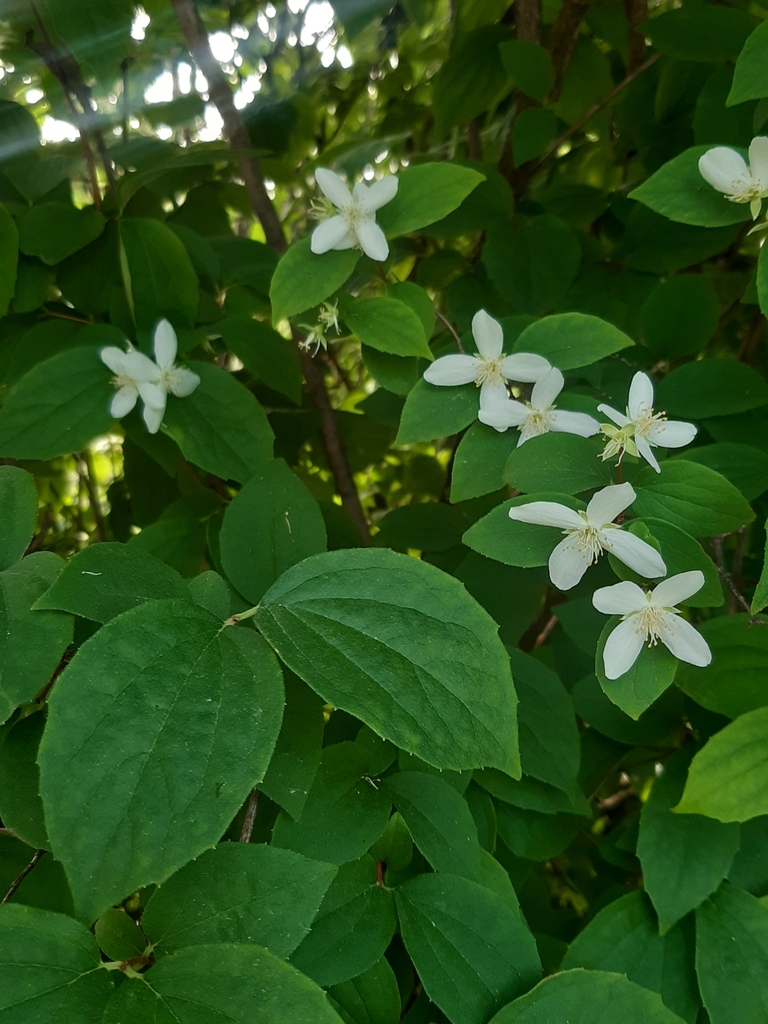
- Fleurs parfumées blanches à quatre pétales
- Feuilles simples ovales opposées
- Écorce papyracée s'écaillant sur les vieilles tiges
- Rameaux ligneux arqués
- Hauteur
- 1,5 à 3m
- Envergure
- 1,5 à 2,5m
- Feuilles
- vert, caduc
- Fleurs
- blanc, 2 à 5cm
Problèmes à surveiller
- OïdiumCourant
- PuceronsCourant
- ChlorosePeu courant
- CochenillesPeu courant
- Pourriture des racinesPeu courant
- Taches foliairesPeu courant
- Mildiou poudreux — Un problème fongique causant des taches blanches poudreuses sur les feuilles.
Par symptôme
Vérifie la santé de ta plante en photo
Pocket Botanist analyse une photo de ta plante et te dit ce qui ne va pas et quoi essayer en premier.
La cultiver
- Multiplication
- boutures, division
- Quand planter
- printemps, automne
- Hivernage
- Le Philadelphus est un arbuste rustique qui ne nécessite généralement pas de soins spéciaux pour l'hivernage. Dans les régions très froides, une couche de paillis autour de la base peut aider à protéger les racines des fluctuations de température extrêmes.
- En pot
- Le Philadelphus peut être cultivé en conteneur, mais il préfère un pot plus grand, d'au moins 15 à 20 gallons, pour accueillir son système racinaire et sa taille éventuelle.
Boutures de bois tendre
- Prenez des boutures de 10 à 15 cm sur la nouvelle croissance à la fin du printemps ou au début de l'été.
- Retirez les feuilles inférieures et trempez l'extrémité coupée dans de l'hormone d'enracinement.
- Insérez les boutures dans un mélange de terreau humide.
- Gardez constamment humide et fournissez une lumière vive et indirecte.
- Les racines devraient se former en 4 à 6 semaines.
Boutures de bois dur
- Prenez des boutures de 15 à 25 cm de bois mature dormant à la fin de l'automne ou en hiver.
- Retirez les feuilles inférieures et les pousses latérales.
- Insérez les boutures dans un lit préparé de sable humide ou de terreau, en laissant deux bourgeons exposés.
- Gardez le milieu constamment humide et protégez des conditions hivernales rigoureuses.
- Les racines se forment généralement au printemps.
Division
- Dégagez les touffes établies au début du printemps ou à l'automne.
- Divisez soigneusement la motte en sections, en vous assurant que chaque section a des racines et des pousses.
- Replantez immédiatement les divisions à la même profondeur.
- Arrosez abondamment après la plantation.
Plantez près d'autres arbustes à floraison printanière pour créer une succession de couleurs et de parfums.
Bonnes associations
- Weigelia ancienne — Ils partagent des exigences similaires en matière de sol et de lumière.
- Pivoine — Leurs périodes de floraison se chevauchent souvent pour un bel affichage.
Espèces similaires
- Deutzia — Ils ont des habitudes de croissance et des fleurs blanches similaires.
Science
- Famille
- Hydrangeaceae
- Genre
- Philadelphus
- Ordre
- Cornales
- Classe
- Magnoliopsida
- Région d'origine
- Amérique du Nord, Europe et Asie.
- Préservation
- Cette plante n'est pas préoccupante en matière de conservation.
Il pousse en lisière de bois et dans les fourrés où il bénéficie d'une lumière tamisée et d'un sol bien drainé et humide.
- Intérêt pour la faune
- source de nectar
- Pollinisateurs
- abeilles, papillons
- Utilisations
- arbuste d'ornement, ajout parfumé au jardin, plante de haie
Au fil des saisons
Repères écologiques
- Salinité
- 2/9
- Réaction du sol
- 6/9
- Lumière
- 6/9
- Humidité
- 5/9
- Nutriments
- 5/9
- Température
- 5/9
Taxonomie vérifiée avec le GBIF.
Ce qu'on demande souvent
- Quand dois-je tailler mon Philadelphus ?
- Taillez immédiatement après la floraison pour encourager une nouvelle croissance pour l'année suivante.
- A-t-il besoin de plein soleil ?
- Il prospère en plein soleil mais tolère la mi-ombre.
D'où vient le nom
Le nom scientifique Philadelphus vient du grec 'amour fraternel', tandis que le nom commun fait référence à son odeur d'orange.
Bon à savoir
- Les fleurs de Philadelphus sont célèbres pour leur parfum intense et sucré.
- C'était un choix populaire dans les jardins victoriens pour son parfum.
- Le nom du genre Philadelphus honore un ancien roi égyptien.
- Ces arbustes demandent très peu d'entretien une fois établis.
Garde ta plante en pleine forme
Cette page est un guide général. Enregistre ta plante dans Pocket Botanist et tu reçois des rappels d'entretien adaptés à cette plante, ainsi qu'un historique d'entretien qui montre ce qui a marché.
Ce guide a été généré par IA et vérifié avec la taxonomie du GBIF. Il s'agit d'informations générales, et non de conseils horticoles ou vétérinaires. Découvre comment nous concevons ces guides.