 Pocket Botanist
Pflanzenratgeber
thymeleaf speedwell.
Veronica serpyllifolia
Aussprache veh-RON-ih-kuh ser-pill-ih-FOH-lee-uh
Auch bekannt als Thyme Leaved Speedwell, Thyme Speedwell, Thyme-leaf Speedwell, Thyme-leaved Speedwell, Thymeleaf Speedwell, Turf speedwell


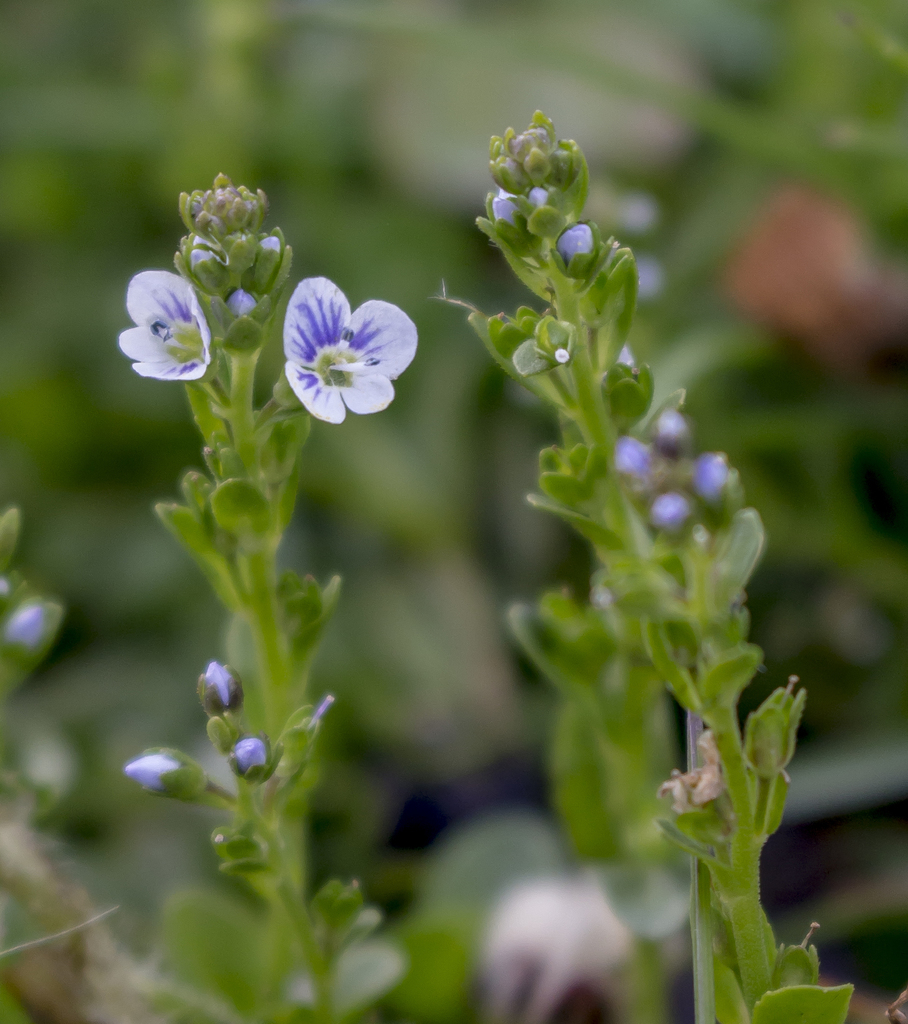
This charming little ground cover is a common sight in lawns and damp meadows. It spreads by creeping stems that root at the nodes. You will love its tiny, delicate flowers that appear in late spring.

Auf einen Blick
- Pflegestufe
- Einfach
- Pflanzenart
- Perennial herb
- Licht
- Partial shade to full sun
- Licht im Innenraum
- Hell, indirekt
- Gießen
- Alle 3 bis 7 Tage
- Endgröße
- 4 to 8 inches tall
- Wachstum
- Schnell
- Winterhärte
- USDA 3 bis 9
- Blütezeit
- Mid to late spring
Pflege
Keep the soil consistently moist as this plant prefers damp conditions. Watch for wilting if the soil dries out too much during hot weather. It thrives in cool, shaded areas of the garden.
- Gießen
- Keep the soil evenly moist but never waterlogged.
- Düngen
- Apply a balanced liquid fertilizer during the active growing season.
- Schneiden
- Trim back after flowering to keep the patch tidy.
- Umtopfen
- Repot if the plant becomes root bound or the soil loses its structure.
- Boden
- Moist, well draining soil
- Boden-pH
- 6.0 to 7.5
- Temperatur
- -25 bis 30°C
- Luftfeuchtigkeit
- 40 bis 70%
- Trockenheitstoleranz
- Gering
- Lebensdauer
- Perennial, typically 3 to 5 years.
- Wildverbiss-Resistenz
- Mittel
Anzeichen fürs Umtopfen
- Roots growing out of drainage holes
- Plant growth slows significantly
- Soil becomes compacted and drains poorly
Sicherheit
- Menschen
- There are no significant reports of human toxicity for this species.
- Kinder
- The plant is not known to be a choking hazard or toxic if handled by children.
- Kontaktallergene
- There is no evidence of skin irritation from handling this plant.
- Allergene in der Luft
- The pollen may cause minor reactions in sensitive individuals during the flowering season.
- Essbarkeit
- This plant is not considered edible and should be avoided for consumption.
So erkennst du die Pflanze
- Opposite oval leaves
- Creeping stems rooting at nodes
- Small white or pale blue flowers
- Flowers have dark purple veins
- Höhe
- 0,05 bis 0,2m
- Breite
- 0,15 bis 0,4m
- Blätter
- green, semi-evergreen
- Blüten
- white, pale blue, 0,5 bis 1cm
Häufige Probleme
- Powdery mildew — A fungal infection that appears as white dusty patches on the leaves during humid weather.
Standort und Pflege
- Vermehrung
- division, seed
- Pflanzzeit
- spring, autumn
- Überwinterung
- It remains semi-evergreen in mild climates and requires no special protection, though it may die back slightly in harsh freezes.
- Im Kübel
- It grows well in shallow, wide containers at least 10 cm deep to accommodate its creeping root system.
Division
- 1. Dig up a clump in spring.
- 2. Gently pull the rooted stems apart.
- 3. Replant immediately in moist soil.
Pair this plant with other moisture-loving ground covers to create a consistent, low-maintenance carpet.
Gute Pflanzpartner
- Lysimachia nummularia — Both plants enjoy similar moist soil conditions and provide a lush ground cover.
- Bugleweed — They share similar growth habits and thrive in partially shaded, damp spots.
Ähnliche Arten
- germander speedwell — It has a similar appearance but features larger, more vibrant blue flowers.
Botanisches
- Familie
- Plantaginaceae
- Gattung
- Veronica
- Ordnung
- Lamiales
- Klasse
- Magnoliopsida
- Ursprüngliche Heimat
- Widespread across temperate regions of Europe, Asia, and North America.
- Artenschutz
- It is a common and widespread species with no special conservation concerns.
It thrives in moist, open habitats where it can outcompete other small plants by forming dense, low-growing mats.
- Nutzen für Wildtiere
- nectar source
- Bestäuber
- Bienen, Schmetterlinge
- Verwendung
- ground cover, rock garden filler, lawn weed
Im Jahresverlauf
Ökologische Zeigerwerte
- Salzgehalt
- 1/9
- Bodenreaktion
- 5/9
- Licht
- 6/9
- Temperatur
- 4/9
- Feuchtigkeit
- 7/9
- Nährstoffe
- 5/9
Taxonomie abgeglichen mit GBIF.
Häufige Fragen
- Is this plant a weed?
- It is often considered a lawn weed because it spreads rapidly in moist, low-cut turf.
- Can I grow it in a pot?
- Yes, it makes a lovely, low-maintenance ground cover for shallow containers.
Woher der Name kommt
The genus name Veronica honors Saint Veronica, while the species name serpyllifolia means thyme-leaved.
Gut zu wissen
- It is commonly known as thyme-leaved speedwell because its leaves resemble those of thyme.
- The plant spreads by creeping stems that root at the nodes.
- It is often found growing in damp, grassy areas across the northern hemisphere.
Probleme mit thymeleaf speedwell?
Diese Seite bietet allgemeine Infos. Pocket Botanist erkennt Probleme anhand eines Fotos deiner echten Pflanze, passt das Gießen an dein Licht und deinen Standort an und erinnert dich an die Pflege.
Dieser Ratgeber wurde mit KI erstellt und mit der GBIF-Taxonomie abgeglichen. Er dient zur allgemeinen Information und ersetzt keine gärtnerische oder tierärztliche Beratung. Hier erfährst du, wie wir diese Ratgeber erstellen.