 Pocket Botanist
Pflanzenratgeber
Cleavers.
Galium aparine
Aussprache GAL-ee-um ah-pah-REE-nee
Auch bekannt als Bedstraw, Bedstraw, Cleavers, Bobby Buttons, Catchweed Bedstraw, Cleavers, Cleaverwort, Clivers, Goose Grass


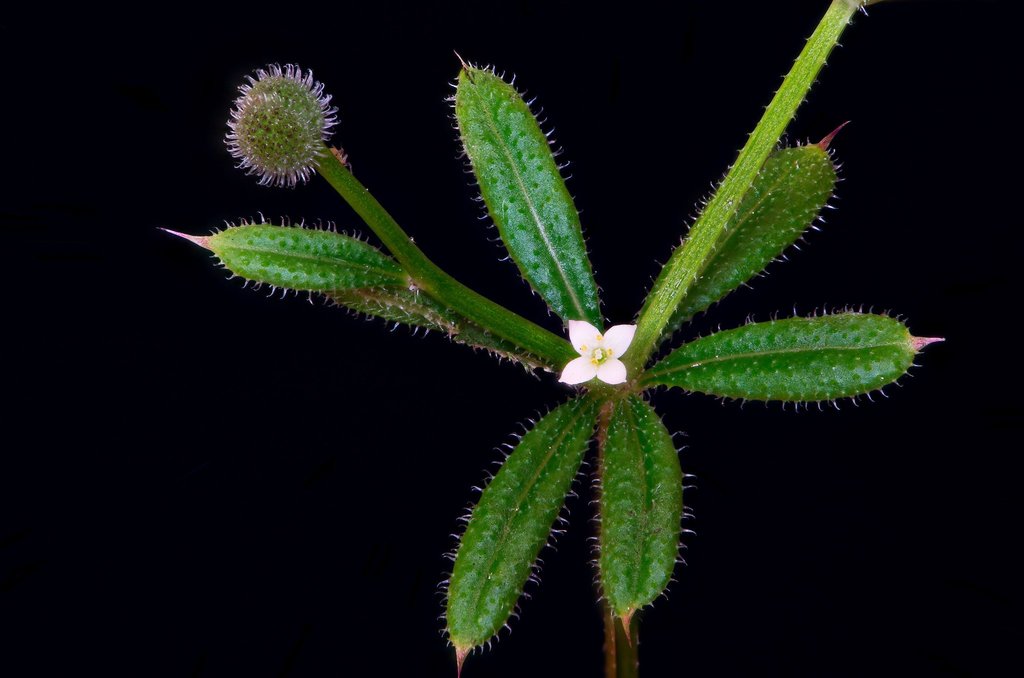
Cleavers is a common annual plant known for its sticky, clinging stems. It often grows in tangled mats across hedges and garden beds. You'll recognize it by its whorled leaves and tiny white flowers.

Auf einen Blick
- Pflegestufe
- Einfach
- Pflanzenart
- Annual herb
- Licht
- Partial shade to full sun
- Licht im Innenraum
- Hell, indirekt
- Gießen
- Alle 3 bis 7 Tage
- Endgröße
- 3 to 5 feet long
- Wachstum
- Schnell
- Winterhärte
- USDA 3 bis 9
- Blütezeit
- Late spring to early summer
Pflege
This plant is often considered a weed, so it needs little care beyond removal if you want to control its spread. Watch for it choking out smaller plants in your garden. It thrives in moist, nitrogen rich soil.
- Gießen
- Keep the soil consistently moist but not waterlogged.
- Düngen
- This plant does not require supplemental fertilizer as it grows vigorously in most conditions.
- Schneiden
- Remove stems regularly to prevent the plant from spreading its seeds.
- Umtopfen
- As an annual, this plant completes its life cycle in one year and does not typically need repotting.
- Boden
- Moist, fertile, well draining soil
- Boden-pH
- 6.0 to 7.5
- Temperatur
- -20 bis 30°C
- Luftfeuchtigkeit
- 40 bis 80%
Sicherheit
- Menschen
- This plant is generally considered non-toxic but may cause contact dermatitis in sensitive individuals.
- Kinder
- The hooked hairs can be irritating to a child's skin if handled frequently.
- Kontaktallergene
- The tiny hooked hairs on the stems and leaves can cause mechanical skin irritation or a rash upon contact.
- Allergene in der Luft
- The pollen is not considered a significant allergen.
- Essbarkeit
- While young leaves are sometimes eaten, they have tiny hooked hairs that can irritate the throat if not cooked thoroughly.
So erkennst du die Pflanze
- Square stems with tiny hooked hairs
- Narrow leaves in whorls of six
- Small white four petaled flowers
- Round burr like seeds that cling
- Höhe
- 0,3 bis 1,2m
- Breite
- 0,3 bis 0,6m
- Blätter
- bright green, deciduous
- Blüten
- white, 0,2 bis 0,3cm
- Früchte
- green, brown, Summer
Häufige Probleme
- Aphids — Small insects that cluster on the stems and suck plant sap.
Standort und Pflege
- Vermehrung
- seed
- Pflanzzeit
- spring, autumn
This plant is usually considered an antagonist to garden crops due to its rapid growth and competitive nature.
Gute Pflanzpartner
- Stinging Nettle — They often share the same moist, nutrient rich habitats.
- Common Chickweed — Both are common cool season weeds that thrive in similar conditions.
Ähnliche Arten
- Galium odoratum — It is a related, non-weedy species often grown as an ornamental ground cover.
Botanisches
- Familie
- Rubiaceae
- Gattung
- Galium
- Ordnung
- Gentianales
- Klasse
- Magnoliopsida
- Ursprüngliche Heimat
- Europe, Asia, and North Africa.
- Artenschutz
- This plant is a common weed and is not of conservation concern.
It thrives in moist, shaded areas and disturbed soils where it can climb over other vegetation for light.
- Nutzen für Wildtiere
- larval host plant, nectar source
- Bestäuber
- Bienen, Käfer
- Verwendung
- foraging, medicinal tea, ground cover
Im Jahresverlauf
Ökologische Zeigerwerte
- Salzgehalt
- 2/9
- Bodenreaktion
- 6/9
- Licht
- 5/9
- Temperatur
- 5/9
- Feuchtigkeit
- 6/9
- Nährstoffe
- 7/9
Taxonomie abgeglichen mit GBIF.
Häufige Fragen
- Is it a weed?
- Yes, it is often considered an aggressive weed in gardens and agricultural fields.
- How do I control it?
- Hand pulling before it sets seed is the most effective method.
Woher der Name kommt
The genus name Galium comes from the Greek word gala, meaning milk, as some species were used to curdle milk. The species name aparine is from the Greek word for to seize or grasp.
Gut zu wissen
- It is a member of the coffee family.
- The seeds were historically roasted and used as a coffee substitute.
- The plant is also known as stickywilly due to its clinging nature.
Probleme mit Cleavers?
Diese Seite bietet allgemeine Infos. Pocket Botanist erkennt Probleme anhand eines Fotos deiner echten Pflanze, passt das Gießen an dein Licht und deinen Standort an und erinnert dich an die Pflege.
Dieser Ratgeber wurde mit KI erstellt und mit der GBIF-Taxonomie abgeglichen. Er dient zur allgemeinen Information und ersetzt keine gärtnerische oder tierärztliche Beratung. Hier erfährst du, wie wir diese Ratgeber erstellen.