 Pocket Botanist
Plant guide
Turmeric.
Curcuma longa
Pronounced KUR-kyu-muh LONG-guh
Also known as Common Turmeric, Indian-saffron, Turmeric



Scan with your phone's camera to get the app
Or go to pocketbotanist.app/get on your phone
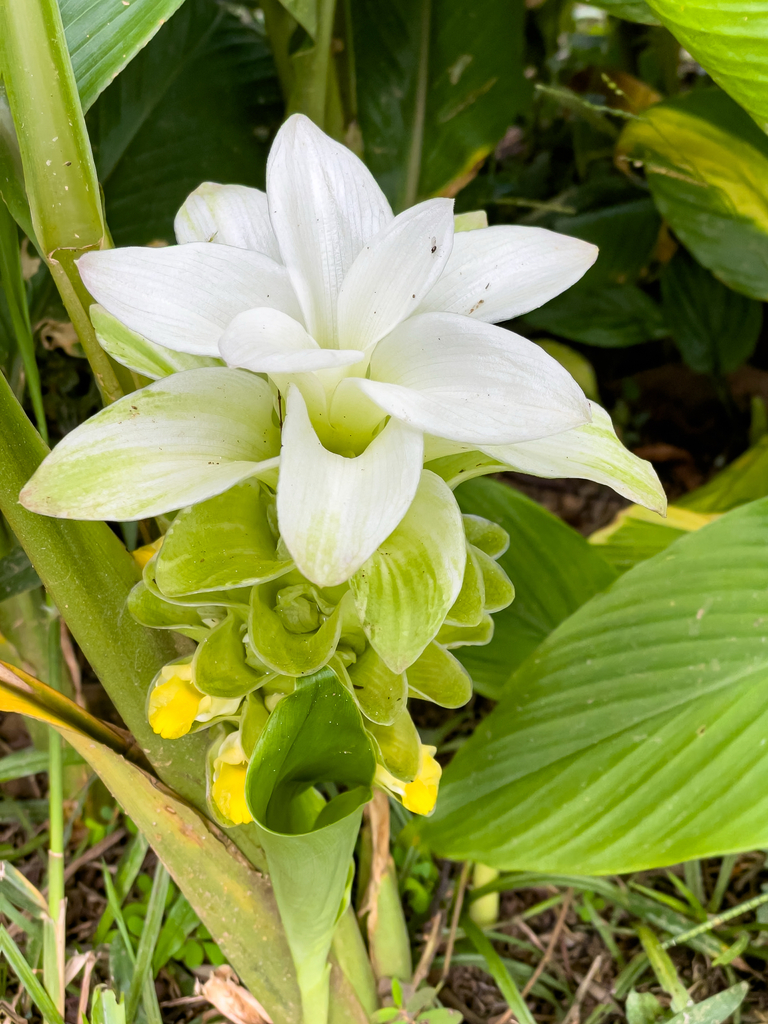
Turmeric is a beautiful tropical perennial that grows from thick, underground rhizomes. It produces lush, broad green leaves and striking, cone shaped flower spikes. You'll love growing it for both its ornamental value and its edible roots.

At a glance
- Care level
- Moderate
- Plant type
- Rhizomatous perennial
- Light
- Partial shade to bright indirect light
- Indoor light
- Bright indirect
- Water
- Every 3 to 7 days
- Mature size
- 3 to 4 feet
- Growth rate
- Medium
- Hardiness
- USDA 9 to 11
- Bloom time
- Mid to late summer
Care
Keep the soil consistently moist but never soggy to mimic its tropical home. Watch for yellowing leaves, which often signal that the soil is too wet. Provide plenty of warmth and humidity to keep your plant happy.
- Watering
- Keep the soil evenly damp throughout the growing season.
- Feeding
- Feed with a balanced liquid fertilizer once a month during the active growing season.
- Pruning
- Trim away any yellowing or damaged foliage to keep the plant tidy.
- Repotting
- Repot in the spring when the rhizomes become crowded in the container.
- Soil
- Rich, well draining organic soil
- Soil pH
- 6.0 to 7.5
- Temperature
- 15 to 35°C
- Humidity
- 60 to 90%
- Drought tolerance
- Low
- Lifespan
- Perennial, typically 3 to 5 years before needing division.
- Fragrance
- Light
- Deer and rabbits
- Moderate
Signs it needs repotting
- Roots growing out of the drainage holes.
- The plant stops producing new growth.
- The rhizomes become crowded and push against the pot walls.
Safety
- People
- This plant is generally considered non toxic to humans.
- Pets
- Turmeric is generally considered non toxic to cats and dogs.
- Children
- The rhizomes are firm and could pose a choking hazard if handled improperly by small children.
- Contact allergens
- Some people may experience skin irritation from handling the raw rhizomes.
- Airborne allergens
- There are no notable airborne allergy risks associated with this plant.
- Edibility
- While the rhizome is a common culinary spice, ensure you are growing the correct species before consumption.
How to identify it
- Broad, lance shaped green leaves
- Thick, fleshy underground rhizomes
- Cone shaped inflorescence with bracts
- Bright yellow or white flowers
- Stems grow from central rhizome
- Height
- 0.6 to 1m
- Spread
- 0.3 to 0.6m
- Leaves
- bright green, deciduous
- Flowers
- white, pink, yellow, 5 to 15cm
Problems to watch for
Check your turmeric from a photo
Pocket Botanist looks at a photo of your plant and tells you what's wrong and what to try first.
Scan with your phone's camera to get the app
Or go to pocketbotanist.app/get on your phone
Growing it
- Propagation
- division
- When to plant
- spring
- Overwintering
- In cooler climates, dig up the rhizomes after the foliage dies back and store them in a cool, dry place until spring. If kept in a pot, bring it indoors before the first frost.
- In containers
- It grows very well in containers, provided you use a pot at least 30 cm wide and deep.
Rhizome Division
- 1. Carefully dig up the mature rhizome clump.
- 2. Break or cut the rhizome into sections, ensuring each piece has at least one bud.
- 3. Plant the sections about 5 cm deep in rich, well draining soil.
Plant turmeric in the shade of larger tropical plants to mimic its natural forest floor habitat.
Grows well with
Similar species
Science
- Family
- Zingiberaceae
- Genus
- Curcuma
- Order
- Zingiberales
- Class
- Liliopsida
- Native range
- Tropical South Asia
- Conservation
- Turmeric is widely cultivated and is not currently of conservation concern.
It thrives in warm, humid forest understories where it spreads through its underground rhizome system.
- Value to wildlife
- nectar source
- Pollinators
- bees, butterflies
- Uses
- culinary spice, natural dye, ornamental foliage
Through the year
Ecological indicators
- Salinity
- 2/9
- Soil reaction
- 6/9
- Light
- 6/9
- Temperature
- 8/9
- Moisture
- 7/9
- Nutrients
- 7/9
Taxonomy resolved against GBIF.
Questions people ask
- Can I grow turmeric in a pot?
- Yes, it thrives in containers as long as they are deep enough for the rhizomes to expand.
- When do I harvest the rhizomes?
- Harvest when the foliage begins to yellow and die back in late autumn.
Where the name comes from
The name Curcuma comes from the Arabic word kurkum, which means saffron. The species name longa refers to the long, finger like rhizomes.
Good to know
- Turmeric has been used for thousands of years in traditional medicine.
- The active compound in turmeric is called curcumin.
- It is a member of the ginger family.
- The rhizomes are boiled and dried to produce the spice powder.
- It is often used as a substitute for saffron.
Also in
Keep your turmeric growing
This page is a general guide. Save your plant in Pocket Botanist and you get care reminders timed for this plant, plus a care history that shows what worked.
Scan with your phone's camera to get the app
Or go to pocketbotanist.app/get on your phone
This guide was generated with AI on and checked against GBIF taxonomy. It is general information, not horticultural or veterinary advice. Read about how we build these guides.