 Pocket Botanist
Guide botanique
Sarracénie pourpre d'Amérique.
Sarracenia
Prononciation sar-uh-SEE-nee-uh
Aussi appelée American pitcher plants, North American pitcher plants, Plantes cruches trompette, Plante cruche, Plante à cruche


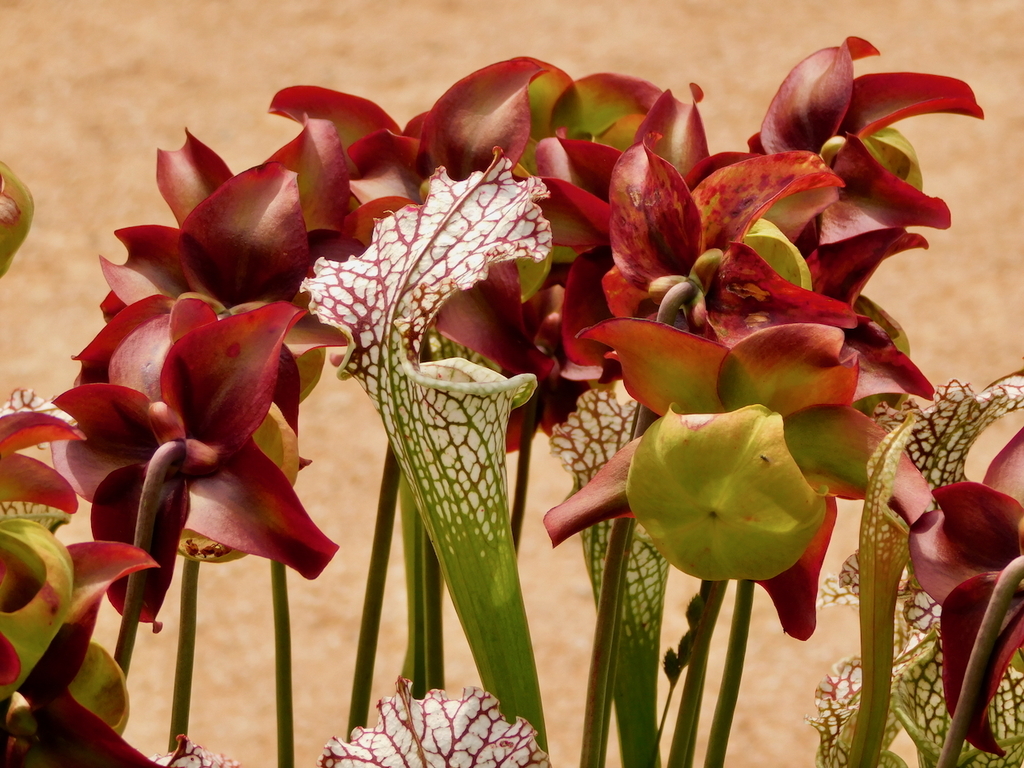
Ces fascinantes plantes carnivores capturent des insectes dans leurs feuilles tubulaires garnies de nectar. Elles sont originaires des zones marécageuses d'Amérique du Nord. Vous adorerez les voir prospérer dans votre jardin ensoleillé.

En un coup d'œil
- Niveau d'entretien
- Moyenne
- Type de plante
- Vivace carnivore
- Lumière
- Plein soleil
- Lumière en intérieur
- Soleil direct
- Arrosage
- Tous les 1 à 3 jours
- Taille adulte
- 2 à 3 pieds
- Croissance
- Moyenne
- Rusticité
- USDA 5 à 9
- Floraison
- Milieu à fin du printemps
Entretien
Gardez toujours le sol constamment humide avec de l'eau distillée ou de pluie. Surveillez les bords bruns des feuilles qui signalent souvent une faible humidité ou une accumulation de minéraux dans l'eau. Assurez-vous qu'elles reçoivent beaucoup de soleil pour conserver leurs couleurs vives.
- Arrosage
- Gardez le sol constamment humide en plaçant le pot dans un plateau peu profond d'eau distillée.
- Engrais
- Ne fertilisez pas ces plantes, car elles tirent leurs nutriments des insectes qu'elles attrapent.
- Taille
- Taillez les cruches mortes ou brunes à la fin de l'hiver avant le début de la nouvelle croissance.
- Rempotage
- Rempotez au début du printemps dans un nouveau mélange de tourbe pauvre en nutriments.
- Sol
- Mélange de tourbe et de perlite
- pH du sol
- Acide
- Température
- -15 à 35°C
- Humidité
- 60 à 90%
- Résistance à la sécheresse
- Faible
- Durée de vie
- Vivace, généralement de 10 à 20 ans
- Parfum
- Léger
- Résistance aux chevreuils et lapins
- Élevée
Signes qu'il faut rempoter
- Les racines sortent des trous de drainage
- La plante a dépassé la taille du pot
- Le substrat s'est décomposé
Sécurité
- Humains
- La plante n'est pas considérée comme toxique, mais elle n'est pas destinée à la consommation.
- Animaux
- Cette plante est non toxique pour les chats et les chiens.
- Enfants
- Les pitchers contiennent des fluides digestifs qui ne doivent pas être ingérés ou manipulés par de jeunes enfants.
- Allergènes de contact
- Les poils rigides de certaines espèces peuvent provoquer une légère irritation cutanée chez les personnes sensibles.
- Allergènes aéroportés
- Le pollen n'est généralement pas considéré comme un allergène aéroporté important.
- Comestibilité
- Ces plantes ne sont pas comestibles et ne doivent jamais être consommées par des humains ou des animaux de compagnie.
Comment l'identifier
- Feuilles creuses en forme de cruche
- Couvercles capuchonnés sur les ouvertures des cruches
- Vaines vivement colorées sur le feuillage
- Fleurs uniques en forme de parapluie
- Hauteur
- 0,2 à 0,9m
- Envergure
- 0,15 à 0,45m
- Feuilles
- vert, rouge, veiné, caduc
- Fleurs
- jaune, rouge, violet, 5 à 10cm
- Fruits
- brun, Fin de l'été
Problèmes à surveiller
- Pourriture des racinesCourant
- PuceronsCourant
- Brunissement du bord des feuillesPeu courant
- DéshydratationPeu courant
Vérifie la santé de ta plante en photo
Pocket Botanist analyse une photo de ta plante et te dit ce qui ne va pas et quoi essayer en premier.
La cultiver
- Multiplication
- division, semis
- Quand planter
- printemps
- Hivernage
- Elles nécessitent une période de dormance froide pour survivre à long terme. Gardez-les dans un garage ou un porche frais et non chauffé où les températures restent au-dessus du gel mais en dessous de 10 degrés Celsius.
- En pot
- Elles poussent bien dans des pots en plastique placés dans un plateau d'eau, avec un diamètre minimum de 15 cm.
Division
- 1. Retirez délicatement la plante de son pot pendant la dormance de fin d'hiver.
- 2. Tirez soigneusement le rhizome en sections avec des racines attachées.
- 3. Rempotez chaque section dans un mélange frais et humide de tourbe et de perlite.
Regroupez les plantes carnivores pour créer un microclimat qui maintient une humidité élevée.
Bonnes associations
- Drosera — Ils partagent des exigences similaires en matière de sol humide et acide.
- Pogonia ophioglossoides — Ces orchidées prospèrent dans les mêmes conditions de tourbière.
Espèces similaires
- Lis des serpents — Une autre plante carnivore avec une structure hooded unique.
- Dionée attrape-mouche — Souvent cultivée dans les mêmes collections de jardins de tourbières.
Science
- Famille
- Sarraceniaceae
- Genre
- Sarracenia
- Ordre
- Ericales
- Classe
- Magnoliopsida
- Région d'origine
- Zones humides et tourbières à travers l'Amérique du Nord.
- Préservation
- De nombreuses espèces sont menacées dans la nature en raison de la perte d'habitat et du braconnage illégal.
Elles prospèrent dans les tourbières acides et pauvres en nutriments où elles dépendent des insectes pour survivre.
- Intérêt pour la faune
- source de nectar, contrôle des proies
- Pollinisateurs
- abeilles, coléoptères
- Utilisations
- jardins de tourbières, collections de plantes carnivores, expositions éducatives
Au fil des saisons
Repères écologiques
- Salinité
- 1/9
- Réaction du sol
- 2/9
- Lumière
- 8/9
- Température
- 5/9
- Humidité
- 9/9
- Nutriments
- 1/9
Taxonomie vérifiée avec le GBIF.
Ce qu'on demande souvent
- Dois-je nourrir ma plante pichet ?
- Non, elles attraperont leurs propres insectes si elles sont gardées à l'extérieur.
- Puis-je utiliser de la terreau ordinaire ?
- Absolument pas, car la terreau standard les tuera. Utilisez un mélange de tourbe et de perlite.
D'où vient le nom
Le nom du genre honore Michel Sarrazin, un médecin français qui a envoyé des spécimens en Europe, tandis que le nom commun fait référence aux feuilles en forme de pichet.
Bon à savoir
- Les plantes pichet sont originaires d'Amérique du Nord.
- Elles nécessitent une eau sans minéraux comme de l'eau de pluie ou de l'eau distillée.
- Les fleurs ont une forme unique pour empêcher les pollinisateurs de devenir des proies.
- Certaines espèces peuvent vivre plusieurs décennies avec des soins appropriés.
Aussi dans
Garde ta plante en pleine forme
Cette page est un guide général. Enregistre ta plante dans Pocket Botanist et tu reçois des rappels d'entretien adaptés à cette plante, ainsi qu'un historique d'entretien qui montre ce qui a marché.
Ce guide a été généré par IA et vérifié avec la taxonomie du GBIF. Il s'agit d'informations générales, et non de conseils horticoles ou vétérinaires. Découvre comment nous concevons ces guides.