 Pocket Botanist
Guide botanique
Red valerian.
Centranthus ruber
Prononciation sen-TRAN-thus ROO-ber
Aussi appelée Bovisand-sailor, Jupiter's beard, Jupiter's-beard, Pretty Betsy, Red Valerian, Spur valerian


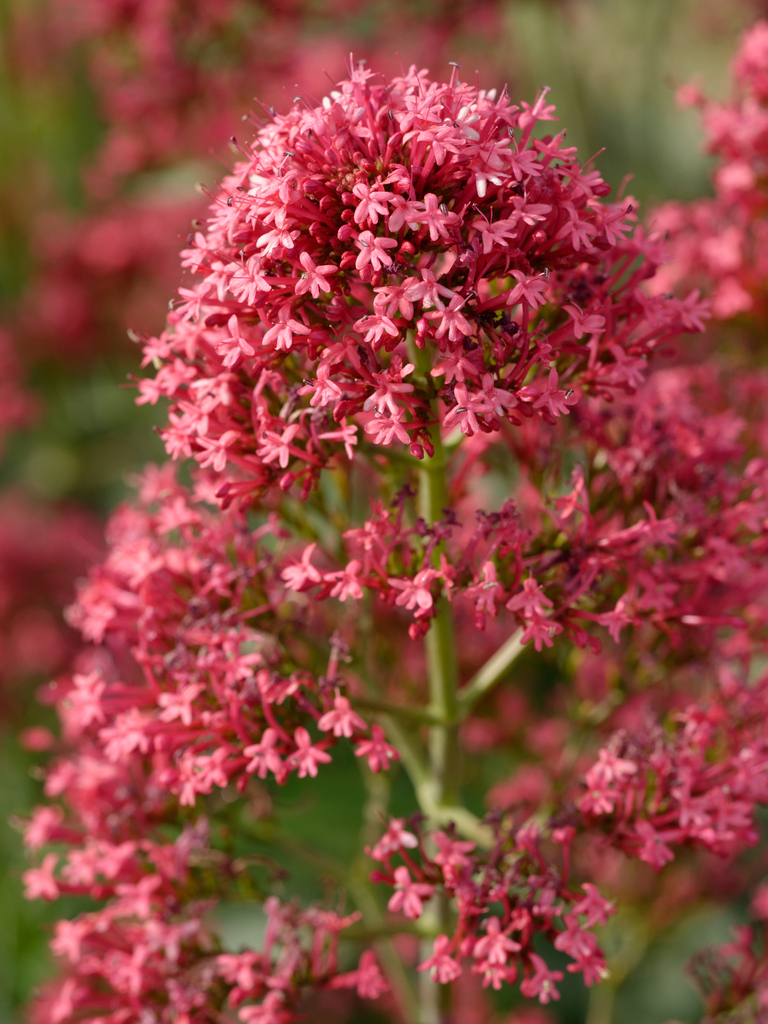
Red valerian is a charming, hardy perennial that brings a splash of color to sunny spots. It is famous for its long blooming season and ability to thrive in rocky, poor soil. You will love how it attracts butterflies to your garden.

En un coup d'œil
- Niveau d'entretien
- Facile
- Type de plante
- Perennial
- Lumière
- Full sun
- Lumière en intérieur
- Soleil direct
- Arrosage
- Tous les 7 à 14 jours
- Taille adulte
- 3 feet
- Croissance
- Rapide
- Rusticité
- USDA 5 à 9
- Floraison
- Late spring to late summer
Entretien
Plant this in a spot with full sun and well draining soil to keep it happy. Watch for wilting if the soil stays too wet, as it prefers to dry out between drinks. Deadhead the spent blooms to encourage a second flush of flowers later in the season.
- Arrosage
- Water deeply once established, but allow the soil to dry out significantly between waterings.
- Engrais
- A light application of compost in the spring is usually plenty for this vigorous grower.
- Taille
- Trim back spent flower stalks throughout the summer to promote continuous blooming.
- Rempotage
- These plants prefer to stay in the ground, but if kept in containers, refresh the soil every few years.
- Sol
- Well draining, rocky, or sandy soil
- pH du sol
- Neutral to alkaline
- Température
- -15 à 35°C
- Humidité
- 30 à 70%
- Résistance à la sécheresse
- Élevée
- Durée de vie
- Short-lived perennial, typically 3 to 5 years.
- Parfum
- Léger
- Résistance aux chevreuils et lapins
- Élevée
Signes qu'il faut rempoter
- Roots growing out of the drainage holes.
- Water sitting on the surface for too long.
- Plant growth slowing significantly.
Sécurité
- Humains
- The plant is not documented as toxic, but it is not intended for human consumption.
- Enfants
- The plant is not inherently dangerous, but children should be discouraged from eating any part of it.
- Allergènes de contact
- The sap may cause mild skin irritation in sensitive individuals.
- Allergènes aéroportés
- The pollen can trigger mild reactions in those with seasonal allergies.
- Comestibilité
- This plant is not considered edible and should be avoided for consumption.
Comment l'identifier
- Clusters of small star shaped flowers
- Blue green succulent like foliage
- Opposite leaves on upright stems
- Spur at base of flower
- Hauteur
- 0,6 à 0,9m
- Envergure
- 0,3 à 0,6m
- Feuilles
- blue-green, grey-green, semi-evergreen
- Fleurs
- red, pink, white, 0,5 à 1cm
Problèmes courants
- Aphids — Small insects that cluster on new growth and flower buds.
- Powdery mildew — A fungal growth that appears as white dust on the foliage during humid weather.
La cultiver
- Multiplication
- seed, division, cuttings
- Quand planter
- spring, autumn
- Hivernage
- Cut back the foliage after the first frost to keep the plant tidy. Ensure the crown stays dry during winter to prevent rot.
- En pot
- It grows well in containers at least 30 centimeters wide, provided the potting mix is gritty and drains very quickly.
Seed
- Sow seeds in trays in early spring.
- Cover lightly with soil.
- Keep moist until germination occurs.
Division
- Dig up the clump in early spring.
- Carefully pull the root mass apart.
- Replant immediately into prepared soil.
Pair this plant with other drought-tolerant species to ensure they all thrive under similar watering schedules.
Bonnes associations
- Lavande d'Angleterre — They share similar requirements for sun and well-drained soil.
- Nepeta faassenii — The blue tones of catmint contrast beautifully with the red flowers of the valerian.
Espèces similaires
- Valériane officinale — It shares a similar common name but has different medicinal uses and growth habits.
Science
- Famille
- Caprifoliaceae
- Genre
- Centranthus
- Ordre
- Dipsacales
- Classe
- Magnoliopsida
- Région d'origine
- Mediterranean region
- Préservation
- It is considered an invasive species in some regions like California and should be managed accordingly.
It thrives in rocky, well-drained soils where it can easily colonize disturbed sites.
- Intérêt pour la faune
- nectar source
- Pollinisateurs
- abeilles, papillons, papillons de nuit
- Utilisations
- cottage gardens, rock gardens, pollinator borders, dry stone walls
Au fil des saisons
Repères écologiques
- Salinité
- 4/9
- Réaction du sol
- 7/9
- Lumière
- 8/9
- Température
- 6/9
- Humidité
- 3/9
- Nutriments
- 3/9
Taxonomie vérifiée avec le GBIF.
Ce qu'on demande souvent
- Does it need a lot of water?
- No, it is quite drought tolerant once established.
- Can I grow it in a pot?
- Yes, it grows well in containers if they have excellent drainage.
D'où vient le nom
The genus name comes from the Greek words kentron for spur and anthos for flower, referring to the spurred base of the corolla.
Bon à savoir
- It is commonly called Jupiter's beard.
- The plant thrives in poor, alkaline soils.
- It is highly tolerant of salt spray in coastal areas.
- Deadheading spent blooms can encourage a second flush of flowers.
Aussi dans
Ta plante a mauvaise mine ?
Cette page est un guide général. Pocket Botanist diagnostique les problèmes directement à partir d'une photo de ta plante, adapte l'arrosage à sa luminosité et te prévient quand il faut t'en occuper.
Ce guide a été généré par IA et vérifié avec la taxonomie du GBIF. Il s'agit d'informations générales, et non de conseils horticoles ou vétérinaires. Découvre comment nous concevons ces guides.