 Pocket Botanist
Pflanzenratgeber
Black eyed susan vine.
Thunbergia alata
Aussprache thun-BER-jee-uh uh-LAY-tuh
Auch bekannt als Black Eyed Susan, Black eyed Susan vine, Black-eyed Susan, Black-eyed Susan clock vine, Bright eyes, Winged clockvine, Black-eyed Susan, Black-eyed Susan vine, Blackeyed Susan Clockvine, Blackeyed Susan vine, black-eyed-Susan-vine



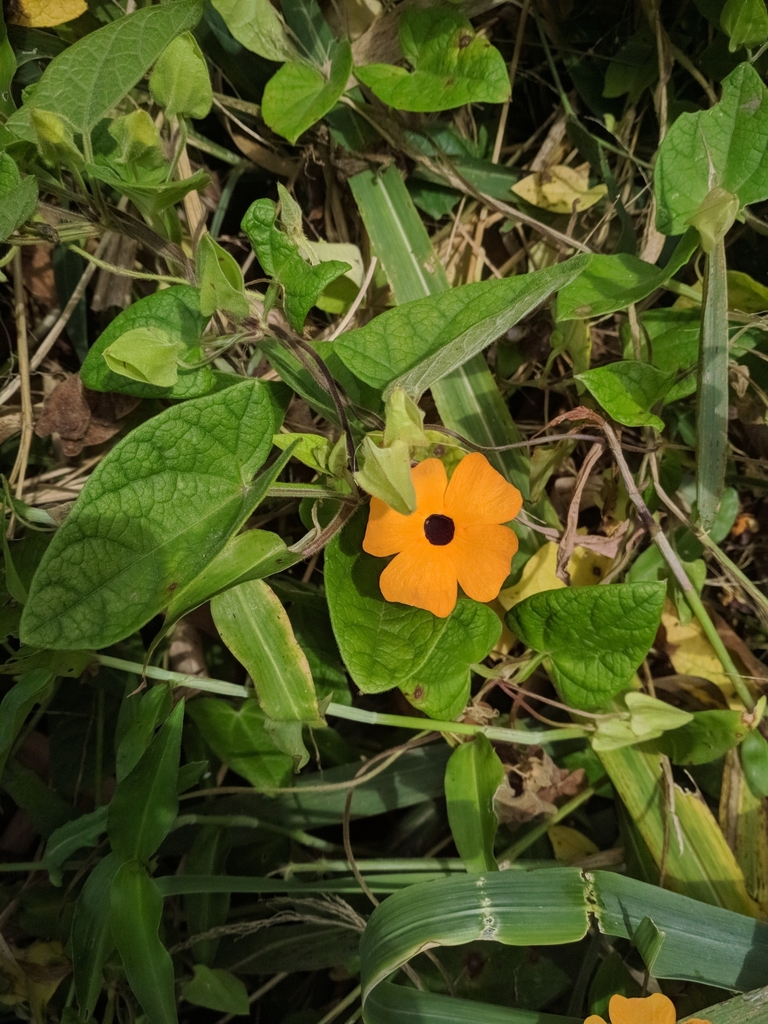
This charming climber is a fast grower that loves to scramble up trellises. It produces cheerful, trumpet shaped flowers with a signature dark center. You'll find it's a fantastic choice for adding vertical interest to your garden.
Auf einen Blick
- Pflegestufe
- Einfach
- Pflanzenart
- Flowering vine
- Licht
- Full sun to partial shade
- Licht im Innenraum
- Hell, indirekt
- Gießen
- Alle 2 bis 4 Tage
- Endgröße
- 6 to 8 feet
- Wachstum
- Schnell
- Winterhärte
- USDA 10 bis 11
- Blütezeit
- Late spring to autumn
Pflege
Provide a sturdy trellis for the vines to climb as they grow. Keep an eye out for pests like spider mites, especially when the air is dry. Ensure the soil stays consistently moist but never soggy to keep the plant happy.
- Gießen
- Water whenever the top inch of soil feels dry to the touch.
- Düngen
- Apply a balanced liquid fertilizer every two weeks during the active growing season.
- Schneiden
- Trim back long stems occasionally to encourage a bushier shape and more blooms.
- Umtopfen
- Repot only if the plant becomes root bound or you need to refresh the soil.
- Boden
- Well draining, rich potting mix
- Boden-pH
- 6.0 to 7.5
- Temperatur
- 10 bis 30°C
- Luftfeuchtigkeit
- 50 bis 70%
- Trockenheitstoleranz
- Gering
- Lebensdauer
- Tender perennial, often grown as an annual.
- Wildverbiss-Resistenz
- Mittel
Anzeichen fürs Umtopfen
- Roots growing out of the drainage holes.
- Water running straight through the pot without soaking in.
- Stunted growth during the peak growing season.
Sicherheit
- Menschen
- The plant is generally considered non-toxic, but ingestion should be avoided.
- Kinder
- Keep the small, round seeds away from young children as they pose a potential choking hazard.
- Kontaktallergene
- There are no notable skin irritants associated with this plant.
- Allergene in der Luft
- The pollen is not typically considered a significant airborne allergen.
- Essbarkeit
- This plant is not intended for consumption and may cause digestive upset if ingested.
So erkennst du die Pflanze
- Trumpet shaped flowers with dark centers
- Heart shaped or triangular green leaves
- Vigorous twining vine growth habit
- Winged leaf stalks
- Höhe
- 1,5 bis 2,5m
- Breite
- 0,3 bis 0,6m
- Blätter
- green, deciduous
- Blüten
- orange, yellow, white, 3 bis 5cm
- Früchte
- brown, late summer
Häufige Probleme
- Whitefly — Small white insects that congregate on the undersides of leaves and suck sap.
- Spider mites — Tiny arachnids that cause stippling on leaves and thrive in dry, hot conditions.
Standort und Pflege
- Vermehrung
- seed, cuttings
- Pflanzzeit
- spring
- Überwinterung
- In cold climates, bring the container indoors to a bright, frost-free location. Keep the soil barely moist until spring growth resumes.
- Im Kübel
- It is excellent for containers, provided you use a pot at least 30 centimeters in diameter with a sturdy trellis.
Seed
- 1. Soak seeds in warm water for 24 hours before planting.
- 2. Sow seeds 1 centimeter deep in moist seed-starting mix.
- 3. Keep at 20 to 25 Celsius until germination occurs.
Pair this vine with plants that enjoy similar moisture levels to ensure the soil stays consistently damp.
Gute Pflanzpartner
- Sweet Potato — The trailing habit of the sweet potato vine complements the vertical growth of the black-eyed susan vine.
- Garden Petunia — Petunias provide a colorful, low-growing base that contrasts well with the climbing vine.
Ähnliche Arten
- Leuchtendes Mädchenauge — Despite the shared common name, this is a completely different plant that grows as a clump-forming perennial.
Botanisches
- Familie
- Acanthaceae
- Gattung
- Thunbergia
- Ordnung
- Lamiales
- Klasse
- Magnoliopsida
- Ursprüngliche Heimat
- Tropical eastern Africa.
- Artenschutz
- This species is not of conservation concern and is considered invasive in some tropical regions.
It grows as a vigorous climber in forest edges and disturbed areas, using its twining stems to reach sunlight.
- Nutzen für Wildtiere
- nectar source
- Bestäuber
- Bienen, Schmetterlinge
- Verwendung
- container gardening, trellis climber, hanging baskets
Im Jahresverlauf
Ökologische Zeigerwerte
- Salzgehalt
- 2/9
- Bodenreaktion
- 6/9
- Licht
- 7/9
- Temperatur
- 8/9
- Feuchtigkeit
- 6/9
- Nährstoffe
- 5/9
Taxonomie abgeglichen mit GBIF.
Häufige Fragen
- Does it need a trellis?
- Yes, it is a twining vine that requires support to climb effectively.
- Can I grow it in a pot?
- It thrives in containers as long as it has a trellis and consistent moisture.
Woher der Name kommt
The genus honors Carl Peter Thunberg, while the species name alata refers to the winged petioles of the leaves.
Gut zu wissen
- It is a fast growing vine that can reach its full height in a single season.
- The genus is named after Swedish botanist Carl Peter Thunberg.
- It is often grown as an annual in cooler climates.
- The flowers close up at night.
Probleme mit Black eyed susan vine?
Diese Seite bietet allgemeine Infos. Pocket Botanist erkennt Probleme anhand eines Fotos deiner echten Pflanze, passt das Gießen an dein Licht und deinen Standort an und erinnert dich an die Pflege.
Dieser Ratgeber wurde mit KI erstellt und mit der GBIF-Taxonomie abgeglichen. Er dient zur allgemeinen Information und ersetzt keine gärtnerische oder tierärztliche Beratung. Hier erfährst du, wie wir diese Ratgeber erstellen.