 Pocket Botanist
Pflanzenratgeber
Ocotillo.
Fouquieria splendens
Aussprache foo-KEE-air-ee-uh SPLEN-denz
Auch bekannt als ocotillo, vine-cactus


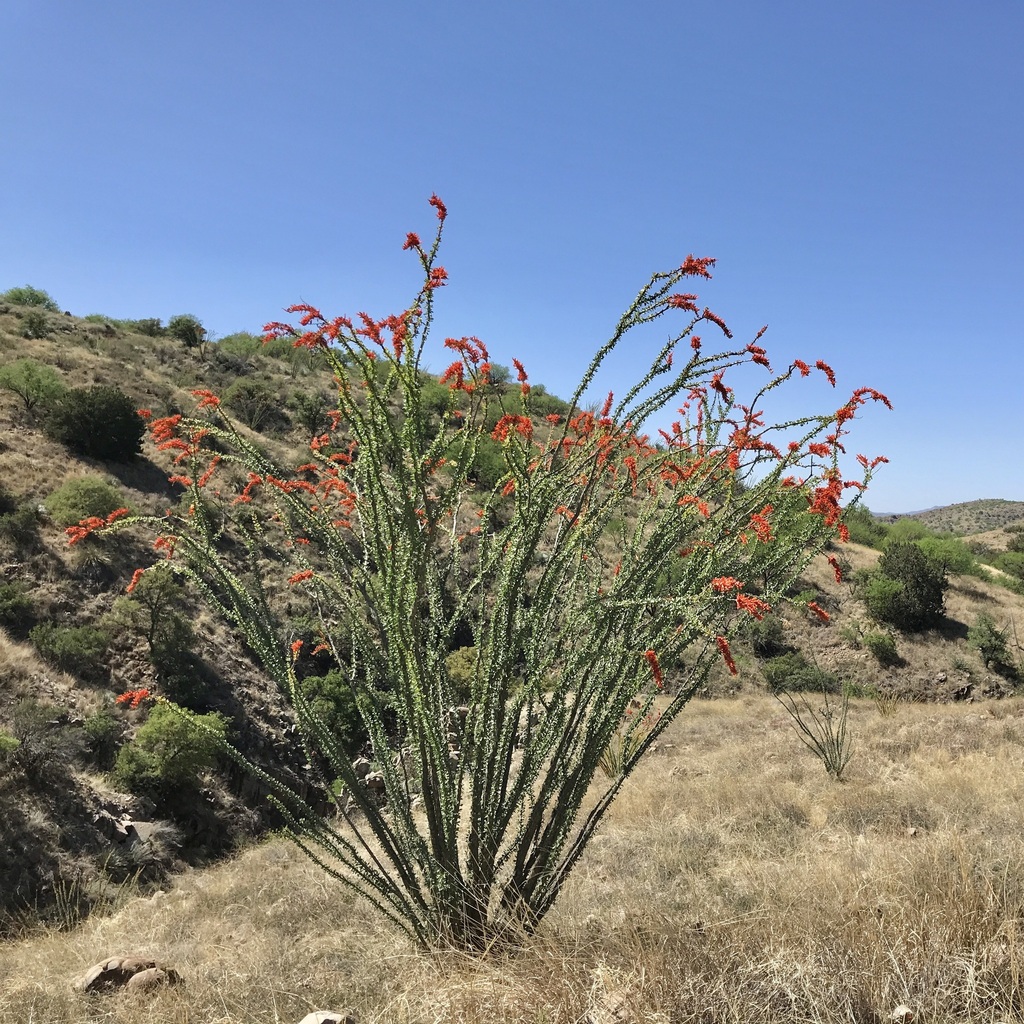
The Ocotillo is a striking desert shrub that looks like a bundle of thorny sticks for most of the year. It quickly sprouts vibrant green leaves after a good rain. You will love its brilliant red flowers that appear at the tips of the stems in spring.
Auf einen Blick
- Pflegestufe
- Einfach
- Pflanzenart
- Succulent shrub
- Licht
- Full sun
- Licht im Innenraum
- Direkte Sonne
- Gießen
- Alle 14 bis 30 Tage
- Endgröße
- 20 feet
- Wachstum
- Langsam
- Winterhärte
- USDA 7 bis 10
- Blütezeit
- Spring to early summer
Pflege
Plant this in very well draining soil and keep it in a spot with intense sun. Watch for shriveled stems as a sign it needs a deep soak, but be careful not to overwater during its dormant phase. It is perfectly adapted to harsh, dry conditions.
- Gießen
- Water deeply only during the active growing season when the soil is completely dry.
- Düngen
- Use a low nitrogen, cactus specific fertilizer sparingly during the spring.
- Schneiden
- Only remove dead or damaged stems during the late winter before new growth begins.
- Umtopfen
- Repot only when the plant has clearly outgrown its container, using a heavy pot to prevent tipping.
- Boden
- Sandy or rocky, fast draining
- Boden-pH
- 6.0 to 8.0
- Temperatur
- -10 bis 45°C
- Luftfeuchtigkeit
- 10 bis 40%
- Trockenheitstoleranz
- Hoch
- Lebensdauer
- Perennial, can live for over 100 years.
- Wildverbiss-Resistenz
- Hoch
Anzeichen fürs Umtopfen
- Roots growing out of the drainage holes.
- Water sitting on the surface for too long.
- Plant becoming top heavy.
Sicherheit
- Menschen
- The plant is not known to be toxic, but its sharp spines pose a significant physical injury risk.
- Kinder
- Keep children away from the plant due to the extremely sharp and rigid spines that can cause serious injury.
- Kontaktallergene
- The sharp, woody spines can cause deep puncture wounds and skin irritation.
- Allergene in der Luft
- There are no notable respiratory allergens associated with this plant.
- Essbarkeit
- The plant is not considered edible and should not be consumed.
So erkennst du die Pflanze
- Long, slender, spiny gray stems
- Small, oval green leaves after rain
- Bright red, tubular terminal flower clusters
- Distinctive candelabra growth habit
- Höhe
- 2 bis 6m
- Breite
- 1 bis 3m
- Blätter
- green, deciduous
- Blüten
- red, 1 bis 2cm
- Früchte
- brown, Late summer
Häufige Probleme
- Root rot — Occurs when the soil remains too wet for too long.
Standort und Pflege
- Vermehrung
- cuttings, seed
- Pflanzzeit
- spring, early autumn
- Überwinterung
- Keep the plant dry during winter months to prevent rot. Ensure it is protected from extreme, prolonged freezing temperatures.
- Im Kübel
- It can be grown in a large, heavy pot with excellent drainage, but it prefers being in the ground.
Cuttings
- Take a hardwood cutting during the dormant season.
- Allow the cut end to callus for several weeks in a dry, shaded area.
- Insert the callused end into a well draining, sandy potting mix.
- Keep the soil barely moist until roots establish.
Group with other desert natives that require minimal irrigation to prevent accidental overwatering.
Gute Pflanzpartner
- Creosote bush — They share the same arid habitat requirements.
- Encelia farinosa — It provides a nice color contrast and thrives in similar conditions.
Ähnliche Arten
- Boojum-Baum — It is a related species with a unique, tall, columnar growth habit.
Botanisches
- Familie
- Fouquieriaceae
- Gattung
- Fouquieria
- Ordnung
- Ericales
- Klasse
- Magnoliopsida
- Ursprüngliche Heimat
- Chihuahuan and Sonoran Deserts of the Southwestern United States and Mexico.
- Artenschutz
- It is not currently endangered, but wild collection is strictly regulated in many areas.
It survives by rapidly producing leaves after rainfall and shedding them quickly during drought.
- Nutzen für Wildtiere
- nectar source
- Bestäuber
- Kolibris, Bienen
- Verwendung
- ornamental desert landscaping, xeriscaping, wildlife gardens
Im Jahresverlauf
Ökologische Zeigerwerte
- Salzgehalt
- 2/9
- Bodenreaktion
- 7/9
- Licht
- 9/9
- Temperatur
- 8/9
- Feuchtigkeit
- 1/9
- Nährstoffe
- 2/9
Taxonomie abgeglichen mit GBIF.
Häufige Fragen
- Does it need a lot of water?
- No, it thrives on very little water and requires excellent drainage.
- Why does my plant have no leaves?
- It is likely dormant and will grow leaves quickly after a good rain.
Woher der Name kommt
The genus honors Pierre Fouquier, a French physician, while the species name splendens refers to its brilliant red flowers.
Gut zu wissen
- It is often called the Ocotillo, which is a Spanish diminutive of the word for pine.
- The stems can remain dormant and leafless for long periods until rain arrives.
- It is a master of water conservation in harsh desert environments.
Auch in
Probleme mit Ocotillo?
Diese Seite bietet allgemeine Infos. Pocket Botanist erkennt Probleme anhand eines Fotos deiner echten Pflanze, passt das Gießen an dein Licht und deinen Standort an und erinnert dich an die Pflege.
Dieser Ratgeber wurde mit KI erstellt und mit der GBIF-Taxonomie abgeglichen. Er dient zur allgemeinen Information und ersetzt keine gärtnerische oder tierärztliche Beratung. Hier erfährst du, wie wir diese Ratgeber erstellen.