 Pocket Botanist
Guide botanique
Sauge d'automne.
Salvia greggii
Prononciation SAL-vee-uh GREG-ee-eye
Aussi appelée Origan de San Antonio, sauge d'automne


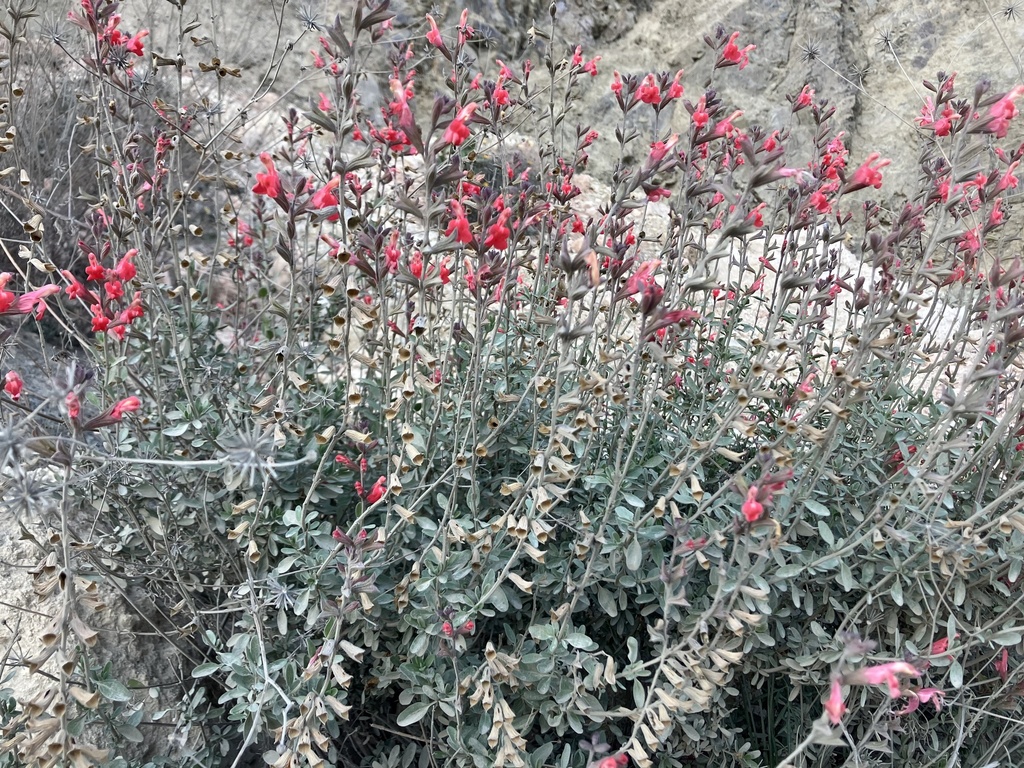
La sauge d'automne est une jolie plante vivace ligneuse qui apporte des couleurs vives aux jardins secs et ensoleillés. Elle prospère par temps chaud et attire les colibris avec ses fleurs riches en nectar. Cette plante est un excellent choix pour la xéropaysagisme.
En un coup d'œil
- Care level
- Easy
- Plant type
- Sous-arbrisseau
- Light
- Plein soleil
- Indoor light
- direct
- Water
- Every 7 to 14 days
- Mature size
- 90 cm de haut sur 90 cm de large
- Growth rate
- medium
- Hardiness
- USDA 7 to 10
- Bloom time
- Printemps à automne
Entretien
Plantez dans un sol bien drainé pour éviter la pourriture des racines, car cette sauge n'aime pas rester dans l'eau. Taillez légèrement après la première floraison pour encourager une seconde floraison à l'automne. Surveillez le jaunissement des feuilles, qui signale souvent un arrosage excessif.
- Watering
- Laissez le sol sécher considérablement entre les arrosages une fois la plante établie.
- Feeding
- Appliquez un engrais équilibré à libération lente une fois au début du printemps.
- Pruning
- Taillez d'un tiers à la fin de l'hiver pour maintenir une forme compacte.
- Repotting
- Rempotez uniquement si la plante est à l'étroit dans son pot.
- Soil
- Sol sablonneux, caillouteux ou loam bien drainé
- Soil pH
- Neutre à légèrement alcalin
- Temperature
- -12 to 40°C
- Humidity
- 20 to 50%
- Drought tolerance
- high
- Lifespan
- Perennial, typically 5 to 10 years.
- Fragrance
- light
- Deer and rabbits
- high
Signes qu'il faut rempoter
- Roots growing out of the drainage holes.
- Water running straight through the pot without soaking in.
- Stunted growth during the active season.
Sécurité
- People
- This plant is not considered toxic to humans.
- Children
- The plant is generally safe, but the small flowers could pose a minor choking hazard if ingested by very young children.
- Contact allergens
- Some individuals may experience mild skin irritation from the aromatic oils in the foliage.
- Airborne allergens
- There are no significant reports of respiratory allergies associated with this plant.
- Edibility
- While the flowers are technically edible, they are primarily grown for ornamental purposes and should be consumed with caution.
Comment l'identifier
- Petites feuilles ovales et aromatiques, vertes
- Fleurs tubulaires de couleurs variées
- Base ligneuse à tiges multiples
- Disposition des feuilles opposées
- Height
- 0.6 to 0.9m
- Spread
- 0.6 to 0.9m
- Leaves
- vert, semi-persistant
- Flowers
- rouge, rose, blanc, violet, 1 to 3cm
Problèmes courants
- Root rot — This occurs when the plant is kept in soil that does not drain well.
La cultiver
- Propagation
- bouturage, semis
- When to plant
- printemps, automne
- Overwintering
- In colder climates, provide a layer of mulch around the base to protect the roots from freezing temperatures. Cut back dead stems in early spring before new growth begins.
- In containers
- It grows very well in containers, provided the pot has excellent drainage and is at least 12 inches wide.
Stem cuttings
- Take a 4 inch cutting from non flowering growth.
- Remove the lower leaves.
- Dip the end in rooting hormone.
- Place in a well draining potting mix.
- Keep moist until roots form.
Group plants with similar low water needs to ensure they thrive together without competition.
Bonnes associations
- Blackfoot Daisy — They share similar water and sun requirements.
- Agave — The structural contrast of agave pairs well with the soft texture of sage.
- Purple Coneflower — Both plants attract a wide variety of pollinators.
Espèces similaires
- Mealycup Sage — It has a similar growth habit but prefers slightly more moisture.
- Cleveland Sage — It shares the same affinity for dry, sunny conditions.
Science
- Family
- Lamiaceae
- Genus
- Salvia
- Order
- Lamiales
- Class
- Magnoliopsida
- Native range
- Texas and northern Mexico.
- Conservation
- This species is common in its native range and is not currently of conservation concern.
It survives in arid, rocky environments by utilizing deep roots to access moisture during dry spells.
- Value to wildlife
- nectar source, pollinator magnet
- Pollinators
- bees, butterflies, hummingbirds
- Uses
- ornamental border, pollinator garden, xeriscaping
Au fil des saisons
Repères écologiques
- Salinity
- 2/9
- Soil reaction
- 6/9
- Light
- 8/9
- Temperature
- 7/9
- Moisture
- 2/9
- Nutrients
- 3/9
Taxonomie vérifiée avec le GBIF.
Ce qu'on demande souvent
- How often should I prune it?
- Light pruning after the first flush of flowers encourages a second bloom.
- Does it need full sun?
- Yes, it performs best with at least six hours of direct sunlight daily.
D'où vient le nom
The specific epithet greggii honors Josiah Gregg, an American merchant and naturalist who collected the plant in the mid 1800s.
Bon à savoir
- It is commonly known as autumn sage.
- The flowers come in a wide range of colors including red, pink, white, and purple.
- It is incredibly heat tolerant.
- The leaves are highly aromatic when crushed.
Ton sauge d'automne a mauvaise mine ?
Cette page est un guide général. Pocket Botanist diagnostique les problèmes directement à partir d'une photo de ta plante, adapte l'arrosage à sa luminosité et te prévient quand il faut t'en occuper.
Ce guide a été généré par IA et vérifié avec la taxonomie du GBIF. Il s'agit d'informations générales, et non de conseils horticoles ou vétérinaires. Découvre comment nous concevons ces guides.