 Pocket Botanist
Pflanzenratgeber
Jade vine.
Strongylodon macrobotrys
Aussprache stron-gi-LO-don ma-kro-BO-tris
Auch bekannt als jadevine



The jade vine is a stunning tropical climber famous for its glowing, claw shaped flowers that hang in long clusters. It thrives in humid, warm environments and needs plenty of space to spread its vigorous vines. You will love watching it bloom if you can provide the right tropical conditions.
Auf einen Blick
- Pflegestufe
- Schwierig
- Pflanzenart
- Vine
- Licht
- Bright indirect light
- Licht im Innenraum
- Hell, indirekt
- Gießen
- Alle 3 bis 7 Tage
- Endgröße
- 18 meters
- Wachstum
- Schnell
- Winterhärte
- USDA 10 bis 12
- Blütezeit
- Late winter to spring
Pflege
Provide a sturdy trellis or arbor for the vine to climb as it grows quite large. Keep the soil consistently moist and maintain high humidity to mimic its native rainforest home. Watch for yellowing leaves which often signal that the plant is too dry or lacks sufficient humidity.
- Gießen
- Keep the soil evenly moist but never waterlogged.
- Düngen
- Use a balanced liquid fertilizer during the active growing season.
- Schneiden
- Trim back long stems after flowering to keep the vine manageable.
- Umtopfen
- Repot when the plant becomes root bound in its container.
- Boden
- Rich, well draining organic soil
- Boden-pH
- 6.0 to 7.0
- Temperatur
- 15 bis 30°C
- Luftfeuchtigkeit
- 70 bis 90%
- Trockenheitstoleranz
- Gering
- Lebensdauer
- Perennial, long lived in ideal tropical conditions
- Wildverbiss-Resistenz
- Mittel
Anzeichen fürs Umtopfen
- Roots growing out of the drainage holes
- Stunted growth during the active season
Sicherheit
- Menschen
- The plant is not considered toxic, but ingestion of any part is not recommended.
- Kinder
- The large, heavy flower clusters could pose a minor hazard if pulled down by a small child.
- Kontaktallergene
- No specific skin irritants are known.
- Allergene in der Luft
- No notable airborne allergens are associated with this plant.
- Essbarkeit
- The seeds and pods are not considered edible and may cause digestive distress.
So erkennst du die Pflanze
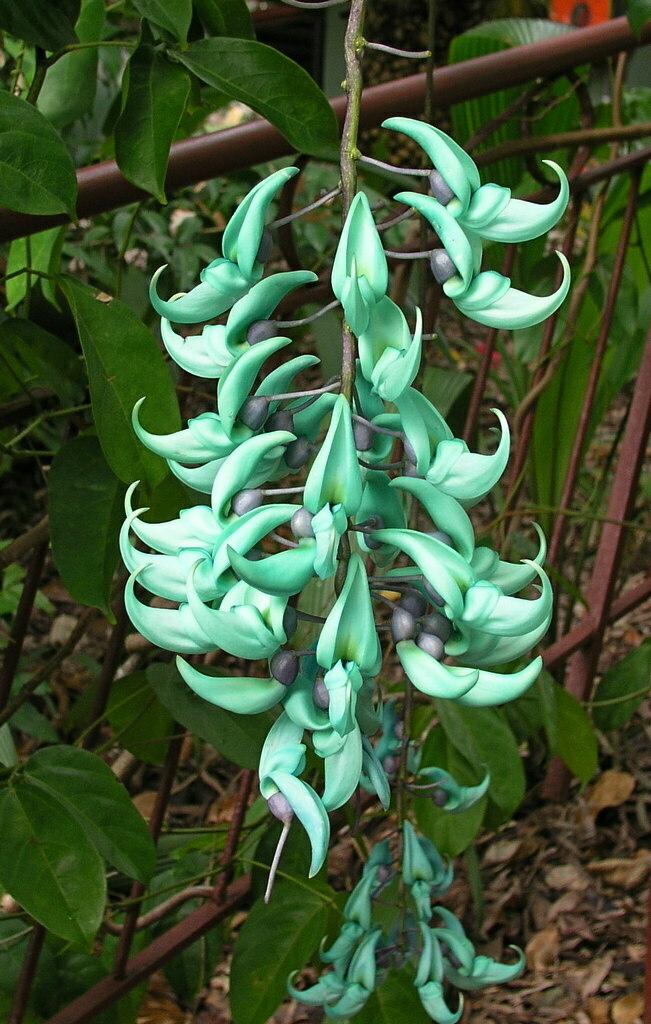
- Striking turquoise, claw shaped flowers
- Large, trifoliate glossy green leaves
- Long, pendulous flower racemes
- Woody, vigorous climbing stems
- Höhe
- 3 bis 18m
- Breite
- 2 bis 6m
- Blätter
- dark green, evergreen
- Blüten
- jade green, blue green, 5 bis 10cm
- Früchte
- green, Late summer
Häufige Probleme
- Root rot — Occurs when the soil remains waterlogged for too long.
- Spider mites — Tiny pests that thrive in dry, warm conditions.
Standort und Pflege
- Vermehrung
- cuttings, seed
- Pflanzzeit
- spring, summer
- Überwinterung
- Keep the plant in a warm, frost free environment with high humidity throughout the winter months.
- Im Kübel
- It is not suitable for standard containers due to its massive size and extensive root system.
Stem Cuttings
- 1. Take semi-hardwood cuttings in spring.
- 2. Dip the cut end in rooting hormone.
- 3. Place in a warm, humid propagation chamber.
Group this vine with other tropical plants that appreciate consistent moisture and high humidity.
Gute Pflanzpartner
- Paradiesvogelblume — They share similar requirements for warmth and high light.
- Chinese hibiscus — They provide a tropical aesthetic that complements the vine.
Ähnliche Arten
- Chinese wisteria — Both are vigorous woody vines with hanging flower clusters.
Botanisches
- Familie
- Fabaceae
- Gattung
- Strongylodon
- Ordnung
- Fabales
- Klasse
- Magnoliopsida
- Ursprüngliche Heimat
- Philippines rainforests
- Artenschutz
- This species is considered vulnerable in the wild due to habitat destruction and deforestation.
It grows as a woody vine in tropical rainforests, climbing high into the canopy to reach sunlight.
- Nutzen für Wildtiere
- nectar source
- Bestäuber
- bats
- Verwendung
- ornamental vine, botanical garden display
Im Jahresverlauf
Ökologische Zeigerwerte
- Salzgehalt
- 1/9
- Bodenreaktion
- 6/9
- Licht
- 7/9
- Temperatur
- 9/9
- Feuchtigkeit
- 8/9
- Nährstoffe
- 6/9
Taxonomie abgeglichen mit GBIF.
Häufige Fragen
- Can I grow this indoors?
- It is extremely difficult to grow indoors due to its massive size and need for high humidity.
- Why is it called jade vine?
- It is named for the striking, translucent blue green color of its flowers.
Woher der Name kommt
The genus name Strongylodon comes from Greek for round tooth, while the species name refers to its large flower clusters.
Gut zu wissen
- The flowers hang in clusters that can reach up to 3 meters in length.
- It is a member of the pea family.
- The specific name macrobotrys means large cluster.
- It is notoriously difficult to grow outside of tropical climates.
Probleme mit Jade vine?
Diese Seite bietet allgemeine Infos. Pocket Botanist erkennt Probleme anhand eines Fotos deiner echten Pflanze, passt das Gießen an dein Licht und deinen Standort an und erinnert dich an die Pflege.
Dieser Ratgeber wurde mit KI erstellt und mit der GBIF-Taxonomie abgeglichen. Er dient zur allgemeinen Information und ersetzt keine gärtnerische oder tierärztliche Beratung. Hier erfährst du, wie wir diese Ratgeber erstellen.