 Pocket Botanist
Pflanzenratgeber
Mangosteen.
Garcinia mangostana
Aussprache gar-SIN-ee-uh man-go-STAY-nuh
Auch bekannt als Gamboge, Mangosteen, king's-fruit, mangostan, purple mangosteen



The mangosteen is a tropical evergreen tree prized for its delicious, sweet fruit. It thrives in humid, warm environments and is quite slow to establish. You will need a lot of patience as it takes several years to bear fruit.
Auf einen Blick
- Pflegestufe
- Schwierig
- Pflanzenart
- Tropical fruit tree
- Licht
- Partial shade to bright indirect light
- Licht im Innenraum
- Hell, indirekt
- Gießen
- Alle 3 bis 7 Tage
- Endgröße
- 20 to 80 feet
- Wachstum
- Langsam
- Winterhärte
- USDA 11 bis 12
- Blütezeit
- Late spring to early summer
Pflege
Keep the soil consistently moist but never waterlogged to mimic its native rainforest home. Watch for yellowing leaves which often signal poor drainage or low humidity. It requires high humidity and protection from cold drafts to stay healthy.
- Gießen
- Keep the soil evenly moist at all times without letting it dry out completely.
- Düngen
- Use a balanced liquid fertilizer during the active growing season.
- Schneiden
- Lightly trim dead or crossing branches once a year to maintain shape.
- Umtopfen
- Repot only when the plant has clearly outgrown its container as it dislikes root disturbance.
- Boden
- Rich, well draining, acidic soil
- Boden-pH
- 5.0 to 6.5
- Temperatur
- 15 bis 35°C
- Luftfeuchtigkeit
- 70 bis 90%
- Trockenheitstoleranz
- Gering
- Lebensdauer
- Long lived perennial, often exceeding 50 years.
- Duft
- Leicht
- Wildverbiss-Resistenz
- Mittel
Anzeichen fürs Umtopfen
- Roots growing out of the drainage holes
- Stunted growth despite proper care
- Soil failing to hold moisture
Sicherheit
- Menschen
- The plant is generally non toxic, but the yellow latex in the rind can cause mild irritation if it contacts sensitive skin.
- Kinder
- The fruit has a hard rind that can be difficult for small children to open without assistance.
- Kontaktallergene
- The yellow sap found in the rind may cause skin irritation in sensitive individuals.
- Allergene in der Luft
- There are no notable respiratory allergens associated with this tree.
- Essbarkeit
- The fruit is delicious, but the thick rind contains latex and tannins that are not meant for consumption.
So erkennst du die Pflanze
- Thick, leathery dark green leaves
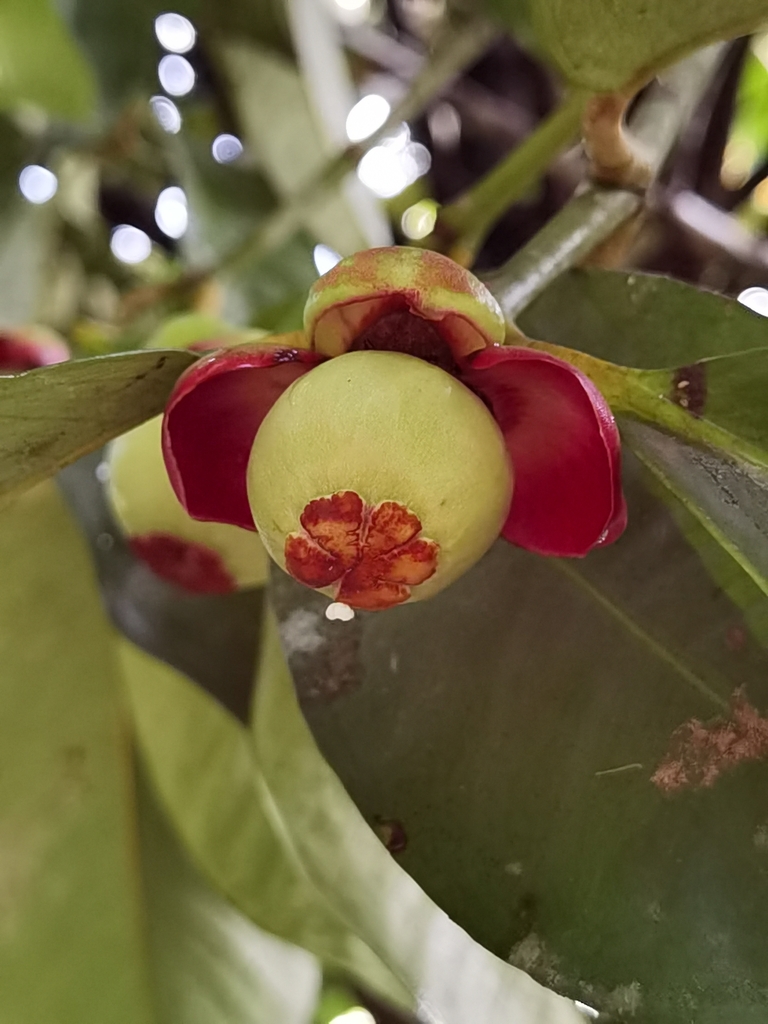
- Deep purple, smooth fruit rind
- Snow white, juicy fruit segments
- Slow growing evergreen habit
- Höhe
- 6 bis 25m
- Breite
- 3 bis 8m
- Blätter
- dark green, evergreen
- Blüten
- greenish white, red, 4 bis 6cm
- Früchte
- purple, Late summer to autumn
Häufige Probleme
- Mangosteen borer — Larvae tunnel into the fruit, causing damage and secondary infections.
- Root rot — Fungal pathogens thrive in waterlogged soil and damage the root system.
Standort und Pflege
- Vermehrung
- seed, cuttings, grafting
- Pflanzzeit
- spring, early summer
- Überwinterung
- Keep the tree in a warm, humid environment above 15 degrees Celsius at all times. Avoid cold drafts and ensure the soil remains moist but not waterlogged.
- Im Kübel
- It is generally not suitable for containers unless you have a very large, climate controlled greenhouse.
Seed
- 1. Extract seeds from fresh, ripe fruit.
- 2. Clean the seeds thoroughly to remove pulp.
- 3. Plant immediately as they lose viability quickly.
- 4. Keep in a warm, humid, and shaded location.
- 5. Maintain consistent moisture during germination.
Plant young trees under a canopy of taller fruit trees to mimic their natural rainforest understory habitat.
Gute Pflanzpartner
- Musa — Provides essential shade for young mangosteen trees.
- Durian — Shares similar tropical requirements and thrives in the same orchard environment.
Ähnliche Arten
- Garcinia prainiana — A smaller relative that is also grown for its edible fruit.
Botanisches
- Familie
- Clusiaceae
- Gattung
- Garcinia
- Ordnung
- Malpighiales
- Klasse
- Magnoliopsida
- Ursprüngliche Heimat
- Southeast Asia, specifically the Malay Archipelago.
- Artenschutz
- It is not currently listed as endangered, but wild populations are increasingly threatened by habitat loss in Southeast Asia.
It thrives in the deep shade of tropical rainforests, requiring high rainfall and constant warmth to survive.
- Nutzen für Wildtiere
- nectar source
- Bestäuber
- Bienen, Käfer
- Verwendung
- culinary fruit, ornamental shade tree, traditional medicine
Im Jahresverlauf
Ökologische Zeigerwerte
- Salzgehalt
- 1/9
- Bodenreaktion
- 5/9
- Licht
- 4/9
- Temperatur
- 9/9
- Feuchtigkeit
- 8/9
- Nährstoffe
- 6/9
Taxonomie abgeglichen mit GBIF.
Häufige Fragen
- Can I grow a mangosteen in a pot?
- It is very difficult due to their slow growth and need for high humidity and consistent tropical heat.
- Why is my tree growing so slowly?
- Mangosteens are naturally very slow growing, especially in their first few years.
Woher der Name kommt
The genus name honors French botanist Laurent Garcin, while the specific epithet refers to the fruit.
Gut zu wissen
- Mangosteens are apomictic, meaning they produce seeds without fertilization.
- The number of stigma lobes on the bottom of the fruit indicates how many segments are inside.
- Queen Victoria reportedly offered a reward to anyone who could bring her a fresh mangosteen.
- It takes 8 to 15 years for a tree to bear its first fruit.
Auch in
Probleme mit Mangosteen?
Diese Seite bietet allgemeine Infos. Pocket Botanist erkennt Probleme anhand eines Fotos deiner echten Pflanze, passt das Gießen an dein Licht und deinen Standort an und erinnert dich an die Pflege.
Dieser Ratgeber wurde mit KI erstellt und mit der GBIF-Taxonomie abgeglichen. Er dient zur allgemeinen Information und ersetzt keine gärtnerische oder tierärztliche Beratung. Hier erfährst du, wie wir diese Ratgeber erstellen.