 Pocket Botanist
Pflanzenratgeber
Cutleaf toothwort.
Cardamine concatenata
Aussprache kar-DA-mi-nee kon-ka-te-NA-ta
Auch bekannt als cut-leaf toothcup, cut-leaved toothwort, five-part toothwort, toothcup, Slender Toothwort


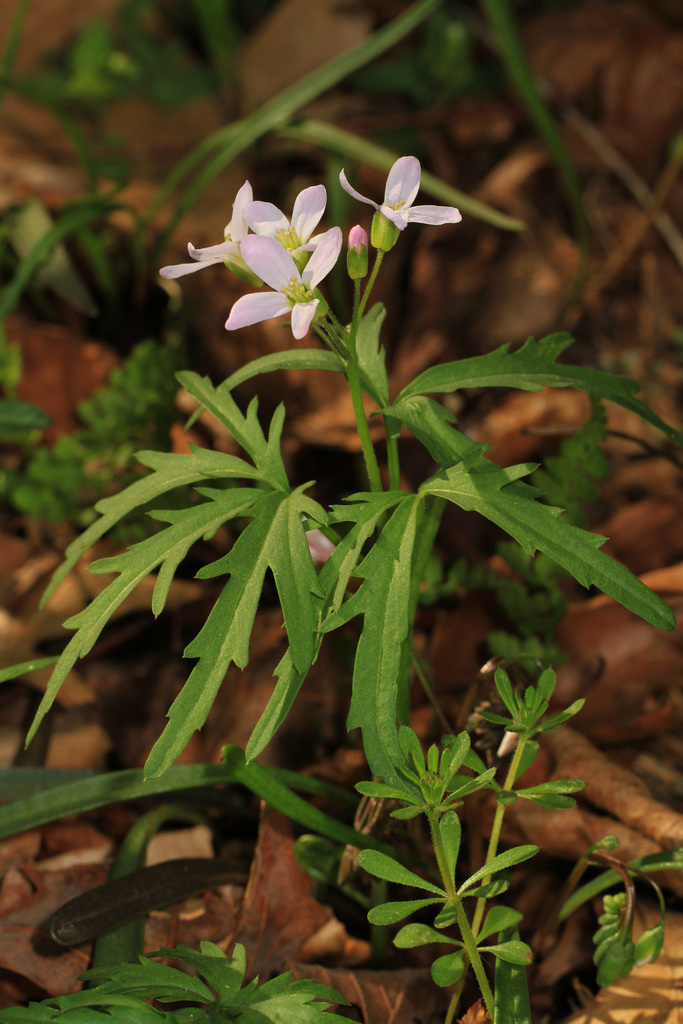
This charming woodland wildflower is a true harbinger of spring. It features delicate white to pale pink flowers that emerge from the forest floor before the trees leaf out. You will find it tucked away in moist, shaded areas.
Auf einen Blick
- Pflegestufe
- Einfach
- Pflanzenart
- Perennial
- Licht
- Partial shade to full shade
- Licht im Innenraum
- Mittleres Licht
- Gießen
- Alle 3 bis 7 Tage
- Endgröße
- 10 to 15 inches
- Wachstum
- Mittel
- Winterhärte
- USDA 3 bis 8
- Blütezeit
- Early to mid spring
Pflege
Keep the soil consistently moist to mimic its natural woodland habitat. Watch for the foliage to die back naturally as the weather warms up in late spring. It prefers cool, shaded spots that stay damp throughout the growing season.
- Gießen
- Ensure the soil stays damp but never waterlogged.
- Düngen
- A light layer of compost in early spring is plenty.
- Schneiden
- Remove dead foliage only after it has turned yellow and withered.
- Umtopfen
- Divide the rhizomes during the dormant season if the colony becomes too crowded.
- Boden
- Rich, moist, organic soil
- Boden-pH
- 6.0 to 7.0
- Temperatur
- -30 bis 25°C
- Luftfeuchtigkeit
- 40 bis 70%
- Trockenheitstoleranz
- Gering
- Lebensdauer
- Perennial, typically 5 to 10 years
- Wildverbiss-Resistenz
- Mittel
Sicherheit
- Menschen
- The plant is generally considered non-toxic but may cause mild irritation due to its mustard oil content.
- Kinder
- The plant is not considered a significant risk to children, but ingestion of any wild plant should be discouraged.
- Kontaktallergene
- The sap can cause mild skin irritation in sensitive individuals.
- Allergene in der Luft
- There are no notable respiratory allergens associated with this plant.
- Essbarkeit
- While the leaves are technically edible, they contain mustard oils that can cause digestive upset if consumed in large quantities.
So erkennst du die Pflanze
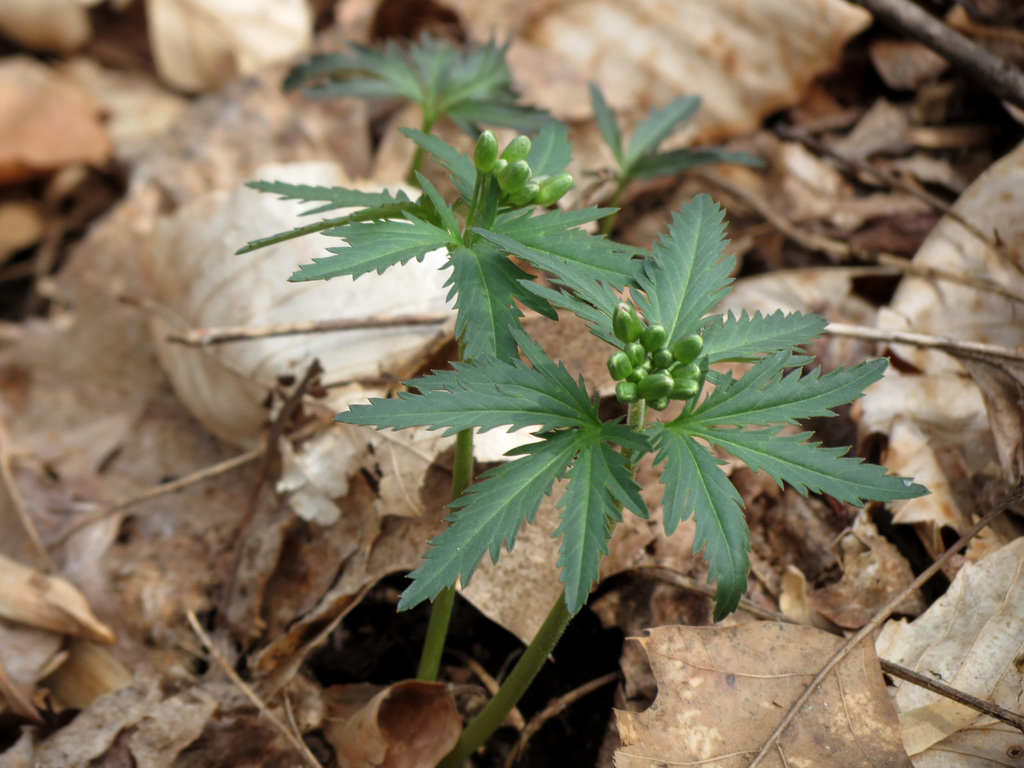
- Deeply lobed palmately compound leaves
- Clusters of four petaled white flowers
- Fleshy white underground rhizomes
- Stems often tinged with purple
- Höhe
- 0,15 bis 0,3m
- Breite
- 0,15 bis 0,25m
- Blätter
- green, deciduous
- Blüten
- white, pink, 1 bis 2cm
- Früchte
- green, Late spring
Häufige Probleme
- Slugs — Slugs may feed on the tender spring foliage.
Standort und Pflege
- Vermehrung
- division, seed
- Pflanzzeit
- fall, early spring
- Überwinterung
- The plant survives winter as a dormant rhizome underground. No special protection is needed.
- Im Kübel
- It is not well suited for containers as it requires specific woodland soil conditions.
Division
- 1. Carefully dig up the rhizomes in late summer or fall.
- 2. Gently break the rhizomes into smaller sections.
- 3. Replant the sections in moist, organic-rich soil.
Pair this with summer-growing ferns to hide the space left behind when the toothwort goes dormant.
Gute Pflanzpartner
- White Trillium — They share similar woodland habitat requirements.
- Asarum canadense — It provides a nice foliage contrast once the toothwort goes dormant.
Ähnliche Arten
- Cardamine diphylla — It is a closely related species with similar growth habits.
Botanisches
- Familie
- Brassicaceae
- Gattung
- Cardamine
- Ordnung
- Brassicales
- Klasse
- Magnoliopsida
- Ursprüngliche Heimat
- Eastern North America
- Artenschutz
- This plant is secure throughout most of its native range.
It thrives in the rich, moist soil of deciduous forests where it can access sunlight before trees leaf out.
- Nutzen für Wildtiere
- early nectar source
- Bestäuber
- Bienen, Schmetterlinge
- Verwendung
- woodland garden, native plant garden, ground cover
Im Jahresverlauf
Ökologische Zeigerwerte
- Salzgehalt
- 1/9
- Bodenreaktion
- 6/9
- Licht
- 3/9
- Temperatur
- 4/9
- Feuchtigkeit
- 6/9
- Nährstoffe
- 5/9
Taxonomie abgeglichen mit GBIF.
Häufige Fragen
- Does it spread quickly?
- It spreads slowly through underground rhizomes.
- When does it disappear?
- The foliage typically yellows and goes dormant by early summer.
Woher der Name kommt
The name Cardamine comes from the Greek word for cress, while concatenata refers to the linked, tooth-like segments of the rhizome.
Gut zu wissen
- It is commonly known as cutleaf toothwort.
- The roots have a peppery taste similar to horseradish.
- It is a member of the mustard family.
Auch in
Probleme mit Cutleaf toothwort?
Diese Seite bietet allgemeine Infos. Pocket Botanist erkennt Probleme anhand eines Fotos deiner echten Pflanze, passt das Gießen an dein Licht und deinen Standort an und erinnert dich an die Pflege.
Dieser Ratgeber wurde mit KI erstellt und mit der GBIF-Taxonomie abgeglichen. Er dient zur allgemeinen Information und ersetzt keine gärtnerische oder tierärztliche Beratung. Hier erfährst du, wie wir diese Ratgeber erstellen.