 Pocket Botanist
Pflanzenratgeber
Mexican Hat Plant.
Kalanchoe daigremontiana
Aussprache kal-an-KOH-ee day-gremon-tee-AN-uh
Auch bekannt als Alligator Plant, Devil's Backbone, Mother of Thousands, Mother-of-Millions, devil's-backbone


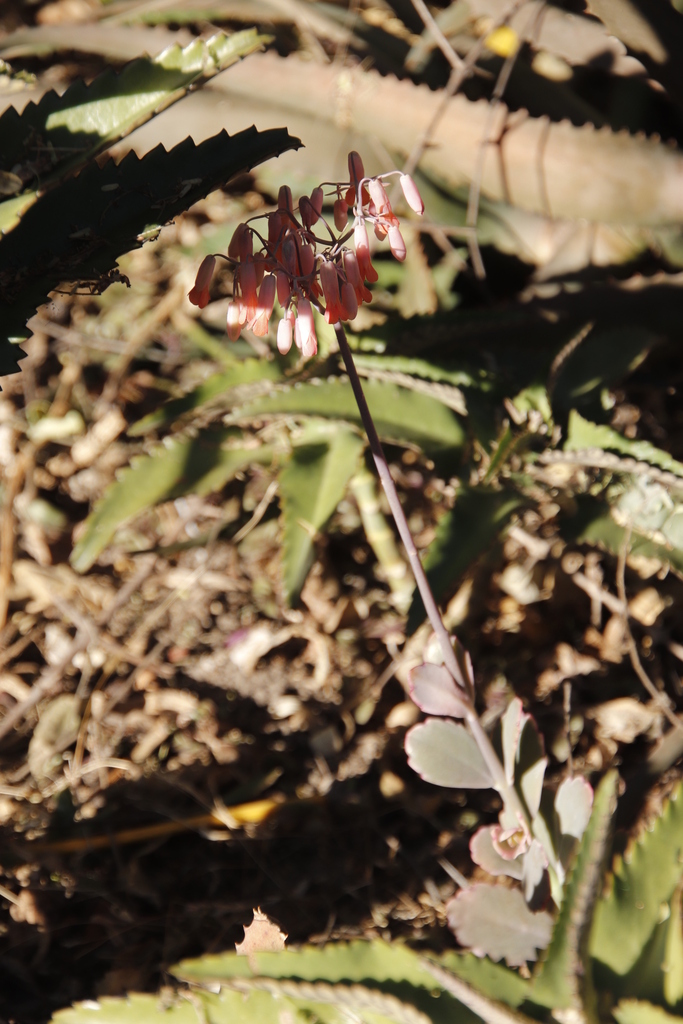
The Mexican Hat Plant is a unique succulent known for its prolific production of plantlets along the edges of its leaves. It's a fast-growing plant that can quickly fill a pot or spread in suitable climates. This plant is primarily grown for its fascinating form and reproductive method.
Auf einen Blick
- Care level
- Easy
- Plant type
- Succulent Perennial
- Light
- Bright indirect light, some morning sun is tolerated.
- Indoor light
- bright-indirect
- Water
- Every 7 to 14 days
- Mature size
- Up to 2 feet tall.
- Growth rate
- fast
- Hardiness
- USDA 10 to 12
- Bloom time
- Winter to early spring, if conditions are favorable.
Pflege
Provide bright, indirect light and well-draining soil. Water sparingly, allowing the soil to dry out between waterings. Protect from frost as it is not cold-hardy.
- Watering
- Allow soil to dry out completely between waterings; reduce watering in winter.
- Feeding
- Feed once every two months during the growing season with a diluted succulent fertilizer.
- Pruning
- Prune as needed to maintain shape or remove dead/damaged leaves.
- Repotting
- Repot when root-bound, typically every 1-2 years.
- Soil
- Well-draining succulent or cactus mix.
- Soil pH
- Slightly acidic to neutral.
- Temperature
- 10 to 30°C
- Humidity
- 30 to 60%
Sicherheit
- People
- Mildly toxic; ingestion may cause gastrointestinal upset.
- Pets
- Mildly toxic; ingestion may cause gastrointestinal upset.
- Edibility
- Not intended for human consumption.
So erkennst du die Pflanze
- Broad, fleshy leaves with serrated edges.
- Numerous tiny plantlets form along leaf margins.
- Leaves are green to grayish-green.
- Trumpet-shaped flowers, usually pinkish or reddish.
- Upright, succulent growth habit.
- Height
- 0.3 to 0.6m
- Spread
- 0.3 to 0.6m
- Leaves
- Green, Gray-green, evergreen
- Flowers
- Pink, Red, 1 to 1.5cm
Häufige Probleme
- Root rot — Caused by overwatering and poor drainage, leading to mushy stems and leaves.
- Mealybugs — Small, white, cottony pests that feed on plant sap, often found in leaf axils.
- Spider mites — Tiny pests that cause stippling on leaves and fine webbing.
Standort und Pflege
- Propagation
- Plantlets, Cuttings
- When to plant
- Spring, Summer
None typically needed as it's often grown as a specimen or in its own container.
Ähnliche Arten
- Mother of Thousands — This is another common name for the same species.
- Bryophyllum delagoense — Very similar in growth habit and prolific plantlet production, though leaves are more cylindrical.
Botanisches
- Family
- Crassulaceae
- Genus
- Kalanchoe
- Order
- Saxifragales
- Class
- Magnoliopsida
- Native range
- Madagascar
It thrives in arid and semi-arid regions, often found in rocky crevices or disturbed soils, where it reproduces rapidly via its plantlets.
- Uses
- Ornamental, Houseplant
Im Jahresverlauf
Ökologische Zeigerwerte
- Salinity
- 2/9
- Soil reaction
- 6/9
- Light
- 7/9
- Temperature
- 7/9
- Moisture
- 3/9
- Nutrients
- 4/9
Taxonomie abgeglichen mit GBIF.
Häufige Fragen
- How do I propagate Mexican Hat Plant?
- Simply place the fallen plantlets on moist soil; they will readily root and grow into new plants.
- Why are the leaves yellowing?
- Yellowing leaves often indicate overwatering or insufficient light.
- Can I grow this outdoors?
- Yes, in frost-free climates where it can be planted directly in the ground or in pots.
Woher der Name kommt
The scientific name 'Kalanchoe' is derived from the Chinese name for one of the species, while 'daigremontiana' honors the French botanist Henri Daigremont.
Gut zu wissen
- It's also known as Mother of Thousands or Mother of Millions.
- The plantlets can travel surprisingly far when they fall off.
- In its native habitat, it can become an invasive species.
Auch in
Geht es deiner mexican hat plant nicht gut?
Diese Seite bietet allgemeine Infos. Pocket Botanist erkennt Probleme anhand eines Fotos deiner echten Pflanze, passt das Gießen an dein Licht und deinen Standort an und erinnert dich an die Pflege.
Dieser Ratgeber wurde mit KI erstellt und mit der GBIF-Taxonomie abgeglichen. Er dient zur allgemeinen Information und ersetzt keine gärtnerische oder tierärztliche Beratung. Hier erfährst du, wie wir diese Ratgeber erstellen.